


AD
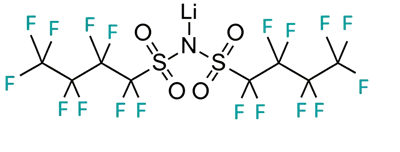
Lithium Bis(nonafluorobutanesulfonyl)imide(CAS: 119229-99-1)
CAS Number
Origin Country
 China
ChinaPrice
negotiable
Package
1KG;5KG;25KG;50KG;100KG;200KG
Product Description
CAS: 119229-99-1
Molecular formula: C₈F₁₈LiNO₄S₂
Molecular weight: 587.13
Appearance: White crystalline powder
Purity: 98% - 99%
Core properties
High electrochemical stability, good thermal stability, low moisture sensitivity
Soluble in organic solvents such as carbonates, ethers, methanol, etc.
Large anion volume, high dissociation degree, high electrolyte conductivity
Resistant to hydrolysis, not prone to corroding aluminum current collector (compared with LiPF₆)
Main applications
Lithium salt for lithium battery electrolyte: as a substitute or complement to LiPF₆, used in high-voltage, long-life, power batteries, solid-state batteries, and super capacitors.
Fluoride ion liquid precursor: for synthesizing high-temperature/high-stability ionic liquids.
High-end electrochemistry: sensors, electrocatalysis, electroplating additives
Related Products
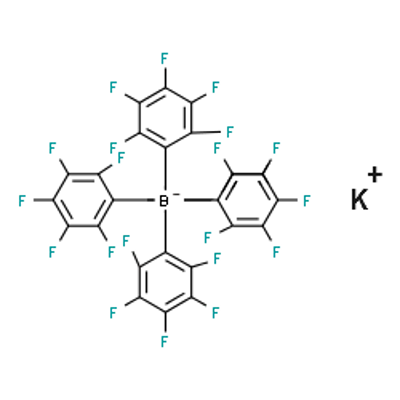
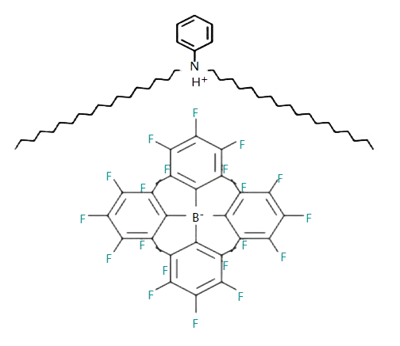
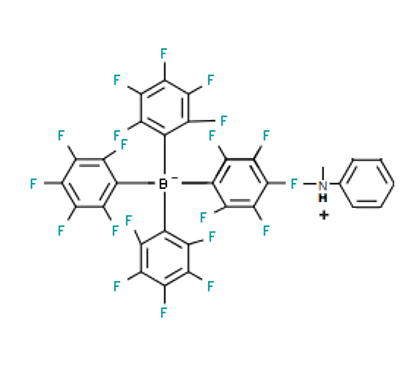
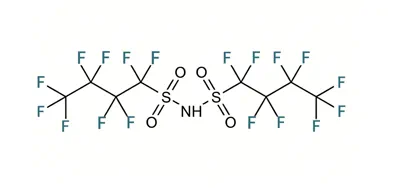
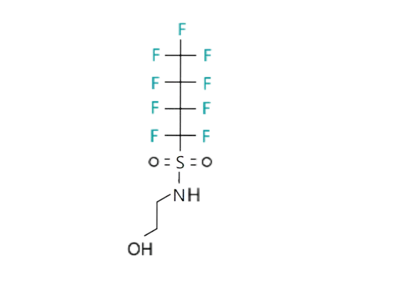
Bis(perfluorobutanesulfonyl)imide
CAS Number: 39847-39-7
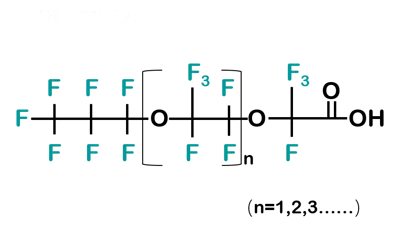
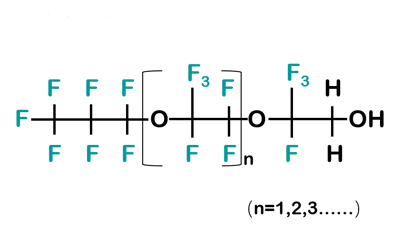
Perfluoropolyether Alcohol(PFPE OH)
CAS Number: 90317-77-4
Other Suppliers for Lithium Bis(nonafluorobutanesulfonyl)imide
![Lithium bis[(nonafluorobutyl)sulfonyl]azanide — Suzhou Cangmu New Materials Co., Ltd.](https://static.chemtradehub.com/suppliers/67ce830b2b2de6e8e95a4746/67ce830b2b2de6e8e95a4746-logo.webp)
![Lithium bis[(nonafluorobutyl)sulfonyl]azanide — Guangdong Wanzhang Chemical Reagent Co., Ltd.](https://static.chemtradehub.com/suppliers/67ce43292b2de6e8e95a42fd/67ce43292b2de6e8e95a42fd-logo.webp)
![Lithium bis[(nonafluorobutyl)sulfonyl]azanide — Shanghai Titan Shareholding Technology Co., Ltd.](https://static.chemtradehub.com/suppliers/67cdfa4757537e5c8069b08b/67cdfa4757537e5c8069b08b-logo.webp)
![Lithium bis[(nonafluorobutyl)sulfonyl]azanide — ShenZhenAiTaHuaXue Co Ltd](https://static.chemtradehub.com/suppliers/67ced0fb2b2de6e8e95a67fa/67ced0fb2b2de6e8e95a67fa-logo.webp)
![Lithium bis[(nonafluorobutyl)sulfonyl]azanide — Shandong Dexin Fine Chemical Co., Ltd.](https://static.chemtradehub.com/suppliers/67cdd21457537e5c8069ad57/67cdd21457537e5c8069ad57-logo.webp)
![Lithium bis[(nonafluorobutyl)sulfonyl]azanide — ShangHaiChuangSai Technology Co Ltd](https://static.chemtradehub.com/suppliers/67cecce82b2de6e8e95a5e02/67cecce82b2de6e8e95a5e02-logo.webp)
![Lithium bis[(nonafluorobutyl)sulfonyl]azanide — Shanghai Yuyeh Biotechnology Co., Ltd.](https://static.chemtradehub.com/suppliers/67ce9f132b2de6e8e95a48fe/67ce9f132b2de6e8e95a48fe-logo.webp)
![Lithium bis[(nonafluorobutyl)sulfonyl]azanide — ShangHaiMaiRuiErShengHua Technology Co Ltd](https://static.chemtradehub.com/suppliers/67ced3b52b2de6e8e95a6e52/67ced3b52b2de6e8e95a6e52-logo.webp)
Basic Information
Molecular Formula
C8F18LiNO4S2
Molecular Weight
587.2 g/mol
Chemical Identifiers
SMILES
[Li+].C(C(C(F)(F)S(=O)(=O)[N-]S(=O)(=O)C(C(C(C(F)(F)F)(F)F)(F)F)(F)F)(F)F)(C(F)(F)F)(F)F
InChIKey
QIWLMMWTZVIAFK-UHFFFAOYSA-N
Database References
MDL Number
MFCD06200837
FAQ
Lithium bis[(nonafluorobutyl)sulfonyl]azanide (CAS: 119229-99-1) falls under the scope of the Globally Harmonized System of Classification and Labelling of Chemicals (GHS), which includes specific hazard categories such as flammable liquids and corrosive substances. It is also subject to the Registration, Evaluation, Authorisation and Restriction of Chemicals (REACH) regulations in the European Union, requiring suppliers to provide Safety Data Sheets (SDS) and register substances above a threshold of 1 ton per year. Additionally, the Food and Drug Administration (FDA) and Environmental Protection Agency (EPA) may regulate its use in pharmaceutical and industrial applications, respectively, mandating compliance with relevant safety and environmental guidelines.
There are several alternatives to Lithium bis[(nonafluorobutyl)sulfonyl]azanide (CAS: 119229-99-1) in synthesis, including other lithium salts such as lithium hexafluorophosphate (LiPF6) or lithium bis(fluorosulfonyl)imide (LiFSI), which offer similar properties in terms of reactivity and stability. These alternatives can serve as effective substitutes depending on the specific application and desired chemical functionality.
The market for Lithium bis[(nonafluorobutyl)sulfonyl]azanide (CAS: 119229-99-1) is growing due to its use in the development of lithium-ion batteries for electric vehicles and energy storage systems. Research trends are focusing on its role in enhancing battery performance, stability, and safety. Additionally, there is increasing interest in its applications in organic synthesis and pharmaceuticals, driven by its unique reactivity and stability in various chemical environments.
Waste containing Lithium bis[(nonafluorobutyl)sulfonyl]azanide (CAS: 119229-99-1) should be handled according to hazardous waste disposal guidelines. This includes proper collection in leak-proof containers, storage in a secure and well-ventilated area, and disposal through professional waste management services. Environmental protection precautions should be taken to prevent contamination of soil and water. Compliance with local and national regulations is essential, and it is recommended to consult the latest Safety Data Sheet (SDS) for specific disposal instructions.
Safety Notice
Please verify product specifications and safety data before use. Contact the supplier for detailed safety information.
Always follow proper handling procedures

Contact Information
Contact Person
Aileen
yangyilin@chemwells.com
Mobile
+86 18860882708
Visit Website
http://chemwells.com/en/Address
Technology Incubation Park,No.6 Beijing West Road, Taicang City,Jiangsu Province, China