



AD
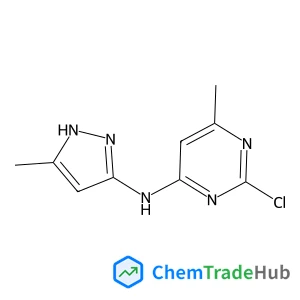
(2-CHLORO-6-METHYL-PYRIMIDIN-4-YL)-(5-METHYL-3H-PYRAZOL-3-YL)-AMINE(CAS: 851435-28-4)
CAS Number
Related Products

![(2-CHLORO-7-CYCLOPENTYL-7H-PYRROLO[2,3-D]PYRIMIDIN-6-YL)METHANOL](https://static.chemtradehub.com/structs/137/1374639-77-6-73fd.webp)
![(2S,5R)-5-[(BENZYLOXY)AMINO]PIPERIDINE-2-CARBOXAMIDE](https://static.chemtradehub.com/structs/141/1416134-49-0-378a.webp)
![(2S,5R)-6-(BENZYLOXY)-7-OXO-1,6-DIAZABICYCLO[3.2.1]OCTANE-2-CARBOXAMIDE](https://static.chemtradehub.com/structs/119/1192651-49-2-346b.webp)
![(2S,5R)-Ethyl-5-[(benzyloxy)amino]piperidine-2-carboxylate ethanedioate (1:1)](https://static.chemtradehub.com/structs/141/1416134-48-9-d3ba.webp)
Other Suppliers for (2-CHLORO-6-METHYL-PYRIMIDIN-4-YL)-(5-METHYL-3H-PYRAZOL-3-YL)-AMINE







Basic Information
Molecular Formula
C9H10ClN5
Molecular Weight
223.67 g/mol
Chemical Identifiers
SMILES
CC1=CC(NC2=NC(Cl)=NC(C)=C2)=NN1
InChIKey
CRJQXLOMFQRQSP-UHFFFAOYSA-N
Database References
MDL Number
MFCD26393306
FAQ
2-Chloro-6-methyl-N-(5-methyl-1H-pyrazol-3-yl)-4-pyrimidinamine (CAS: 851435-28-4) must comply with the regulatory guidelines defined by the Globally Harmonized System of Classification and Labelling of Chemicals (GHS) for health and environmental hazards. In the European Union, it is also subject to the Registration, Evaluation, Authorisation and Restriction of Chemicals (REACH) regulations. Additionally, the U.S. Food and Drug Administration (FDA) and Environmental Protection Agency (EPA) may have specific requirements for its use and disposal.
Several alternatives can be considered for the synthesis of 2-Chloro-6-methyl-N-(5-methyl-1H-pyrazol-3-yl)-4-pyrimidinamine (CAS: 851435-28-4). These include related compounds like 2-chloro-6-methyl-N-(5-methyl-1H-pyrazol-3-yl)-4-pyrimidinamide and isomers such as 2-chloro-4-methyl-N-(5-methyl-1H-pyrazol-3-yl)-6-pyrimidinamine, as well as other reagents like chloroacetyl chloride or methyl isocyanate.
The market for 2-Chloro-6-methyl-N-(5-methyl-1H-pyrazol-3-yl)-4-pyrimidinamine (CAS: 851435-28-4) is growing due to its applications in pharmaceuticals, agrochemicals, and biotechnology. Research trends focus on exploring its potential as an antifungal agent and as a precursor for synthesizing other biologically active molecules. Market demand is expected to increase as more studies confirm its efficacy and safety.
Waste containing 2-Chloro-6-methyl-N-(5-methyl-1H-pyrazol-3-yl)-4-pyrimidinamine (CAS: 851435-28-4) should be collected in appropriate containers and stored in a well-ventilated area. For disposal, incineration is a common method, but professional waste disposal services or hazardous waste facilities should be used to ensure compliance with local regulations. Environmental precautions include proper containment to prevent spillage and the use of personal protective equipment (PPE) during handling and disposal.
Safety Notice
Please verify product specifications and safety data before use. Contact the supplier for detailed safety information.
Always follow proper handling procedures
Contact Information
Contact Person
May