



AD
Sodium 4-hydroxybutanoate(CAS: 502-85-2)
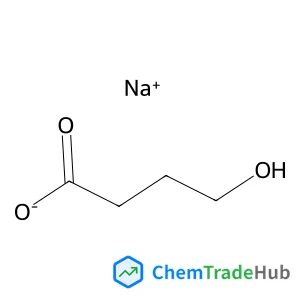
CAS Number
Related Products
![1-(4-Amino-3,5-dichlorophenyl)-2-{[2-(~2~H_3_)methyl(~2~H_6_)-2-propanyl]amino}ethanol](https://static.chemtradehub.com/structs/129/129138-58-5-530e.webp)
![(4S)-3-[(5S)-5-(4-Fluorophenyl)-5-hydroxypentanoyl]-4-phenyl-1,3-oxazolidin-2-one](https://static.chemtradehub.com/structs/189/189028-95-3-f1cc.webp)
Other Suppliers for Sodium 4-hydroxybutanoate



Basic Information
Molecular Formula
C4H7NaO3
Molecular Weight
126.09 g/mol
Physical Properties
Melting Point
143-147℃
Chemical Identifiers
SMILES
C(CC(=O)[O-])CO.[Na+]
InChIKey
XYGBKMMCQDZQOZ-UHFFFAOYSA-M
Database References
FAQ
Sodium 4-hydroxybutanoate (CAS: 502-85-2) is subject to various regulatory guidelines. It should be handled according to the Globally Harmonized System of Classification and Labeling of Chemicals (GHS) and classified as an oxidizing agent. For European Union manufacturers and importers, it must comply with REACH regulations, ensuring that all safety data sheets (SDS) are up to date and available. In the United States, it falls under the jurisdiction of the Environmental Protection Agency (EPA) and may require registration and compliance with the Food and Drug Administration (FDA) when used in pharmaceutical or food applications.
There are several alternatives to Sodium 4-hydroxybutanoate (CAS: 502-85-2) in synthetic processes. For example, sodium 3-hydroxybutanoate and sodium 5-hydroxybutanoate are common analogs. Additionally, other reagents such as sodium 2-hydroxybutanoate and sodium 6-hydroxybutanoate can be used as substitutes based on the specific requirements of the synthesis. The choice of alternative reagents depends on the desired product and the reaction conditions.
The market and research trends for Sodium 4-hydroxybutanoate (CAS: 502-85-2) are focused on its applications in pharmaceuticals, food additives, and as a precursor in organic synthesis. Recent research has explored its use in developing natural flavorings and aroma compounds. There is also growing interest in its potential as a bio-based chemical for sustainable products. Market trends indicate increasing demand due to its biodegradable and environmentally friendly properties, driving further innovation and adoption in various industries.
Waste containing Sodium 4-hydroxybutanoate (CAS: 502-85-2) should be handled with care to ensure environmental safety. Collect waste in appropriate containers labeled with the correct hazardous material identification numbers (HMIs). Incineration is a common disposal method, but it should be conducted in a controlled combustion system to minimize emissions. For less hazardous waste, professional waste disposal services can be utilized. Always follow local waste management regulations and ensure that all disposal methods comply with GHS and other relevant safety guidelines.
Safety Notice
Please verify product specifications and safety data before use. Contact the supplier for detailed safety information.
Always follow proper handling procedures
Contact Information
878312285@qq.com