



AD
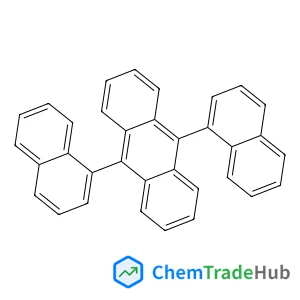
9,10-Di(1-naphthyl)anthracene(CAS: 26979-27-1)
CAS Number
Related Products
![2,7-Bis(4-aminophenyl)benzo[lmn][3,8]phenanthroline-1,3,6,8(2H,7H)-tetrone](https://static.chemtradehub.com/structs/495/49546-11-4-93ac.webp)
![7-Fluoro-2,3-dihydropyrrolo[2,1-b]quinazolin-9(1H)-one](https://static.chemtradehub.com/structs/380/380638-36-8-59fd.webp)
![1,1'-Biphenyl]-4-carboxylic acid, 4'-[2-(4'-carboxy[1,1'-biphenyl]-4-yl)-1,2-diphenylethenyl]-](https://static.chemtradehub.com/structs/225/2256821-87-9-f6da.webp)
![2'-Bromo-2,7-bis(2-methyl-2-propanyl)-9,9'-spirobi[fluorene]](https://static.chemtradehub.com/structs/393/393841-81-1-12f0.webp)
Other Suppliers for 9,10-Di(1-naphthyl)anthracene






Basic Information
Molecular Formula
C34H22
Molecular Weight
430.55 g/mol
Physical Properties
Melting Point
360°C(lit.)
Chemical Identifiers
SMILES
C1=CC=C2C(=C1)C=CC=C2C3=C4C=CC=CC4=C(C5=CC=CC=C53)C6=CC=CC7=CC=CC=C76
InChIKey
GWNJZSGBZMLRBW-UHFFFAOYSA-N
Database References
MDL Number
MFCD04222155
FAQ
9,10-Di(1-naphthyl)anthracene (CAS: 26979-27-1) is classified under hazardous substances according to the Globally Harmonized System of Classification and Labelling of Chemicals (GHS). It falls under REACH regulations for European Union member states, requiring registration for substances above one tonne per year. In the United States, the Environmental Protection Agency (EPA) may regulate it based on its potential toxicity and environmental impact. FDA regulations do not typically apply to this compound as it is not a food additive or drug ingredient.
While 9,10-Di(1-naphthyl)anthracene is a specific compound, alternatives in synthesis include other electron-donating aromatics such as anthracene derivatives. Isomers like 1,2-Di(1-naphthyl)anthracene and 7,8-Di(1-naphthyl)anthracene can serve as substitutes. Common alternative reagents in synthetic chemistry include various aldehydes, ketones, and other functionalized aromatic compounds that can be used through reactions like condensation or coupling.
The market for 9,10-Di(1-naphthyl)anthracene is niche, primarily driven by its use in organic photovoltaics and organic light-emitting diodes (OLEDs). Research trends focus on developing more efficient and stable organic semiconductor materials. There is a growing interest in exploring its potential in new applications such as sensors and electronic devices, driven by advancements in materials science and nanotechnology.
Waste containing 9,10-Di(1-naphthyl)anthracene should be collected in dedicated containers and stored separately. Incineration is a common method for disposal, but professional waste disposal services should be used to ensure compliance with local regulations. Environmental protection precautions include minimizing exposure to air and water, and proper personal protective equipment (PPE) should be worn during handling. Following local hazardous waste management guidelines is essential to prevent environmental contamination.
Safety Notice
Please verify product specifications and safety data before use. Contact the supplier for detailed safety information.
Always follow proper handling procedures
Contact Information
2853979818@qq.com