



AD
9-Phenyl-3,6-bis(4,4,5,5-tetramethyl-1,3,2-dioxaborolan-2-yl)-9H-carbazole(CAS: 618442-57-2)
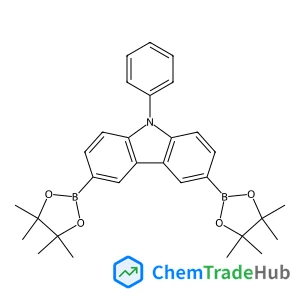
CAS Number
Related Products
![N-([1,1'-Biphenyl]-4-yl)-9,9-dimethyl-9H-fluoren-2-amine](https://static.chemtradehub.com/structs/897/897671-69-1-4330.webp)
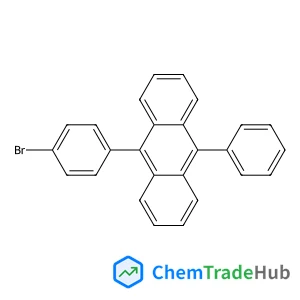
9-(4-Bromophenyl)-10-phenylanthracene
CAS Number: 625854-02-6
![[4-(1-Naphthyl)phenyl]boronic acid](https://static.chemtradehub.com/structs/870/870774-25-7-a673.webp)
[4-(1-Naphthyl)phenyl]boronic acid
CAS Number: 870774-25-7
![2,2'-(9,9'-Spirobi[fluorene]-2,2'-diyl)bis(4,4,5,5-tetramethyl-1,3,2-dioxaborolane)](https://static.chemtradehub.com/structs/676/676168-63-1-c812.webp)
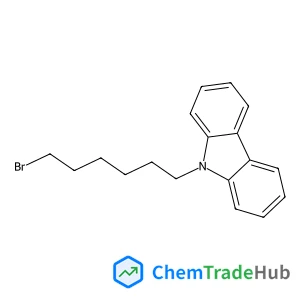
9-(6-bromohexyl)-9H-carbazole
CAS Number: 94847-10-6
![2,2'-Dibromo-9,9'-spirobi[fluorene]](https://static.chemtradehub.com/structs/676/67665-47-8-6d28.webp)
2,2'-Dibromo-9,9'-spirobi[fluorene]
CAS Number: 67665-47-8
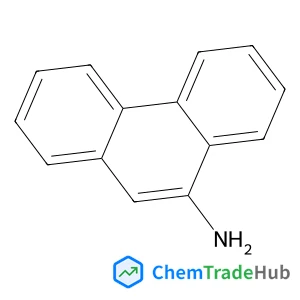
9-Aminophenanthrene
CAS Number: 947-73-9
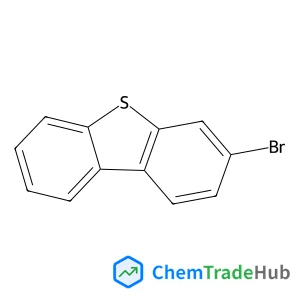
3-bromoDibenzothiophene
CAS Number: 97511-04-1
Other Suppliers for 9-Phenyl-3,6-bis(4,4,5,5-tetramethyl-1,3,2-dioxaborolan-2-yl)-9H-carbazole



Basic Information
Molecular Formula
C30H35B2NO4
Molecular Weight
495.24 g/mol
Physical Properties
Melting Point
238.0 to 242.0 deg-C
Boiling Point
587.8±43.0°C at 760 mmHg
Density
1.11±0.1 g/cm3 (20 ºC 760 Torr),
Chemical Identifiers
SMILES
B1(OC(C(O1)(C)C)(C)C)C2=CC3=C(C=C2)N(C4=C3C=C(C=C4)B5OC(C(O5)(C)C)(C)C)C6=CC=CC=C6
InChIKey
BMKVLWGCSCKZTD-UHFFFAOYSA-N
Database References
MDL Number
MFCD28015750
FAQ
9-Phenyl-3,6-bis(4,4,5,5-tetramethyl-1,3,2-dioxaborolan-2-yl)-9H-carbazole is a solid with a crystalline form. Its molecular weight is approximately 705.4 g/mol. This compound has limited solubility in organic solvents like THF and DMF. It is less reactive than typical carbazoles but can undergo typical carbazole reactions under appropriate conditions. It is stable under normal laboratory conditions and does not require special handling beyond standard organic chemical precautions.
9-Phenyl-3,6-bis(4,4,5,5-tetramethyl-1,3,2-dioxaborolan-2-yl)-9H-carbazole is typically synthesized via a palladium-catalyzed reaction involving phenylboronic acid, 9H-carbazole, and 1,3,2-dioxaborolane. The synthesis proceeds through a Suzuki coupling reaction, which allows for the introduction of the dioxaborolyl groups. The reaction requires a suitable palladium catalyst and a base. The yield is typically around 70-80%, depending on the purity of reagents and reaction conditions.
9-Phenyl-3,6-bis(4,4,5,5-tetramethyl-1,3,2-dioxaborolan-2-yl)-9H-carbazole is used in the semiconductor and polymer industries. It can serve as a building block for organic light-emitting diodes (OLEDs) and as a monomer in the synthesis of functional polymers. In the pharmaceutical industry, it can be used in the synthesis of certain drug candidates, particularly those involving organic electronics and optoelectronics applications.
When handling 9-Phenyl-3,6-bis(4,4,5,5-tetramethyl-1,3,2-dioxaborolan-2-yl)-9H-carbazole, use appropriate personal protective equipment (PPE) including gloves and safety goggles. Store the compound in a sealed container at room temperature away from direct sunlight. If a spill occurs, clean it up using standard organic waste procedures. Always refer to the Material Safety Data Sheet (MSDS) for detailed information on safe handling and disposal. This compound is not considered hazardous, but standard organic chemical safety practices should be followed.
Safety Notice
Please verify product specifications and safety data before use. Contact the supplier for detailed safety information.
Always follow proper handling procedures
Contact Information
m18792503214@163.com