



AD
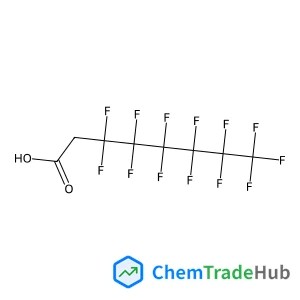
3,3,4,4,5,5,6,6,7,7,8,8,8-Tridecafluorooctanoic acid(CAS: 53826-12-3)
CAS Number
Related Products
![Naphtho[1,2-c]furan-1,3-dione](https://static.chemtradehub.com/structs/534/5343-99-7-5dbe.webp)
Naphtho[1,2-c]furan-1,3-dione
CAS Number: 5343-99-7
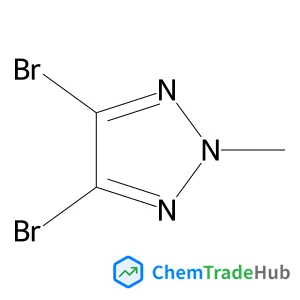
4,5-Dibromo-2-methyl-2H-1,2,3-triazole
CAS Number: 28938-17-2
![1-[Chloro(1-pyrrolidinyl)methylene]pyrrolidinium tetrafluoroborate](https://static.chemtradehub.com/structs/115/115007-14-2-7aa4.webp)
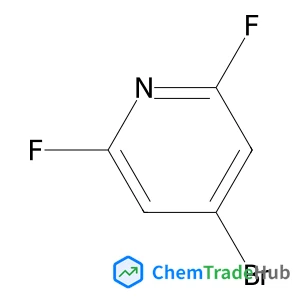
4-Bromo-2,6-difluoropyridine
CAS Number: 903513-58-6
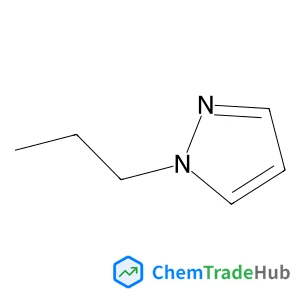
1-propyl-1H-pyrazole
CAS Number: 32500-67-7
![N~5~-[N-(Mesitylsulfonyl)carbamimidoyl]-N~2~-{[(2-methyl-2-propanyl)oxy]carbonyl}-L-ornithine](https://static.chemtradehub.com/structs/682/68262-71-5-07ff.webp)
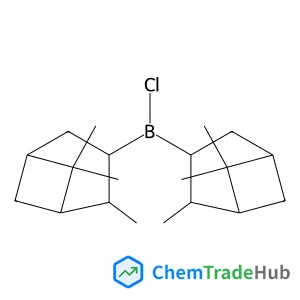
(-)-DIP-chloride (~60% in Heptane)
CAS Number: 85116-37-6
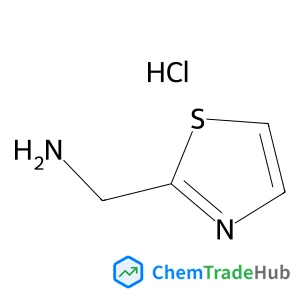
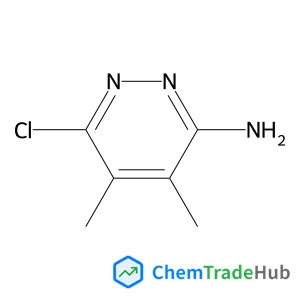
6-Chloro-4,5-dimethyl-3-pyridazinamine
CAS Number: 76593-36-7
Other Suppliers for 3,3,4,4,5,5,6,6,7,7,8,8,8-Tridecafluorooctanoic acid








Basic Information
Molecular Formula
C8H3F13O2
Molecular Weight
378.08 g/mol
Physical Properties
Melting Point
55 ºC (carbon tetrachloride )
Boiling Point
193.4±35.0 ºC (760 Torr),
Density
1.670±0.06 g/cm3 (20 ºC 760 Torr),
Flash Point
70.8±25.9 ºC,
Chemical Identifiers
SMILES
C(C(=O)O)C(C(C(C(C(C(F)(F)F)(F)F)(F)F)(F)F)(F)F)(F)F
InChIKey
LRWIIEJPCFNNCZ-UHFFFAOYSA-N
Database References
MDL Number
MFCD06203190
FAQ
3,3,4,4,5,5,6,6,7,7,8,8,8-Tridecafluorooctanoic acid (CAS: 53826-12-3) falls under the regulatory framework of GHS (Globally Harmonized System of Classification and Labelling of Chemicals) for hazardous chemicals. It is also subject to the REACH regulations in the EU, which require manufacturers and importers to register substances above a certain tonnage threshold. In the USA, the FDA and EPA have specific requirements for the handling and disposal of this compound, including registration and reporting under the Toxic Substances Control Act (TSCA).
Several alternatives to 3,3,4,4,5,5,6,6,7,7,8,8,8-Tridecafluorooctanoic acid (CAS: 53826-12-3) exist in synthesis, including other perfluoroalkanoic acids with varying carbon chain lengths. Common substitutes include perfluorooctanoic acid and longer or shorter chain analogs. These can be used depending on the specific application and desired properties. Isomers and structural analogs might also be viable alternatives.
The market for 3,3,4,4,5,5,6,6,7,7,8,8,8-Tridecafluorooctanoic acid (CAS: 53826-12-3) is driven by its use in various industries, particularly in surfactant and lubricant applications. Recent research trends focus on the development of more environmentally friendly alternatives and the investigation of its properties for use in coatings and adhesives. The market is also influenced by regulatory changes and safety concerns, leading to increased demand for safer and more sustainable products.
Waste containing 3,3,4,4,5,5,6,6,7,7,8,8,8-Tridecafluorooctanoic acid (CAS: 53826-12-3) should be handled according to local and national regulations, including proper waste collection, storage, and disposal. Incineration is a common method, but it must be conducted in specialized facilities to ensure complete destruction and minimal environmental impact. Alternatively, professional waste disposal services can be used to ensure compliance with environmental protection measures and regulatory requirements. Proper handling includes neutralizing the waste to reduce toxicity before disposal.
Safety Notice
Please verify product specifications and safety data before use. Contact the supplier for detailed safety information.
Always follow proper handling procedures

Contact Information
Contact Person
Jin Jinle (National Unified Telephone Line)
hnjjlchem@126.com
Telephone
10106090
Visit Website
https://www.jinjinlechem.com/Address
Changsha Kaifu District Tongtai Street Zhongshan Road 589 Kaifu Wangdawei Square C District 3rd Office Building 2905