



AD
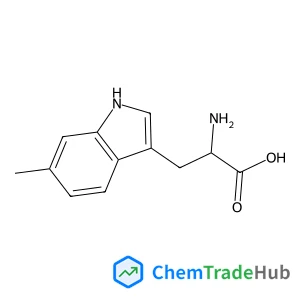
6-Methyltryptophan(CAS: 2280-85-5)
CAS Number
Related Products
![3-(3-Methylphenyl)-3-({[(2-methyl-2-propanyl)oxy]carbonyl}amino)propanoic acid](https://static.chemtradehub.com/structs/284/284493-57-8-0bd5.webp)
![2-{[(2-Methyl-2-propanyl)oxy]carbonyl}-1-isoindolinecarboxylic acid](https://static.chemtradehub.com/structs/221/221352-46-1-712b.webp)
![1-({[(2-Methyl-2-propanyl)oxy]carbonyl}amino)-1,2,3,4-tetrahydro-1-naphthalenecarboxylic acid](https://static.chemtradehub.com/structs/898/898404-93-8-81f4.webp)
![3-(3-Fluorophenyl)-3-({[(2-methyl-2-propanyl)oxy]carbonyl}amino)propanoic acid](https://static.chemtradehub.com/structs/284/284493-59-0-1259.webp)
![3-(4-Cyanophenyl)-3-({[(2-methyl-2-propanyl)oxy]carbonyl}amino)propanoic acid](https://static.chemtradehub.com/structs/282/282524-88-3-f46e.webp)
![(3S)-3-(3-Chlorophenyl)-3-({[(2-methyl-2-propanyl)oxy]carbonyl}amino)propanoic acid](https://static.chemtradehub.com/structs/500/500770-74-1-0897.webp)
Other Suppliers for 6-Methyltryptophan






Basic Information
Molecular Formula
C12H14N2O2
Molecular Weight
218.26 g/mol
Physical Properties
Melting Point
290 °C (dec.)
Boiling Point
447.4°Cat760mmHg
Density
1.313
Flash Point
224.4°C
Chemical Identifiers
SMILES
CC1=CC2=C(C=C1)C(=CN2)CC(C(=O)O)N
InChIKey
GDMRVYIFGPMUCG-UHFFFAOYSA-N
Database References
MDL Number
MFCD00022772
FAQ
6-Methyltryptophan (CAS: 2280-85-5) is subject to regulatory guidelines established by agencies such as the REACH in the EU, which requires manufacturers and importers to register chemicals if they manufacture or import more than one ton per year. The compound also falls under the purview of the EPA in the USA and the TSCA, requiring reporting and record-keeping for specific uses. Additionally, the FDA regulates the use of 6-Methyltryptophan in food and pharmaceutical applications, ensuring safety and compliance with labeling regulations.
There are several alternatives to 6-Methyltryptophan (CAS: 2280-85-5) in synthesis, including 5-Methyltryptophan and other tryptophan derivatives. Common alternative reagents such as bromine, iodine, or other halogenating agents can be used to introduce functional groups at the 6-position. Isomers like 6-methoxytryptophan can also be considered as synthetic alternatives depending on the specific application.
The market for 6-Methyltryptophan (CAS: 2280-85-5) is growing, driven by increasing research interest in its potential as a precursor for the synthesis of various indole-based compounds. Emerging applications in pharmaceuticals and natural product chemistry are boosting demand, particularly in the development of novel antidepressants and sleep aids. Additionally, there is growing interest in its use as a dietary supplement, although careful consideration of regulatory and safety standards is essential.
Waste containing 6-Methyltryptophan (CAS: 2280-85-5) should be handled according to local and international hazardous waste regulations. Collection should be done in properly labeled containers to prevent leakage and ensure safety. The waste should then be disposed of through professional waste disposal services, such as incineration or chemical treatment, to minimize environmental impact. Proper safety precautions, including the use of personal protective equipment, are essential during handling and disposal to prevent exposure and environmental contamination.
Safety Notice
Please verify product specifications and safety data before use. Contact the supplier for detailed safety information.
Always follow proper handling procedures

Contact Information
sales@amateksci.com
Telephone
0512-56316828,400-867-5858
Fax
0512-56316826
Visit Website
www.amateksci.com