



AD
7-Bromo-1,3-benzothiazole(CAS: 767-70-4)
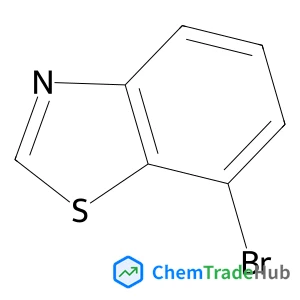
CAS Number
Related Products
![Ethyl 5,6-dihydro-4H-pyrrolo[3,2,1-ij]quinoline-1-carboxylate](https://static.chemtradehub.com/structs/124/124730-53-6-3463.webp)
![N-1H-Imidazo[4,5-d]pyridazin-7-ylbenzamide](https://static.chemtradehub.com/structs/108/108880-46-2-6d07.webp)

(3S)-3-Acetylcyclohexanone
CAS Number: 1932251-08-5

3-amino-2,3-dihydro-1H-inden-4-ol
CAS Number: 58350-01-9



Ethyl 3-aminocyclohexanecarboxylate
CAS Number: 53084-60-9
![5-Bromo-1H-pyrazolo[3,4-c]pyridine-3-carboxylic acid](https://static.chemtradehub.com/structs/208/2089651-75-0-0fa0.webp)

5-Acetyl-2-isobutoxybenzonitrile
CAS Number: 1198617-51-4
Other Suppliers for 7-Bromo-1,3-benzothiazole



Basic Information
Molecular Formula
C7H4BrNS
Molecular Weight
214.09 g/mol
Physical Properties
Melting Point
82 ºC
Boiling Point
291.5±13.0 ºC (760 Torr),
Density
1.748±0.06 g/cm3 (20 ºC 760 Torr),
Flash Point
130.1±19.8 ºC,
Chemical Identifiers
SMILES
C1=CC2=C(C(=C1)Br)SC=N2
InChIKey
HIHGDDIOQDNKSV-UHFFFAOYSA-N
Database References
MDL Number
MFCD11858589
FAQ
7-Bromo-1,3-benzothiazole (CAS: 767-70-4) is subject to various regulatory guidelines. Under the Globally Harmonized System of Classification and Labeling of Chemicals (GHS), it is classified as a skin and eye irritant. In Europe, it is regulated under REACH (Registration, Evaluation, Authorization and Restriction of Chemicals), which requires manufacturers and importers to register the substance with the European Chemicals Agency (ECHA). Additionally, the U.S. Food and Drug Administration (FDA) and Environmental Protection Agency (EPA) have specific requirements for the use and disposal of this compound.
There are several alternatives to 7-Bromo-1,3-benzothiazole (CAS: 767-70-4) that can be used in synthesis, depending on the desired properties. For instance, 7-Chloro-1,3-benzothiazole and 7-Iodo-1,3-benzothiazole are isomers that can serve similar roles. Other alternatives include 1,3-benzothiazole derivatives with different substituents, such as 7-ethyl, 7-methyl, or 7-phenyl groups. These alternatives can provide similar functional groups for various chemical reactions while offering different physical and chemical properties.
The market for 7-Bromo-1,3-benzothiazole (CAS: 767-70-4) is primarily driven by its use in pharmaceuticals, agrochemicals, and as a precursor in organic synthesis. Recent research trends have focused on its application in drug discovery, particularly as a potential lead compound for treating diseases such as cancer and inflammatory conditions. Additionally, there is growing interest in its potential as an alternative to more toxic compounds in agricultural applications, leading to increased demand in the agricultural sector.
Waste containing 7-Bromo-1,3-benzothiazole (CAS: 767-70-4) should be handled according to proper waste disposal protocols. Waste liquids should be collected in appropriate containers and stored separately to avoid contamination. For solid waste, it should be collected in sealed containers and disposed of through a certified hazardous waste disposal service. Incineration is an effective method for disposal, but it must be conducted in a manner that complies with local environmental regulations. It is important to ensure that all safety and environmental protection precautions are followed to minimize the risk of exposure and environmental impact.
Safety Notice
Please verify product specifications and safety data before use. Contact the supplier for detailed safety information.
Always follow proper handling procedures
Contact Information
sales02@chemsoon.com