AD
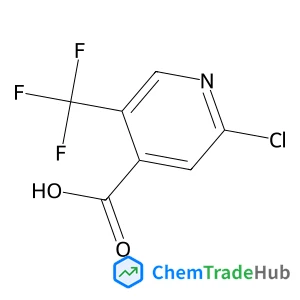
2-Chloro-5-(trifluoromethyl)isonicotinic acid(CAS: 505084-58-2)
CAS Number
Related Products
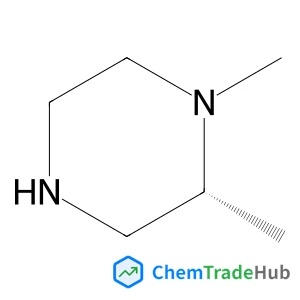
(2R)-1,2-Dimethylpiperazine
CAS Number: 623586-02-7
![(2S)-4-Hydroxy-7-(hydroxymethyl)-2-(2-hydroxy-2-propanyl)-2,3-dihydro-5H-furo[3,2-g]chromen-5-one](https://static.chemtradehub.com/structs/496/49624-66-0-7116.webp)
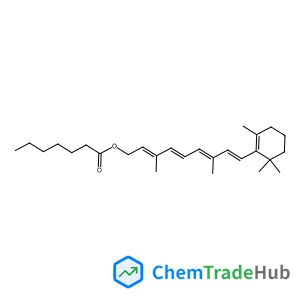
O~15~-Heptanoylretinol
CAS Number: 88641-44-5
![1-Methoxy-2-[1-(4-methoxyphenyl)propyl]benzene](https://static.chemtradehub.com/structs/334/33451-22-8-2ef2.webp)
CAS Number: 1350524-27-4
Other Suppliers for 2-Chloro-5-(trifluoromethyl)isonicotinic acid





Basic Information
Molecular Formula
C7H3ClF3NO2
Molecular Weight
225.55 g/mol
Physical Properties
Melting Point
185-186°C
Boiling Point
281.6°C at 760 mmHg
Flash Point
124.151℃
Water Solubility
Slightly soluble in water.
Chemical Identifiers
SMILES
C1=C(C(=CN=C1Cl)C(F)(F)F)C(=O)O
InChIKey
OIODRBHIESSYRO-UHFFFAOYSA-N
Database References
MDL Number
MFCD01862019
FAQ
2-Chloro-5-(trifluoromethyl)isonicotinic acid falls under the classification of hazardous chemicals according to GHS. It is subject to regulatory requirements under REACH in the EU, which includes notification and registration of substances. In the US, it must comply with FDA regulations for pharmaceuticals and EPA guidelines for environmental protection and handling. Special attention should be given to its classification as a hazardous substance due to its chemical properties.
Alternatives to 2-Chloro-5-(trifluoromethyl)isonicotinic acid include other isonicotinic acid derivatives such as 3-chloroisonicotinic acid or isonicotinamide. In some cases, synthetic analogs like 2-(trifluoromethyl)isonicotinic acid can be used. These alternatives offer similar functionalities but with varying substitution patterns, which might be more or less suitable depending on the specific application.
The market for 2-Chloro-5-(trifluoromethyl)isonicotinic acid is driven by its applications in pharmaceuticals and agrochemicals. Recent research trends focus on its use in developing new pharmaceutical compounds and as an intermediate in pesticide synthesis. The trend indicates increasing investment in R&D for novel derivatives and formulations, driven by the need for more effective and safer products.
Waste containing 2-Chloro-5-(trifluoromethyl)isonicotinic acid should be collected in appropriate containers and disposed of through a licensed hazardous waste management facility. Incineration is a common method, provided it is conducted under controlled conditions to prevent the release of harmful emissions. Environmental precautions include the use of protective clothing and equipment, and adherence to local and international regulations to minimize environmental impact.
Safety Notice
Please verify product specifications and safety data before use. Contact the supplier for detailed safety information.
Always follow proper handling procedures