



AD
Epimedin A(CAS: 110623-72-8)
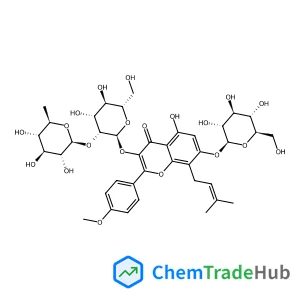
CAS Number
Related Products
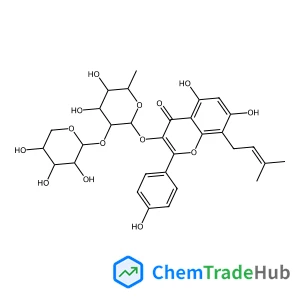
Ikarisoside F
CAS Number: 113558-14-8
![4-[(2S)-7-Hydroxy-4-oxo-3,4-dihydro-2H-chromen-2-yl]phenyl beta-D-glucopyranoside](https://static.chemtradehub.com/structs/551/551-15-5-216a.webp)
![2-(3-Hydroxy-4-methoxyphenyl)ethyl 6-deoxy-alpha-L-mannopyranosyl-(1->3)-[beta-D-galactopyranosyl-(1->6)]-4-O-[(2E)-3-(4-hydroxy-3-methoxyphenyl)-2-propenoyl]-beta-D-glucopyranoside](https://static.chemtradehub.com/structs/120/120406-37-3-495b.webp)
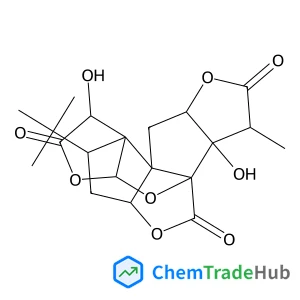
Ginkgolide A
CAS Number: 15291-75-5
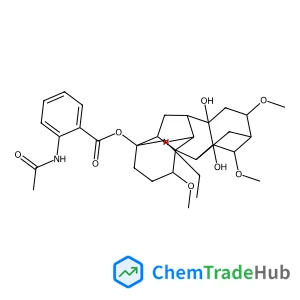
Lappaconitine
CAS Number: 32854-75-4
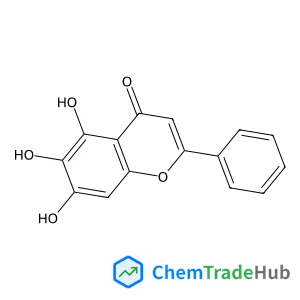
![(3beta,16beta,17alpha,18alpha)-16-Hydroxy-13,28-epoxyolean-11-en-3-yl 6-deoxy-alpha-L-mannopyranosyl-(1->4)-[beta-D-glucopyranosyl-(1->6)]-beta-D-glucopyranoside](https://static.chemtradehub.com/structs/207/20736-08-7-7c82.webp)
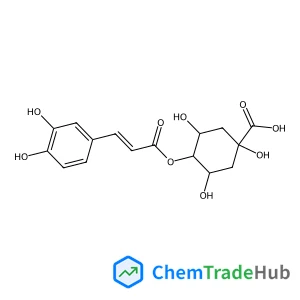
Cryptochlorogenic acid
CAS Number: 905-99-7
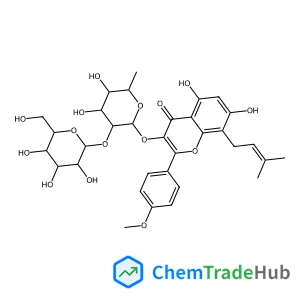
Sagittatoside A
CAS Number: 118525-35-2
Other Suppliers for Epimedin A




Basic Information
Molecular Formula
C39H50O20
Molecular Weight
838.81 g/mol
Physical State
Yellow powder
Physical Properties
Melting Point
197-199 °C(Solv: methanol (67-56-1))
Boiling Point
1099.8±65.0 °C(Predicted)
Density
1.61±0.1 g/cm3(Predicted)
Chemical Identifiers
SMILES
COc1ccc(cc1)c1oc2c(CC=C(C)C)c(O[C@@H]3O[C@H](CO)[C@H]([C@@H]([C@H]3O)O)O)cc(c2c(=O)c1O[C@@H]1O[C@@H](CO)[C@@H]([C@H]([C@H]1O[C@@H]1O[C@H](C)[C@H]([C@@H]([C@H]1O)O)O)O)O)O
InChIKey
XZZWIAROZYRYJC-NVAIDQJVSA-N
Database References
MDL Number
MFCD30496681
FAQ
Epimedin A is a natural steroidal saponin compound with the chemical formula C41H68O14. It is known for its antioxidant and anti-inflammatory properties, commonly found in plants like *Epimedium* species. This compound exhibits hydrophilic characteristics and is typically soluble in alcohol. Its structure includes a triterpenoid backbone with glycoside substitutions, making it a key component in traditional herbal medicine research.
Epimedin A is primarily used in pharmaceutical research for its potential therapeutic applications, including neuroprotective and cardiovascular benefits. It is also studied as a dietary supplement for enhancing physical performance and reducing oxidative stress. The compound's role in herbal medicine and its use as a research tool in drug development make it relevant in both medical and scientific fields.
Epimedin A is generally considered safe when used appropriately, but its safety profile requires careful handling. Limited toxicity data suggests low acute risk, though long-term effects are under investigation. Precautions include avoiding ingestion in large quantities and ensuring proper storage to maintain stability. Always follow safety guidelines for chemical handling and consult experts for specific applications.
Epimedin A should be stored in a cool, dry place away from light, ideally at 2-8°C. Maintain low humidity levels to prevent degradation, and keep it in airtight, moisture-proof containers. Glass vials are recommended for storage to avoid contamination. Proper storage ensures the compound's stability and prolongs its shelf life for research or medicinal use.
Safety Notice
Please verify product specifications and safety data before use. Contact the supplier for detailed safety information.
Always follow proper handling procedures