



AD
Dehydroabietic Acid(CAS: 1740-19-8)
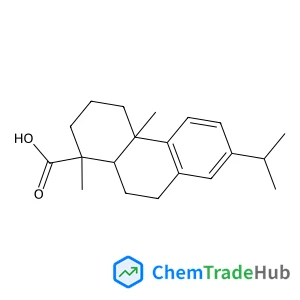
CAS Number
Other Suppliers for Dehydroabietic Acid






Basic Information
Molecular Formula
C20H28O2
Molecular Weight
300.44 g/mol
Physical State
Powder
Physical Properties
Melting Point
174-176 ºC
Boiling Point
394.13°C (rough estimate)
Chemical Identifiers
SMILES
CC(C)C1=CC2=C(C=C1)C3(CCCC(C3CC2)(C)C(=O)O)C
InChIKey
NFWKVWVWBFBAOV-MISYRCLQSA-N
Database References
MDL Number
MFCD09839012
Beilstein Registry Number
2059290
FAQ
Dehydroabietic Acid, with the CAS number 1740-19-8, is a diterpene acid commonly found in pine resin. It has a molecular formula of C20H36O2 and is characterized by its high melting point, typically around 135–140°C. This compound is white to off-white in appearance and is used in various industrial applications due to its chemical stability and unique properties.
Dehydroabietic Acid (CAS: 1740-19-8) is widely used in the production of adhesives, coatings, and inks due to its resinous properties. It also serves as a precursor in the synthesis of other chemical compounds, including pharmaceuticals and specialty chemicals. Additionally, it is employed in research for its potential applications in polymer science and as a natural product derivative.
Dehydroabietic Acid (CAS: 1740-19-8) is generally considered safe when handled properly. However, it may cause skin or eye irritation upon contact. Safety data sheets recommend using protective gloves, goggles, and ventilation. It is important to follow standard chemical safety protocols to ensure safe handling and minimize exposure risks.
Dehydroabietic Acid (CAS: 1740-19-8) should be stored in a cool, dry, and well-ventilated area, away from direct sunlight. It is best kept in a sealed container to prevent moisture absorption and maintain its stability. Storage at temperatures below 25°C is recommended to avoid degradation and ensure long-term quality.
Safety Notice
Please verify product specifications and safety data before use. Contact the supplier for detailed safety information.
Always follow proper handling procedures