



AD
2-Chloro-1,4-dimethoxybenzene(CAS: 2100-42-7)
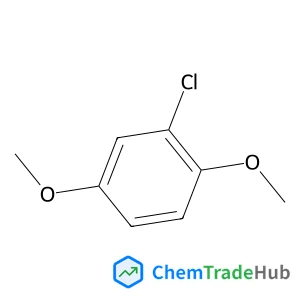
CAS Number
Related Products
![Ethyl bicyclo[2.2.1]hept-5-ene-2-carboxylate](https://static.chemtradehub.com/structs/101/10138-32-6-a6c4.webp)

Cyclobutylmethanol
CAS Number: 4415-82-1

1,5-Dibromo-3-methylpentane
CAS Number: 4457-72-1

Enalapril Impurity 4
CAS Number: 15121-89-8
![1-[2-(Ethylsulfonyl)ethyl]-2-methyl-5-nitro-1H-imidazole](https://static.chemtradehub.com/structs/193/19387-91-8-a76f.webp)
Other Suppliers for 2-Chloro-1,4-dimethoxybenzene




Basic Information
Molecular Formula
C8H9ClO2
Molecular Weight
172.61 g/mol
Physical Properties
Melting Point
8.1 ºC
Boiling Point
235°C(lit.)
Flash Point
117 ºC
Chemical Identifiers
SMILES
COC1=CC(=C(C=C1)OC)Cl
InChIKey
QMXZSRVFIWACJH-UHFFFAOYSA-N
Database References
MDL Number
MFCD00008356
FAQ
2-Chloro-1,4-dimethoxybenzene (CAS: 2100-42-7) is a yellow crystalline solid with a molecular weight of 228.07 g/mol. It has a melting point of 80-82°C and a boiling point of 230-231°C. This compound is slightly soluble in water but miscible with organic solvents like ethanol and acetone. It is moderately reactive towards nucleophiles and electrophiles, making it useful in various organic syntheses. Its solubility and reactivity make it an important intermediate in organic chemistry.
2-Chloro-1,4-dimethoxybenzene (CAS: 2100-42-7) is typically synthesized via the Friedel-Crafts reaction, where 1,4-dimethoxybenzene reacts with chlorine in the presence of a Lewis acid catalyst such as aluminum chloride. This method provides good yields and control over the substitution pattern. The reaction is usually carried out under anhydrous conditions to minimize side reactions. The use of a suitable catalyst enhances the selectivity and yield of the desired product.
2-Chloro-1,4-dimethoxybenzene (CAS: 2100-42-7) is primarily used in the pharmaceutical industry as a precursor for the synthesis of various medicinal compounds. It is also utilized in the polymer industry for the production of stabilizers and other polymer additives. Additionally, it finds applications in the semiconductor industry for the production of organic semiconductors. Its reactivity and chemical versatility make it a valuable intermediate in these fields.
When handling 2-Chloro-1,4-dimethoxybenzene (CAS: 2100-42-7), it is essential to follow proper safety protocols. Wear appropriate personal protective equipment (PPE) such as gloves, goggles, and a lab coat. Work in a well-ventilated area or a fume hood to minimize exposure to the compound. In the event of a spill, immediately clean it up using absorbent material and dispose of it according to local regulations. Always consult the Safety Data Sheet (SDS) for detailed handling and disposal information. Ensure proper storage under cool, dry conditions away from heat sources and combustibles.
Safety Notice
Please verify product specifications and safety data before use. Contact the supplier for detailed safety information.
Always follow proper handling procedures
Contact Information
Contact Person
Tuyu Tangmengting
1400868822@qq.com