AD
Alcohol dehydrogenase(CAS: 9031-72-5)
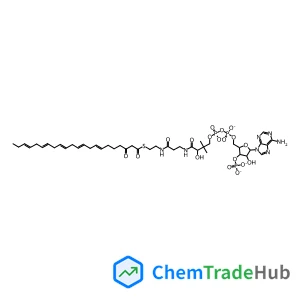
CAS Number
Related Products
![(2R)-2,7,8-Trimethyl-2-[(4R,8R)-4,8,12-trimethyltridecyl]-6-chromanol](https://static.chemtradehub.com/structs/54-/54-28-4-155c.webp)
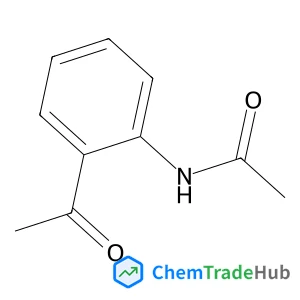
N-(2-Acetylphenyl)acetamide
CAS Number: 5234-26-4
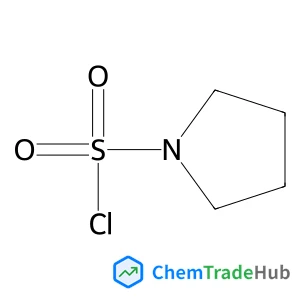
1-Pyrrolidinesulfonyl chloride
CAS Number: 1689-02-7
![3-Hexyl-2-[3-(3-hexyl-1,3-benzoxazol-2(3H)-ylidene)-1-propen-1-yl]-1,3-benzoxazol-3-ium iodide](https://static.chemtradehub.com/structs/532/53213-82-4-e483.webp)
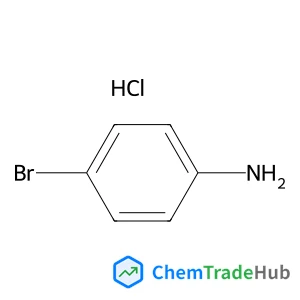
4-Bromoaniline hydrochloride (1:1)
CAS Number: 624-19-1
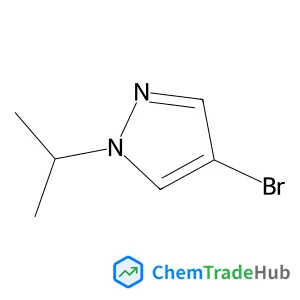
4-Bromo-1-isopropyl-1H-pyrazole
CAS Number: 313735-62-5
Other Suppliers for Alcohol dehydrogenase







Basic Information
Molecular Formula
C43H62N7O18P3S-4
Molecular Weight
1090 g/mol
Physical Properties
Water Solubility
Soluble in water.
Chemical Identifiers
SMILES
CCC=CCC=CCC=CCC=CCC=CCCCC(=O)CC(=O)SCCNC(=O)CCNC(=O)C(C(C)(C)COP(=O)([O-])OP(=O)([O-])OCC1C(C(C(O1)N2C=NC3=C(N=CN=C32)N)O)OP(=O)([O-])[O-])O
InChIKey
SLYKKQSPRFJDAF-UHFFFAOYSA-J
Database References
MDL Number
MFCD00081305
FAQ
Alcohol dehydrogenase (CAS: 9031-72-5) falls under the regulations of the GHS for classification as a biological product. It is subject to registration under the European Union’s REACH regulations, and users must comply with FDA and EPA guidelines for handling and use in the United States. Regulatory compliance includes proper labeling, storage, and handling to ensure safety and environmental protection.
Yes, there are alternatives to Alcohol dehydrogenase for synthesis, such as using other dehydrogenases like glucose dehydrogenase or replacing it with synthetic equivalents. These alternatives can be more cost-effective or have better stability and specificity, depending on the specific application. However, each alternative requires careful evaluation of its enzymatic activity and compatibility with the reaction conditions.
The market for Alcohol dehydrogenase (CAS: 9031-72-5) is driven by increasing research in biotechnology and pharmaceuticals. Recent trends show a growing interest in its use for metabolic engineering and drug discovery. Research is also focusing on improving its catalytic efficiency and developing more robust variants. Market trends indicate a steady demand with potential for growth in novel applications.
Waste containing Alcohol dehydrogenase (CAS: 9031-72-5) should be collected in sealed containers and disposed of according to local waste management regulations. For bulk waste, incineration or professional waste disposal services are recommended. Environmental protection measures include minimizing spillage and ensuring proper containment to prevent contamination. Users should adhere to safe handling practices and follow relevant safety protocols.
Safety Notice
Please verify product specifications and safety data before use. Contact the supplier for detailed safety information.
Always follow proper handling procedures