



AD
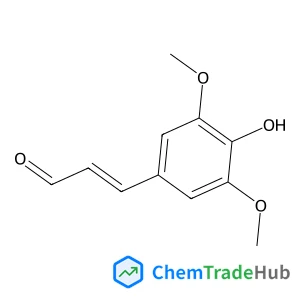
(2E)-3-(4-Hydroxy-3,5-dimethoxyphenyl)acrylaldehyde(CAS: 4206-58-0)
CAS Number
Related Products
![(2E)-N-[2-(beta-D-Glucopyranosyloxy)ethyl]-3-(methylsulfanyl)acrylamide](https://static.chemtradehub.com/structs/138/138916-58-2-f395.webp)
![2,7-Dihydroxy-3,8-dimethoxychromeno[5,4,3-cde]chromene-5,10-dione](https://static.chemtradehub.com/structs/223/2239-88-5-ca12.webp)
![3,4,5-Trimethoxyphenyl 6-O-[(2R,3R,4R)-3,4-dihydroxy-4-(hydroxymethyl)tetrahydro-2-furanyl]-beta-D-glucopyranoside](https://static.chemtradehub.com/structs/875/87562-76-3-8d70.webp)
![(1S,4S,12S,13R,16R,17R)-17-(Hydroxymethyl)-12-methyl-8-oxapentacyclo[14.2.1.0~1,13~.0~4,12~.0~5,9~]nonadeca-5(9),6-dien-17-ol](https://static.chemtradehub.com/structs/469/469-83-0-e2af.webp)
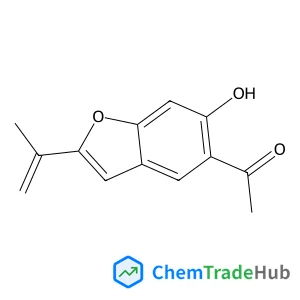
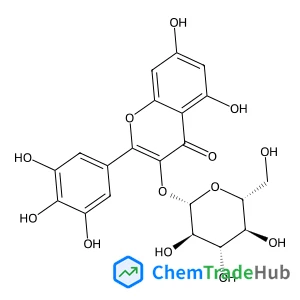
Other Suppliers for (2E)-3-(4-Hydroxy-3,5-dimethoxyphenyl)acrylaldehyde







Basic Information
Molecular Formula
C11H12O4
Molecular Weight
208.21 g/mol
Physical State
Yellow powder
Physical Properties
Melting Point
104-106 °C (lit.)
Boiling Point
372.3±37.0 °C at 760 mmHg
Density
1.2±0.1 g/cm3
Flash Point
146.3±20.0 °C
Chemical Identifiers
SMILES
COc1cc(C=CC=O)cc(OC)c1O
InChIKey
CDICDSOGTRCHMG-ONEGZZNKSA-N
Database References
MDL Number
MFCD00075980
FAQ
Regulatory guidelines for (2E)-3-(4-Hydroxy-3,5-dimethoxyphenyl)acrylaldehyde (CAS: 4206-58-0) include GHS classification, which categorizes it as hazardous due to its flammability and skin irritation properties. REACH regulations require manufacturers and importers to register the substance if produced or imported in quantities above one tonne per year. FDA and EPA regulations may also apply based on its use in pharmaceuticals, cosmetics, and consumer products, respectively, with specific reporting and testing requirements.
Alternatives to (2E)-3-(4-Hydroxy-3,5-dimethoxyphenyl)acrylaldehyde (CAS: 4206-58-0) in synthesis include similar compounds such as (2E)-3-(4-hydroxy-3-methoxyphenyl)acrylaldehyde or (2E)-3-(3,4-dimethoxyphenyl)acrylaldehyde. Isomers like (2Z)-3-(4-Hydroxy-3,5-dimethoxyphenyl)acrylaldehyde are also available. In some cases, reagents such as (2E)-3-(4-hydroxyphenyl)acrylaldehyde or other aldehydes can serve as substitutes, depending on the specific reaction conditions and desired product profiles.
The market for (2E)-3-(4-Hydroxy-3,5-dimethoxyphenyl)acrylaldehyde (CAS: 4206-58-0) is driven by its applications in the pharmaceutical and cosmetic industries. Research trends focus on its potential as a precursor for natural product synthesis and as an intermediate in the development of new drugs. Market trends indicate a growing interest in sustainable and eco-friendly synthesis methods, alongside increasing demand for dermatologically safe ingredients in cosmetics. However, due to its chemical complexity, challenges remain in large-scale production and its environmental impact.
Waste containing (2E)-3-(4-Hydroxy-3,5-dimethoxyphenyl)acrylaldehyde (CAS: 4206-58-0) should be collected in appropriate containers and stored in a controlled environment to prevent exposure to air, moisture, and light, which can affect its stability. Incineration is a common method for disposal, but professional waste disposal services are recommended for handling hazardous waste. Environmental protection precautions include ensuring that waste is treated in accordance with local regulations and that all containers are properly labeled. Proper documentation of waste disposal procedures is essential for compliance with regulatory requirements.
Safety Notice
Please verify product specifications and safety data before use. Contact the supplier for detailed safety information.
Always follow proper handling procedures
Contact Information
Contact Person
Miss Zhang
2056216494@qq.com
Mobile
18607107848
Visit Website
https://www.chemfaces.cnAddress
Wuhan Economic and Technological Development Zone 4MA Block No.1 Workshop (Chēchéng East Road 176) 4th Floor