



AD
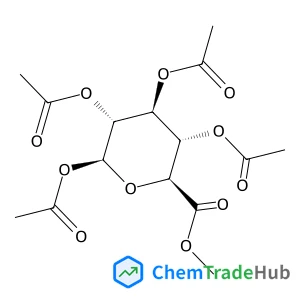
Methyl 1,2,3,4-tetra-O-acetyl-beta-D-glucopyranuronate(CAS: 7355-18-2)
CAS Number
Related Products
![2,2-Bis[(benzoyloxy)methyl]butyl benzoate](https://static.chemtradehub.com/structs/545/54547-34-1-c22c.webp)
![N-Benzyl-2-[(2,6-dimethylphenyl)amino]-N,N-diethyl-2-oxoethanaminium 3-oxo-3H-1,2-benzothiazol-2-ide 1,1-dioxide](https://static.chemtradehub.com/structs/908/90823-38-4-1d50.webp)


![(3aR,5S,6S,6aR)-5-[(4R)-2,2-dimethyl-1,3-dioxolan-4-yl]-2,2-dimethyl-tetrahydro-2H-furo[2,3-d][1,3]dioxol-6-ol](https://static.chemtradehub.com/structs/582/582-52-5-5c4c.webp)
![N-Benzyl-2-[(2,6-dimethylphenyl)amino]-N,N-diethyl-2-oxoethanaminium benzoate](https://static.chemtradehub.com/structs/373/3734-33-6-2f15.webp)


Other Suppliers for Methyl 1,2,3,4-tetra-O-acetyl-beta-D-glucopyranuronate




Basic Information
Molecular Formula
C15H20O11
Molecular Weight
376.31 g/mol
Physical Properties
Melting Point
177.0 to 181.0 deg-C
Boiling Point
412.3°C at 760 mmHg
Density
1.33±0.1 g/cm3 (20 ºC 760 Torr),
Flash Point
178.4 °C
Chemical Identifiers
SMILES
COC(=O)[C@H]1O[C@@H](OC(=O)C)[C@H](OC(=O)C)[C@@H](OC(=O)C)[C@@H]1OC(=O)C
InChIKey
DPOQCELSZBSZGX-XOBFJNJYSA-N
Database References
MDL Number
MFCD00069834
FAQ
Methyl 1,2,3,4-tetra-O-acetyl-beta-D-glucopyranuronate (CAS: 7355-18-2) is subject to various regulatory guidelines including GHS classification, REACH regulations, and FDA/EPA requirements. Under the Globally Harmonized System of Classification and Labelling of Chemicals (GHS), it is classified based on its physical and chemical properties. REACH regulations in the EU require manufacturers and importers to register the substance, providing detailed information on its properties and hazards. The FDA and EPA may have additional specific requirements related to its use in pharmaceuticals and environmental safety, respectively.
While Methyl 1,2,3,4-tetra-O-acetyl-beta-D-glucopyranuronate (CAS: 7355-18-2) is a unique compound, alternatives in synthesis include using other acetylated derivatives of glucopyranuronate or employing different glycosylation strategies. Isomers and analogs, such as mono- or tri-O-acetylated glucopyranuronates, can serve as substitutes, depending on the specific needs of the synthesis. Common alternative reagents include acetyl chloride and acetic anhydride, which are widely used in acetylation reactions.
Research into Methyl 1,2,3,4-tetra-O-acetyl-beta-D-glucopyranuronate (CAS: 7355-18-2) is relatively limited, but there is growing interest in its potential applications in carbohydrate chemistry and enzymology. Market trends suggest increasing demand in specialized research and development, particularly in pharmaceutical and biotechnology sectors. Price trends indicate stability, with research-grade materials commanding higher prices due to their specialized applications. Emerging research fields focus on understanding the structural and functional properties of acetylated glucopyranuronates for their potential in drug design and carbohydrate-based materials.
Waste containing Methyl 1,2,3,4-tetra-O-acetyl-beta-D-glucopyranuronate (CAS: 7355-18-2) should be managed according to local and international regulations. Collection of waste should be done in appropriate containers to prevent spillage and contamination. For disposal, incineration is a common method, provided it meets environmental standards. Alternatively, professional waste disposal services can handle the waste safely, ensuring compliance with environmental protection laws. Special precautions include the use of personal protective equipment (PPE) and following safety protocols to minimize exposure and environmental impact.
Safety Notice
Please verify product specifications and safety data before use. Contact the supplier for detailed safety information.
Always follow proper handling procedures
Contact Information
Contact Person
Liu Jianwei
ljw@synose.com