



AD
2-(3,4-Dihydroxyphenyl)-5,7-dihydroxy-4-oxo-4H-chromen-3-yl 6-O-(6-deoxy-alpha-L-mannopyranosyl)-beta-D-glucopyranoside(CAS: 153-18-4)
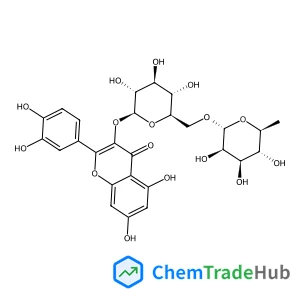
CAS Number
Related Products
![2,3,9,10-Tetramethoxy-5,8,13,13a-tetrahydro-6H-isoquinolino[3,2-a]isoquinolinium chloride](https://static.chemtradehub.com/structs/602/6024-85-7-3c50.webp)
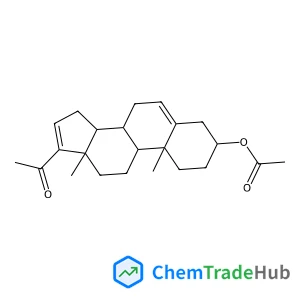
16-Dehydropregnenolone acetate
CAS Number: 979-02-2
![b-D-Glucopyranoside,(1aR,2S,3aR,5R,5aR,5bS)-5b-[(benzoyloxy)methyl]tetrahydro-5-hydroxy-2-methyl-2,5-methano-1H-3,4-dioxacyclobuta[cd]pentalen-1a(2H)-yl](https://static.chemtradehub.com/structs/231/23180-57-6-9a90.webp)
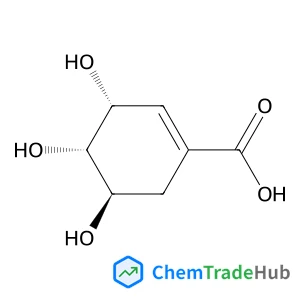
![4-[(1R)-1-Hydroxy-2-(methylamino)ethyl]phenol](https://static.chemtradehub.com/structs/94-/94-07-5-909e.webp)
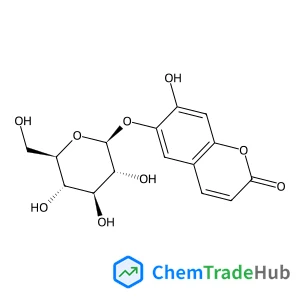
![(3beta)-3-[(3-Carboxypropanoyl)oxy]-11-oxoolean-12-en-30-oic acid](https://static.chemtradehub.com/structs/569/5697-56-3-6b7e.webp)
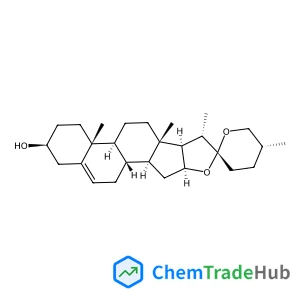
(3beta,25R)-Spirost-5-en-3-ol
CAS Number: 512-04-9
Other Suppliers for 2-(3,4-Dihydroxyphenyl)-5,7-dihydroxy-4-oxo-4H-chromen-3-yl 6-O-(6-deoxy-alpha-L-mannopyranosyl)-beta-D-glucopyranoside



Basic Information
Molecular Formula
C27H30O16
Molecular Weight
610.52 g/mol
Physical State
Yellow powder
Physical Properties
Melting Point
195 ºC
Boiling Point
983.1°C at 760 mmHg
Water Solubility
12.5 g/100 mL
Chemical Identifiers
SMILES
C[C@@H]1O[C@@H](OC[C@H]2O[C@@H](Oc3c(oc4cc(O)cc(O)c4c3=O)c5ccc(O)c(O)c5)[C@H](O)[C@@H](O)[C@@H]2O)[C@H](O)[C@H](O)[C@H]1O
InChIKey
IKGXIBQEEMLURG-NVPNHPEKSA-N
Database References
MDL Number
MFCD00006830
FAQ
This compound, with CAS number 153-18-4, is a complex glycoside derivative containing a chromene ring and multiple hydroxyl groups. Its chemical structure includes a flavonoid core linked to a beta-D-glucopyranoside sugar chain modified with a 6-deoxy-alpha-L-mannopyranosyl group. It exhibits antioxidant properties due to its phenolic groups and is commonly found in plant-based materials. The compound's molecular formula is C21H20O11, and it is a white solid with moderate solubility in polar solvents.
This compound is primarily used in pharmaceutical research for its antioxidant and anti-inflammatory potential. It serves as a precursor in drug development targeting oxidative stress-related diseases. In the food industry, it may be studied for natural preservative properties. Additionally, it is utilized in biochemical studies to explore flavonoid glycoside interactions and metabolic pathways.
The compound is generally considered safe in controlled research settings. However, handling precautions include avoiding inhalation, ingestion, or skin contact. Protective measures like gloves and safety goggles are recommended. While no major toxicity data exist, adherence to standard lab safety protocols is essential to ensure safe use and disposal, minimizing risks associated with chemical exposure.
Store this compound in a cool, dry place (2-8°C), away from light and moisture. Use airtight, dark-colored containers to prevent degradation. Maintain low humidity levels to avoid hydrolysis. It is stable under these conditions but should be protected from thermal and oxidative stress. Always follow manufacturer guidelines for long-term storage and handling.
Safety Notice
Please verify product specifications and safety data before use. Contact the supplier for detailed safety information.
Always follow proper handling procedures