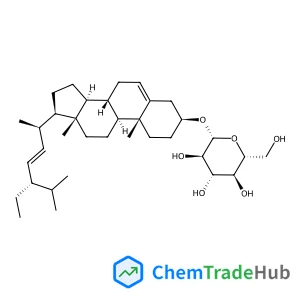
(3beta,22E)-Stigmasta-5,22-dien-3-yl beta-D-glucopyranoside
CAS Number:
19716-26-8
Molecular Formula:
C35H58O6
Sugandha Singh, Manas K. Ghorai, Kamal K. Kar
A redox-active donor–acceptor pair conjugated organic polymer (COP), TBB-phen, was synthesized via tetrakis(triphenylphosphine)palladium-catalyzed Sonogashira-coupling. It was modified further by stabilizing cobalt(II) into the organic polymer to create Co@TBB-phen. At room temperature, the polymers exhibited substantial charge separation, semiconducting behavior, and an embedded spherical morphology. Multi-point Brunauer–Emmett–Teller analysis revealed adequate surface area and mesoporosity (d = 2.7 nm). TBB-phen was explored for electrocatalysis, where it showed good oxygen reduction activity with a low onset potential of 0.78 V (vs. reversible hydrogen electrode) and low overpotential (332 mV@10 mA cm−2) towards the hydrogen evolution reaction (HER). However, Co@TBB-phen could deliver the oxygen evolution reaction (OER) along with amelioration of the oxygen reduction reaction (ORR) and HER. The overpotential for the ORR and HER was reduced by 30 mV and 33 mV, respectively, with oxygen evolution at 560 mV@10 mA cm−2. A study on natural bond orbitals revealed charge transfer and orbital interactions that confirmed the effective utilization of π-conjugation in the ORR and OER. Density functional theory (DFT) computations in the OER and HER provided a plausible reaction mechanism and descriptors, along with affirming that the designed polymer was an impeccable donor–acceptor pair. This work opens a door for phenanthroline molecules in electrochemical-energy applications.
Yan Bai, Dong Guo, Chun-ying Duan, Dong-bin Dang, Ke-liang Pang, Qing-jin Meng
DOI: 10.1039/B306264C
Ram K. R. Jetti, Roland Boese, Tejender S. Thakur, Venu R. Vangala, Gautam R. Desiraju
DOI: 10.1039/B407319C
Tao Gao, Taihong Wang
DOI: 10.1039/B411018H
Neil Burford, Melanie D. Eelman, Wesley G. LeBlanc, T. Stanley Cameron, Katherine N. Robertson
DOI: 10.1039/B311599B
Adam F. Lee, Paul A. Carr, Karen Wilson
DOI: 10.1039/B408745C
DOI: 10.1039/B409730K
A. Ratnamala, V. Durga Kumari, M. Subrahmanyam, N. Archana
DOI: 10.1039/B409413A
Andrew Campbell, Pietro Taylor, Olivier J. Cayre, Vesselin N. Paunov
DOI: 10.1039/B406941B
Christophe Corre, Cyrille A. S. Landreau, Michael Shipman, Philip A. S. Lowden
DOI: 10.1039/B410592C
Koji Nakayama, Masayuki Endo, Tetsuro Majima
DOI: 10.1039/B409844G
When handling 2-Chloro-1,2-bis(4-methylphenyl)ethanone (CAS: 71193-32-3), it is ...
4-Ethoxy-3-(5-methyl-4-oxo-7-propyl-1,4-dihydroimidazo[5,1-f][1,2,4]triazin-2-yl...
Methyl 3-Oxo-4-Androsten-17-Carboxylate (CAS: 2681-55-2) should be stored in a c...
(R)-3-Amino-4-(3-hexylphenylamino)-4-oxobutylphosphonic acid is primarily used i...
2-Methyl-2-propanyl 3-amino-3-carbamoyl-1-azetidinecarboxylate (CAS: 1254120-14-...
There are alternative reagents that can be used in synthesis instead of (E)-4-(t...
[2-(3-Chlorophenyl)-1,3-thiazol-4-yl]methanol (CAS: 121202-20-8) is a crystallin...
The market and research trends for Methyl (2S)-[(4S)-2,2-dimethyl-1,3-dioxolan-4...
The market for 1-Bromo-2-isocyanatoethane (CAS: 42865-19-0) is driven by its use...
4-Nitro-D-phenylalanine hydrochloride (CAS: 147065-06-3) is primarily used in re...

Journal of Materials Chemistry A, B & C cover high quality studies across all fields of materials chemistry. The journals focus on those theoretical or experimental studies that report new understanding, applications, properties and synthesis of materials. The journals have a strong history of publishing quality reports of interest to interdisciplinary communities and providing an efficient and rigorous service through peer review and publication. The journals are led by an international team of Editors-in-Chief and Associate Editors who are all active researchers in their fields. Journal of Materials Chemistry A, B & C are separated by the intended application of the material studied. Broadly, applications in energy and sustainability are of interest to Journal of Materials Chemistry A, applications in biology and medicine are of interest to Journal of Materials Chemistry B, and applications in optical, magnetic and electronic devices are of interest to Journal of Materials Chemistry C. More than one Journal of Materials Chemistry journal may be suitable for certain fields and researchers are encouraged to submit their paper to the journal that they feel best fits for their particular article. Example topic areas within the scope of Journal of Materials Chemistry A are listed below. This list is neither exhaustive nor exclusive. Artificial photosynthesis Batteries Carbon dioxide conversion Catalysis Fuel cells Gas capture/separation/storage Green/sustainable materials Hydrogen generation Hydrogen storage Photocatalysis Photovoltaics Self-cleaning materials Self-healing materials Sensors Supercapacitors Thermoelectrics Water splitting Water treatment