












Strain induced reactivity of cyclic iminoboranes: the (2 + 2) cycloaddition of a 1H-1,3,2-diazaborepine with ethene
Literature Information
Publication Date
2023-12-12
DOI
10.1039/D3SC04901A
Impact Factor
9.825
Authors
Divanshu Gupta, Ralf Einholz, Holger F. Bettinger
View Original
Abstract
Iminoboranes have gathered immense attention due to their reactivity and potential applications as isoelectronic and isosteric alkynes. While cyclic alkynes are well investigated and useful reagents, cyclic iminoboranes are underexplored and their existence was inferred only via trapping experiments. We report the first direct spectroscopic evidence of a cyclic seven-membered iminoborane, 1-(tert-butyldimethylsilyl)-1H-1,3,2-diazaborepine 2, under cryogenic matrix isolation conditions. The amino-iminoborane 2 was photochemically generated in solid argon at 4 K from 2-azido-1-(tert-butyldimethylsilyl)-1,2-dihydro-1,2-azaborinine (3) and was characterized using FT-IR, UV-vis spectroscopy, and computational chemistry. The characteristic BN stretching vibration (1751 cm−1) is shifted by about 240 cm−1 compared to linear amino-iminoboranes indicating a significant weakening of the bond. The Lewis acidity value determined computationally (LAB = 9.1 ± 2.6) is similar to that of boron trichloride, and twelve orders of magnitude lower than that of 1,2-azaborinine (BN-aryne, LAB = 21.5 ± 2.6), a six-membered cyclic iminoborane. In contrast to the latter, the reduced ring strain of 2 precludes nitrogen fixation, but it unexpectedly allows facile (2 + 2) cycloaddition reaction with C2H4 under matrix isolation conditions at 30 K.
Related Literature
An electrochemical sensor for 3,4-dihydroxyphenylacetic acid with carbon nanotubes as electronic transducer and synthetic cyclophane as recognition element
Jie Yan, Yucheng Zhou, Ping Yu, Lei Su, Lanqun Mao, Deqing Zhang, Daoben Zhu
2008-07-17
Communication
DOI: 10.1039/B805958F
Improved oxygen mobility in nanosized mixed-oxide particles synthesized using a simple nanocasting route
Magali Bonne, Nicolas Bion, Frédéric Pailloux, Sabine Valange, Sébastien Royer, Jean-Michel Tatibouët, Daniel Duprez
2008-08-01
Communication
DOI: 10.1039/B808699K
Facile fabrication of conducting polymer hydrogels via supramolecular self-assembly
Tingyang Dai, Xiujuan Jiang, Shouhu Hua, Xiaoshu Wang, Yun Lu
2008-07-16
Communication
DOI: 10.1039/B807116K
Controlled generation of acentric and homochiral coordination compounds from a versatile asymmetric ligand 4-(1H-1,2,4-triazol-3-yl)-4H-1,2,4-triazole
Jian Zhang, Zhao-Ji Li, Ye-Yan Qin, Jian-Kai Cheng, Yuan-Gen Yao
2008-07-15
Communication
DOI: 10.1039/B807320A
A facile method of achieving low surface coverage of Au nanoparticles on an indium tin oxide electrode and its application to protein detection
Md. Abdul Aziz, Srikanta Patra, Haesik Yang
2008-08-04
Communication
DOI: 10.1039/B808026G
Ultra stable ordered mesoporous phenol/formaldehydepolymers as a heterogeneous support for vanadium oxide
Ilke Muylaert, Marijke Borgers, Els Bruneel, Joseph Schaubroeck, Francis Verpoort, Pascal Van Der Voort
2008-07-29
Communication
DOI: 10.1039/B808566H
Suzuki cross-coupling reactions on the surface of carbon-coated cobalt: expanding the applicability of core–shell nano-magnets
Chun Ghee Tan, Robert N. Grass
2008-07-16
Communication
DOI: 10.1039/B807741J
Kagomé type extra-large microporous solid based on a paddle-wheel Cu2+ dimer
Satoshi Horike, Shinpei Hasegawa, Daisuke Tanaka, Masakazu Higuchi
2008-07-21
Communication
DOI: 10.1039/B806616G
Hierarchical carbon nanotube assemblies created by sugar–boric or boronic acid interactions
Shingo Tamesue, Munenori Numata, Kenji Kaneko, Tony D. James, Seiji Shinkai
2008-07-30
Communication
DOI: 10.1039/B808599D
Temporal and spatial imaging of hydrogen storage materials: watching solvent and hydrogen desorption from aluminium hydride by transmission electron microscopy
Shane D. Beattie, Terry Humphries, Louise Weaver, G. Sean McGrady
2008-07-28
Communication
DOI: 10.1039/B807091A
You might also like
Compound Q&A
What precautions should be taken when handling 4-(2-Furylmethyl)thiomorpholine 1,1-dioxide (CAS: 79206-94-3)?
When handling 4-(2-Furylmethyl)thiomorpholine 1,1-dioxide (CAS: 79206-94-3), it ...
79206-94-34-(2-Furylmethyl)thi...
Compound Q&A
What precautions should be taken when handling 4-Chloro-N-[2-(4-morpholinyl)ethyl]benzamide (CAS: 71320-77-9)?
When handling 4-Chloro-N-[2-(4-morpholinyl)ethyl]benzamide (CAS: 71320-77-9), it...
71320-77-94-Chloro-N-[2-(4-mor...
Compound Q&A
How should waste containing 2-[2-(2-Methoxyethoxy)ethoxy]ethyl 4-methylbenzenesulfonate (CAS: 62921-74-8) be handled?
Waste containing this compound (CAS: 62921-74-8) should be handled according to ...
62921-74-82-[2-(2-Methoxyethox...
Compound Q&A
How should waste containing (S)-Methyl 2-amino-3-cyclohexylpropanoate be handled?
Waste containing (S)-Methyl 2-amino-3-cyclohexylpropanoate should be collected i...
40056-18-6(S)-Methyl 2-amino-3...
Compound Q&A
How is 5-({4-[(2S,4R)-4-Hydroxy-2-methyltetrahydro-2H-pyran-4-yl]-2-thienyl}sulfanyl)-1-methyl-1,3-dihydro-2H-indol-2-one (CAS: 166882-70-8) typically synthesized?
This compound can be synthesized using a multi-step process involving the conjug...
166882-70-85-({4-[(2S,4R)-4-Hyd...
Compound Q&A
Are there alternatives to (2E)-3-(3,4-Dichlorophenyl)acrylic acid (CAS: 7312-27-8) in synthesis?
There are several alternatives to (2E)-3-(3,4-Dichlorophenyl)acrylic acid in syn...
7312-27-8(2E)-3-(3,4-Dichloro...
Compound Q&A
How should Ethyl 6-(2-nitrophenyl)imidazo[2,1-b][1,3]thiazole-3-carboxylate (CAS: 925437-84-9) be stored?
Ethyl 6-(2-nitrophenyl)imidazo[2,1-b][1,3]thiazole-3-carboxylate (CAS: 925437-84...
925437-84-9Ethyl 6-(2-nitrophen...
Compound Q&A
How should waste containing 2-(1,3-Thiazol-2-yl)ethanamine (CAS: 18453-07-1) be handled?
Waste containing 2-(1,3-Thiazol-2-yl)ethanamine (CAS: 18453-07-1) should be coll...
18453-07-12-(1,3-Thiazol-2-yl)...
Compound Q&A
How is Methyl 5-iodo-2-methylbenzoate (CAS: 103440-54-6) typically synthesized?
Methyl 5-iodo-2-methylbenzoate can be synthesized through the iodination of meth...
103440-54-6Methyl 5-iodo-2-meth...
Compound Q&A
How is 5-Chloro[1,2,4]triazolo[1,5-a]pyridine (CAS: 1427399-34-5) typically synthesized?
5-Chloro[1,2,4]triazolo[1,5-a]pyridine is commonly synthesized via the condensat...
1427399-34-55-Chloro[1,2,4]triaz...
Source Journal
Chemical Science

CiteScore:
14.4
Self-citation Rate:
3.9%
Articles per Year:
1413
Our journal has a wide-ranging scope which covers the full breadth of the chemical sciences. The research we publish contains the sorts of novel ideas, challenging questions and progressive thinking that bring undiscovered breakthroughs within reach. Your paper could focus on a single area, or cross many. It could be beyond the accepted bounds of the chemical sciences. It might address an immediate challenge, contribute to a future breakthrough or be wholly conceptual. We’re a team from every field of the chemical sciences, and know from experience that breakthroughs that drive the solutions to global challenges can come from anywhere, at any time. You could even start an entirely new area of research. Too bold? Too progressive? No such thing
Recommended Compounds

![2,6-Di(thiophen-2-yl)dithieno[3,2-b:2',3'-d]thiophene structure](https://static.chemtradehub.com/structs/910/910788-24-8-5b70.webp "2,6-Di(thiophen-2-yl)dithieno[3,2-b:2',3'-d]thiophene structure")
2,6-Di(thiophen-2-yl)dithieno[3,2-b:2',3'-d]thiophene
CAS Number:
910788-24-8
Molecular Formula:
C16H8S5
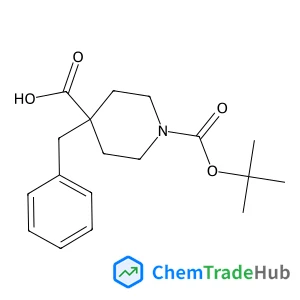
4-Benzyl-1-(tert-butoxycarbonyl)piperidine-4-carboxylic acid
CAS Number:
170838-87-6
Molecular Formula:
C18H25NO4
Recommended Suppliers







Disclaimer
This page provides academic journal information for reference and research purposes only. We are not affiliated with any journal publishers and do not handle publication submissions. For publication-related inquiries, please contact the respective journal publishers directly.
If you notice any inaccuracies in the information displayed, please contact us at support@chemtradehub.com. We will promptly review and address your concerns.