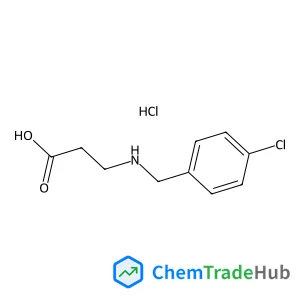
N-(4-Chlorobenzyl)-beta-alanine hydrochloride (1:1)
CAS Number:
1172479-10-5
Molecular Formula:
C10H13Cl2NO2
David Dan, Sara L. Adelman, David B. Kimball, Stosh A. Kozimor, Jenifer C. Shafer
Controlling aqueous 5f-element electron transfer chemistry is critical for processing efforts associated with actinide technologies. Often, redox agents are added during actinide processing steps to control actinide redox chemistry and manipulate the actinide oxidation states for the separation. Sodium chlorite, NaClO2(aq), represents one of these useful redox agents. For example, NaClO2(aq) finds widespread application in the processing of plutonium and americium. Surprisingly, however, redox reactivity between NaClO2(aq) and other actinides, like neptunium, has been largely ignored. That knowledge gap is addressed herein. We characterized some redox reactivity between NaClO2(aq) and Np4+(aq) and identified experimental conditions that held neptunium in the +4 oxidation state or converted Np4+(aq) to NpO22+(aq) or NpO21+(aq). This was achieved by carefully adjusting four variables: ingoing concentrations of (1) Np4+(aq), (2) NaClO2(aq), (3) Cl1−(aq), and (4) H1+(aq). We discovered that three neptunium oxidation states (+4, +5, and +6) could be accessed using one ubiquitous redox agent, NaClO2(aq). These results highlight the diverse electron transfer chemistry available to neptunium in aqueous solutions, provide new insight on how neptunium reacts with NaClO2(aq), and are discussed within the context of their importance to plutonium and americium processing.

Geotextiles and Geomembranes

Ceramics International

Experimental Techniques

Journal of the Royal Society of New Zealand

Composites Science and Technology

Applied Organometallic Chemistry

Bulletin of the Korean Chemical Society

Ferroelectrics Letters Section

Chemistry Letters

Journal of Analytical Atomic Spectrometry
Qin Li, Zhenxian Liu, Haipeng Zhang
DOI: 10.1039/D3SE01330H
Zhiye Wang, Yunchuan Li, Mingjun Sun
DOI: 10.1039/D3CP04593E
Hainan Jiang, Yaolong He, Xiaolin Li, Zhiyao Jin, Huijie Yu, Dawei Li
DOI: 10.1039/D3CP04274J
Bratislav P. Marinković, Jaime Rosado, Francisco Blanco, Gustavo García, Jelena B. Maljković
DOI: 10.1039/D3CP05052A
Liying Pan, Xuxin Kang
DOI: 10.1039/D3CP04660E
Qian Wang, Yu Zhuang, Abuduwayiti Aierken, Qiaogang Song, Qin Zhang, Youbo Dou, Qiuli Zhang, Shuyi Zhang
DOI: 10.1039/D3CP05309A
Yi-Rong Liu, Yan Jiang
DOI: 10.1039/D3CP04702D
Laura T. Wey, Jouko Peltonen, Yagut Allahverdiyeva
DOI: 10.1039/D3SE01185B
Waste containing N-Methoxy-N-methyl-1,3-thiazole-5-carboxamide (CAS: 898825-89-3...
N-(4-Biphenylyl)dibenzo[b,d]furan-4-amine should be stored in a tightly sealed c...
The market for 3-Acetamido-5-amino-2,4,6-triiodobenzoic acid (CAS: 1713-07-1) is...
Benzyl 2-O-acetyl-3,4,6-tri-O-benzyl-beta-D-galactopyranoside (CAS: 61820-03-9) ...
2-Ethylpiperazine dihydrochloride (CAS: 438050-52-3) is regulated under the Glob...
1,1'-[1,3-Phenylenebis(methylene)]bis(3-methyl-1H-pyrrole-2,5-dione) (CAS: 11946...
Several alternatives can be used in the synthesis of 5-Fluoro-2-(1-pyrrolidinyl)...
Proper personal protective equipment (PPE) must be worn when handling this compo...
When handling 6-Bromoimidazo[1,2-a]pyridin-8-amine, it is important to wear appr...
Alternatives to (2S,4R)-4-(4-Nitrobenzyl)pyrrolidine-2-carboxylic acid hydrochlo...

NJC (New Journal of Chemistry) is a broad-based primary journal encompassing all branches of chemistry and its sub-disciplines. It contains full research articles, communications, perspectives and focus articles. This well-established journal, owned by the Centre National de la Recherche Scientifique (CNRS) of France, has been co-published with the Royal Society of Chemistry since January 1998. NJC is the forum for the publication of high-quality, original and significant work that opens new directions in chemistry or other scientific disciplines. In addition to having a significant chemical component, work published in NJC must demonstrate that it will have an impact on areas of research other than that of the reported work.
![2-(7,7-Difluorobicyclo[4.1.0]hept-1-yl)ethanamine structure](https://static.chemtradehub.com/structs/209/2098065-08-6-ff24.webp "2-(7,7-Difluorobicyclo[4.1.0]hept-1-yl)ethanamine structure")
![4-Chloro-2-{[(2-chlorophenoxy)acetyl]amino}benzoic acid structure](https://static.chemtradehub.com/structs/351/351424-20-9-9467.webp "4-Chloro-2-{[(2-chlorophenoxy)acetyl]amino}benzoic acid structure")