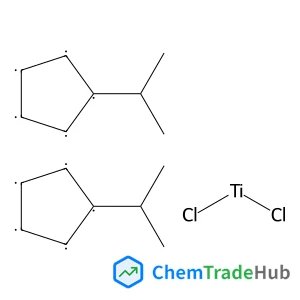
BIS(I-PROPYLCYCLOPENTADIENYL)TITANIUM DICHLORIDE
CAS Number:
12130-65-3
Molecular Formula:
C16H22Cl2Ti
Corentin Grassin, Corina H. Pollok, Nora M. Kreienborg, Christian Merten
Combining vibrational circular dichroism (VCD) spectroscopy with the matrix isolation (MI) technique opens up interesting possibilities to study chiral molecules. MI involves the isolation of guest species in inert solid matrices at cryogenic temperatures. Hence, MI-VCD measures are solid-state VCD measurements, and as such, can suffer from mostly birefringance-related artefacts in the same way as common solid-state VCD measurements. In this contribution, we demonstrate that the sample preparation condition have tremendous impact on the quality and reliability of the recorded MI-VCD spectra. While MI-IR spectra are basically blind to these artefacts, the variation of deposition temperatures and host flow rates seem to control whether high quality MI-VCD spectra are obtained or if depolarization effects lead to completely obscured spectra. For two selected examples, styrene oxide (SO) and 1-phenyl propylene oxide (PPO), we discuss how the various experimental conditions may lead to the aforementioned effects and give a microscopic description of their origin.
Bo-wen Sun, Hong-yu Yu, Yong-jing Yang, Hui-jun Li, Cheng-yu Zhai, Dong-Jin Qian, Meng Chen
DOI: 10.1039/C7CP05242A
S. Yang, J. Huang
DOI: 10.1039/C7CP00247E
Rachel Pflieger, Temim Ouerhani, Thierry Belmonte, Sergey I. Nikitenko
DOI: 10.1039/C7CP04813K
Hugo R. Fernandes, Bertrand Doumert, Lionel Montagne, José M. F. Ferreira
DOI: 10.1039/C7CP01690E
Xiaomei Yu, Yunfei Wang, Yu Kwon Kim
DOI: 10.1039/C7CP03579A
Rebecca van der Westen, Prashant K. Sharma, Hans De Raedt, Ijsbrand Vermue, Henny C. van der Mei, Henk J. Busscher
DOI: 10.1039/C7CP04676F
Micheál D. Scanlon, Pekka Peljo, Lucie Rivier, Heron Vrubel, Hubert H. Girault
DOI: 10.1039/C7CP04601D
Quan Zhuang, Xilian Jin, Qianqian Lv, Ying Li, Ziji Shao, Zhao Liu, Xin Li, Huadi Zhang, Xing Meng, Kuo Bao, Tian Cui
DOI: 10.1039/C7CP03435K
Zhen Pu, Wenjie Yu, Soumendra K. Roy, Chaoyang Li, Bingyun Ao, Tianwei Liu, Maobing Shuai, Xuefeng Wang
DOI: 10.1039/C7CP00419B
2-Methylbenzene-1,4-diamine dihydrochloride (CAS: 615-45-2) should be stored in ...
(1S,4S)-2,5-Diazabicyclo[2.2.1]heptane dihydrobromide is generally considered sa...
(6-Chloropyridazin-3-YL)methanamine finds applications in the pharmaceutical ind...
2-Fluoro-3-methylphenol is primarily used in the synthesis of pharmaceuticals, p...
When handling 3-Methoxy-4-nitrobenzonitrile, it is important to wear appropriate...
When handling 1,3-Oxazolo[4,5-b]pyridine-2(3H)-thione (CAS: 211949-57-4), it is ...
4-Ethynylbenzamide (CAS: 90347-86-7) falls under various regulatory guidelines i...
3-(2-Ethylphenyl)-2-thioxo-4-imidazolidinone is primarily used as an intermediat...
(2-Fluoro-6-methoxyphenyl)acetic acid, also known as 4-fluoro-3-methoxybenzoic a...
Market trends for 2-[4-(Hydroxymethyl)phenoxy]ethanol (CAS: 102196-18-9) indicat...

Physical Chemistry Chemical Physics (PCCP) is an international journal co-owned by 19 physical chemistry and physics societies from around the world. This journal publishes original, cutting-edge research in physical chemistry, chemical physics and biophysical chemistry. To be suitable for publication in PCCP, articles must include significant innovation and/or insight into physical chemistry; this is the most important criterion that reviewers and Editors will judge against when evaluating submissions. The journal has a broad scope and welcomes contributions spanning experiment, theory, computation and data science. Topical coverage includes spectroscopy, dynamics, kinetics, statistical mechanics, thermodynamics, electrochemistry, catalysis, surface science, quantum mechanics, quantum computing and machine learning. Interdisciplinary research areas such as polymers and soft matter, materials, nanoscience, energy, surfaces/interfaces, and biophysical chemistry are welcomed if they demonstrate significant innovation and/or insight into physical chemistry. Joined experimental/theoretical studies are particularly appreciated when complementary and based on up-to-date approaches.
![1-Benzyl-1,7-diazaspiro[4.4]nonane dihydrochloride structure](https://static.chemtradehub.com/structs/115/1159822-71-5-0320.webp "1-Benzyl-1,7-diazaspiro[4.4]nonane dihydrochloride structure")