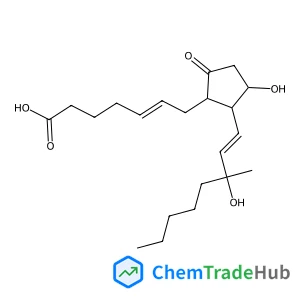
(5Z,11alpha,13E,15R)-11,15-Dihydroxy-15-methyl-9-oxoprosta-5,13-dien-1-oic acid
CAS Number:
55028-70-1
Molecular Formula:
C21H34O5
Dong Fan, Maoye Yin, Minghui Zhu, Hengshuai Li, Zhihao Wang, Haiquan Hu, Feng Guo, Zhenbao Feng, Jun Li, Xiaocheng Hu, Dong Zhang, Zhi Li
The electronic structure of g-C3N4/C2N-h2D nanoribbons was investigated by first-principles calculations. As a splice structure, we first computed the three magnetic coupled states of g-C3N4/C2N-h2D nanoribbons. After self-consistent calculations, both the antiferromagnetic and paramagnetic coupling states become ferromagnetic coupling states. It was proved that the ferromagnetic coupling state is the most stable state. Thermodynamic stability was subsequently verified based on the ferromagnetic coupling state. It had a steady electron spin polarization, with a magnetic moment of 1 μB for each primitive cell. It changed from a direct band-gap semiconductor to an indirect band-gap semiconductor and exhibited the properties of a narrow band gap semiconductor through the analysis of the energy band and charge density. To transform the electronic structure, we adsorbed different transition metals in g-C3N4/C2N-h2D nanoribbons. We investigated the electronic structure of g-C3N4/C2N-h2D nanoribbons adsorbed by different transition metals. It was shown that the electronic structure of g-C3N4/C2N-h2D nanoribbons could be regulated by the adsorption of different transition metal atoms. Moreover, the adsorption of Fe and Ni can generate a 100% polarized current in the Fermi surface, which will provide more application potential for spintronics devices.
Madeleine F. Dupont, Edwin Mayes, Kay Latham
DOI: 10.1039/C9CP04542B
Edoardo Buttarazzi, Francesco Rosi, Gianluca Ciancaleoni
DOI: 10.1039/C9CP03811F
M. Jotkar, L. Rongy, A. De Wit
DOI: 10.1039/C9CP03044A
DOI: 10.1039/C9CP03635K
E. Tangarife, A. H. Romero, J. Mejía-López
DOI: 10.1039/C9CP01927H
Ke Li, Shanlong Li, Lifen Liu, Wei Huang, Yuling Wang, Chunyang Yu, Yongfeng Zhou
DOI: 10.1039/C9CP03798E
Yuji Otsuki, Kazuya Watanabe, Yoshiyasu Matsumoto
DOI: 10.1039/C8CP07269H
Thomas Niemann
DOI: 10.1039/C9CP04337C
Ruth Prieto-Montero, Rebeca Sola-Llano, Raul Montero, Asier Longarte, Teresa Arbeloa, Iñigo López-Arbeloa, Virginia Martínez-Martínez, Sylvie Lacombe
DOI: 10.1039/C9CP03454D
Janne Soetbeer, Peter Gast, Joseph J. Walish, Yanchuan Zhao, Christy George, Chen Yang, Timothy M. Swager, Robert G. Griffin, Guinevere Mathies
DOI: 10.1039/D0CP90040K
When handling 2-Methyl-2-propanyl 5-amino-2-thiophenecarboxylate (CAS: 1498311-5...
5-Bromo-1,2-dichloro-3-fluorobenzene (CAS: 1000572-93-9) is a crystalline solid ...
(2R)-2-Amino-2-(4-bromophenyl)ethanol (CAS: 354153-64-3) should be stored in a c...
Methyl 4-(aminomethyl)tetrahydro-2H-pyran-4-carboxylate hydrochloride (CAS: 3627...
1,4-Dimethyl-1H-pyrazole-5-sulfonyl chloride is primarily used as an intermediat...
Dinaphtho[1,2-b:2',1'-d]furan is generally safe when handled with appropriate pe...
The market for 7-Methyl-7,9-dihydro-1H-purine-2,6,8(3H)-trione (CAS: 612-37-3) i...
2-(4-Chlorophenyl)malonaldehyde (CAS: 205676-17-1) is a colorless or light yello...
2-Methylchrysene (CAS: 3351-32-4) is typically synthesized via the reaction of c...
N-(6-aminopyrimidin-4-yl)acetamide (CAS: 89533-23-3) is generally considered saf...

Physical Chemistry Chemical Physics (PCCP) is an international journal co-owned by 19 physical chemistry and physics societies from around the world. This journal publishes original, cutting-edge research in physical chemistry, chemical physics and biophysical chemistry. To be suitable for publication in PCCP, articles must include significant innovation and/or insight into physical chemistry; this is the most important criterion that reviewers and Editors will judge against when evaluating submissions. The journal has a broad scope and welcomes contributions spanning experiment, theory, computation and data science. Topical coverage includes spectroscopy, dynamics, kinetics, statistical mechanics, thermodynamics, electrochemistry, catalysis, surface science, quantum mechanics, quantum computing and machine learning. Interdisciplinary research areas such as polymers and soft matter, materials, nanoscience, energy, surfaces/interfaces, and biophysical chemistry are welcomed if they demonstrate significant innovation and/or insight into physical chemistry. Joined experimental/theoretical studies are particularly appreciated when complementary and based on up-to-date approaches.