












High-performance Ruddlesden–Popper two-dimensional perovskite solar cells via solution processed inorganic charge transport layers
Literature Information
Publication Date
2022-06-07
DOI
10.1039/D2CP02033E
Impact Factor
3.676
Authors
Zhihai Liu, Lei Wang, Xiaoyin Xie, Chongyang Xu, Jianfeng Tang, Wei Li
View Original
Abstract
Two-dimensional (2D) layered halide perovskites have been shown to enable improved long-term stability in comparison to the well-known three-dimensional hybrid organic–inorganic halide perovskites. The optoelectronic properties of the 2D perovskites are strongly influenced by the chemical nature of the charge transport layer. In this work, we fabricated Ruddlesden–Popper 2D perovskite solar cells (PSCs) using solution processed inorganic NiOx and a C60 : C70 (1 : 1) mixture as the hole and electron transport layers, which significantly improved the performance of the 2D PSCs. Time resolved photoluminescence measurements indicate the shortened lifetime of excitons, which demonstrates the excellent charge extraction properties. The PSCs based on these inorganic charge transport materials (CTMs) exhibit an average power conversion efficiency (PCE) of 14.1%, which is higher than that (12.3%) of PSCs using organic CTMs of poly(3,4-ethylenedioxythiophene) : poly(styrenesulfonate) (PEDOT:PSS) and phenyl-C61-butyric acid methyl ester (PCBM). Compared with PEDOT:PSS and PCBM based cases, the PSCs using inorganic CTMs also show improved long-term stability, with the PCE degradation significantly suppressed from 20% to 12% after a measurement of 15 days. The best PSCs using NiOx and C60 : C70 show a high PCE of 14.4%, with a stable power output and negligible hysteresis.
Related Literature
Heteropolyacid-assisted fabrication of carbon nanostructures under ambient conditions
Enbo Wang
2008-12-15
Communication
DOI: 10.1039/B812573B
In situ antimony doping of solution-grown ZnOnanorods
Joe Briscoe, Diego E. Gallardo, Steve Dunn
2009-01-19
Communication
DOI: 10.1039/B820797F
Monoalkylation of primary amines and N-sulfinylamides
José Luis García Ruano, Alejandro Parra, José Alemán, Francisco Yuste, Virginia M. Mastranzo
2008-11-24
Communication
DOI: 10.1039/B816846F
Versatile, efficient derivatization of polysiloxanesvia click technology
Ferdinand Gonzaga, Gilbert Yu, Michael A. Brook
2009-02-05
Communication
DOI: 10.1039/B821788B
Reversible photoisomerisability and particle size changes of mill-dispersed azobenzene crystals in water
2009-01-27
Communication
DOI: 10.1039/B820022J
Novel ⊕N(←L)2 species with two lone pairs on nitrogen: systems isoelectronic to carbodicarbenes
Dhilon S. Patel, Prasad V. Bharatam
2009-01-05
Communication
DOI: 10.1039/B816595E
Polyester-graft-phosphorylcholine prepared by ring-opening polymerization and click chemistry
Beth M. Cooper, Delphine Chan-Seng, Debasis Samanta, Xiongfei Zhang, Sangram Parelkar, Todd Emrick
2008-12-17
Communication
DOI: 10.1039/B817600K
Microwave synthesis of Cr nanowires on polymeric substrate
Daeseob Shim, Seung-Ho Jung, Eun-Ha Kim, Dong-Myung Yoon, Kun-Hong Lee, Soo-Hwan Jeong
2008-12-24
Communication
DOI: 10.1039/B816534C
You might also like
Compound Q&A
What precautions should be taken when handling 2-Methyl-2-propanyl 5-amino-2-thiophenecarboxylate (CAS: 1498311-57-1)?
When handling 2-Methyl-2-propanyl 5-amino-2-thiophenecarboxylate (CAS: 1498311-5...
1498311-57-12-Methyl-2-propanyl ...
Compound Q&A
What are the physical and chemical properties of 5-Bromo-1,2-dichloro-3-fluorobenzene (CAS: 1000572-93-9)?
5-Bromo-1,2-dichloro-3-fluorobenzene (CAS: 1000572-93-9) is a crystalline solid ...
1000572-93-95-Bromo-1,2-dichloro...
Compound Q&A
How should (2R)-2-Amino-2-(4-bromophenyl)ethanol (CAS: 354153-64-3) be stored?
(2R)-2-Amino-2-(4-bromophenyl)ethanol (CAS: 354153-64-3) should be stored in a c...
354153-64-3(2R)-2-Amino-2-(4-br...
Compound Q&A
What regulatory guidelines apply to Methyl 4-(aminomethyl)tetrahydro-2H-pyran-4-carboxylate hydrochloride (CAS: 362707-24-2)?
Methyl 4-(aminomethyl)tetrahydro-2H-pyran-4-carboxylate hydrochloride (CAS: 3627...
362707-24-2Methyl 4-(aminomethy...
Compound Q&A
What are the main uses of 1,4-dimethyl-1H-pyrazole-5-sulfonyl chloride (CAS: 1174834-52-6)?
1,4-Dimethyl-1H-pyrazole-5-sulfonyl chloride is primarily used as an intermediat...
1174834-52-61,4-dimethyl-1H-pyra...
Compound Q&A
Is Dinaphtho[1,2-b:2',1'-d]furan (CAS: 239-69-0) safe?
Dinaphtho[1,2-b:2',1'-d]furan is generally safe when handled with appropriate pe...
239-69-0Dinaphtho[1,2-b:2',1...
Compound Q&A
What is the market or research trend for 7-Methyl-7,9-dihydro-1H-purine-2,6,8(3H)-trione (CAS: 612-37-3)?
The market for 7-Methyl-7,9-dihydro-1H-purine-2,6,8(3H)-trione (CAS: 612-37-3) i...
612-37-37-Methyl-7,9-dihydro...
Compound Q&A
What are the physical and chemical properties of 2-(4-Chlorophenyl)malonaldehyde (CAS: 205676-17-1)?
2-(4-Chlorophenyl)malonaldehyde (CAS: 205676-17-1) is a colorless or light yello...
205676-17-12-(4-Chlorophenyl)ma...
Compound Q&A
How is 2-Methylchrysene (CAS: 3351-32-4) typically synthesized?
2-Methylchrysene (CAS: 3351-32-4) is typically synthesized via the reaction of c...
3351-32-42-Methylchrysene
Compound Q&A
Is N-(6-aminopyrimidin-4-yl)acetamide (CAS: 89533-23-3) safe?
N-(6-aminopyrimidin-4-yl)acetamide (CAS: 89533-23-3) is generally considered saf...
89533-23-3N-(6-aminopyrimidin-...
Source Journal
Physical Chemistry Chemical Physics

CiteScore:
5.5
Self-citation Rate:
10.3%
Articles per Year:
3036
Physical Chemistry Chemical Physics (PCCP) is an international journal co-owned by 19 physical chemistry and physics societies from around the world. This journal publishes original, cutting-edge research in physical chemistry, chemical physics and biophysical chemistry. To be suitable for publication in PCCP, articles must include significant innovation and/or insight into physical chemistry; this is the most important criterion that reviewers and Editors will judge against when evaluating submissions. The journal has a broad scope and welcomes contributions spanning experiment, theory, computation and data science. Topical coverage includes spectroscopy, dynamics, kinetics, statistical mechanics, thermodynamics, electrochemistry, catalysis, surface science, quantum mechanics, quantum computing and machine learning. Interdisciplinary research areas such as polymers and soft matter, materials, nanoscience, energy, surfaces/interfaces, and biophysical chemistry are welcomed if they demonstrate significant innovation and/or insight into physical chemistry. Joined experimental/theoretical studies are particularly appreciated when complementary and based on up-to-date approaches.
Recommended Compounds
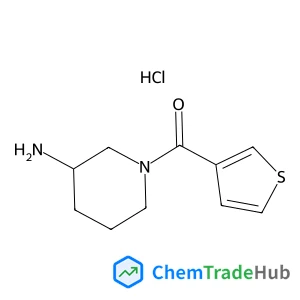
(3-Amino-piperidin-1-yl)-thiophen-3-yl-methanone hydrochloride
CAS Number:
1185316-70-4
Molecular Formula:
C10H15ClN2OS
![1-Oxa-8-azaspiro[4.5]decan-3-ol structure](https://static.chemtradehub.com/structs/757/757239-76-2-a0ec.webp "1-Oxa-8-azaspiro[4.5]decan-3-ol structure")
![2-Bromo-7-chloro-4H-pyrrolo[2,3-b]pyrazine structure](https://static.chemtradehub.com/structs/115/1150617-58-5-0b0a.webp "2-Bromo-7-chloro-4H-pyrrolo[2,3-b]pyrazine structure")
Recommended Suppliers






Disclaimer
This page provides academic journal information for reference and research purposes only. We are not affiliated with any journal publishers and do not handle publication submissions. For publication-related inquiries, please contact the respective journal publishers directly.
If you notice any inaccuracies in the information displayed, please contact us at support@chemtradehub.com. We will promptly review and address your concerns.