













Vacancy-induced high activity of MoS2 monolayers for CO electroreduction: a computational study
Literature Information
Publication Date
2021-08-18
DOI
10.1039/D1SE00988E
Impact Factor
6.367
Authors
Dongxu Jiao, Yu Tian, Yuejie Liu, Jingxiang Zhao
View Original
Abstract
The electroreduction of CO (COER) to valuable carbon-based chemicals is an attractive alternative to the traditional Fischer–Tropsch process, in which the development of electrocatalysts with high activity and high selectivity still remains a huge challenge. Herein, by means of density functional theory (DFT) computations, we systematically explored the potential of defective MoS2 monolayers with sulfur vacancies, including mono-sulfur (VS), di-sulfur (VS2 and V2S), and tri-sulfur (V3S), as COER electrocatalysts. Our results revealed that these defective MoS2-based candidates exhibit low formation energies and high stability, holding great promise for experimental synthesis and practical applications. In particular, according to the computed free energy changes, we found that the catalytic activity of these considered defective MoS2 monolayers for COER is highly dependent on the size of sulfur vacancies in MoS2 monolayers, among which V3S exhibits the best COER catalytic performance, and CH4 is identified as the main product. Interestingly, the difference between the adsorption strength of *CH2 and *CH3 species can be used as a rational descriptor to evaluate the COER catalytic activity of these defective MoS2 monolayers. Thus, controlling the size of S-vacancies can make MoS2 monolayers a promising electrocatalyst for COER, which not only further widens the potential of MoS2 monolayers in electrocatalysis, but also opens a new door for CO reduction for renewable energy supply.
Recommended Journals
Related Literature
Disappearance of oscillations in the Brusselator on the mesoscopic scale
2001-03-14
Paper
DOI: 10.1039/B100192M
Symmetric binary polymer blends confined in thin films between competing walls: Interplay between finite size and wetting behavior
E. V. Albano
2001-02-13
Paper
DOI: 10.1039/B008627O
High frequency EPR investigations of gadolinium(III)-doped strontium aluminates
T. Nakamura, K. Kaiya, N. Takahashi, T. Matsuzawa, M. Ohta, C. C. Rowlands, G. M. Smith, P. C. Riedi
2001-01-22
Paper
DOI: 10.1039/B008251L
Phthalocyanines: structure and vibrations
Daniel R. Tackley, Geoffrey Dent, W. Ewen Smith
2001-03-14
Paper
DOI: 10.1039/B007763L
Dynamics of the OH( = 1,2,4) + O3 atmospheric reaction
L. Zhang, A. J. C. Varandas
2001-03-20
Paper
DOI: 10.1039/B010149O
Atomistic simulation and molecular dynamics of model systems for perfluorinated ionomer membranes
Paper
DOI: 10.1039/A905267D
You might also like
Compound Q&A
What are the main uses of (3.beta.)-3-Hydroxy-N,N-dimethyl-chol-5-en-24-amide (CAS: 79066-03-8)?
(3.beta.)-3-Hydroxy-N,N-dimethyl-chol-5-en-24-amide (CAS: 79066-03-8) is primari...
79066-03-8(3.beta.)-3-Hydroxy-...
Compound Q&A
What regulatory guidelines apply to 5-(aminomethyl)-2-methoxyphenol (CAS: 89702-89-6)?
5-(Aminomethyl)-2-methoxyphenol (CAS: 89702-89-6) is classified under GHS as a s...
89702-89-65-(aminomethyl)-2-me...
Compound Q&A
What is Thieno[2,3-c]pyridin-7(6H)-one (CAS: 28981-13-7)?
Thieno[2,3-c]pyridin-7(6H)-one (CAS: 28981-13-7) is a heterocyclic organic compo...
28981-13-7Thieno[2,3-c]pyridin...
Compound Q&A
Is 1-[(6-Methoxy-3-pyridinyl)methyl]-4-piperidinamine dihydrochloride (CAS: 1185311-28-7) safe?
1-[(6-Methoxy-3-pyridinyl)methyl]-4-piperidinamine dihydrochloride is generally ...
1185311-28-71-[(6-Methoxy-3-pyri...
Compound Q&A
What regulatory guidelines apply to [(2E)-3-Phenyl-2-propen-1-yl]phosphonic acid (CAS: 146404-58-2)?
[(2E)-3-Phenyl-2-propen-1-yl]phosphonic acid (CAS: 146404-58-2) is regulated und...
146404-58-2[(2E)-3-Phenyl-2-pro...
Compound Q&A
What regulatory guidelines apply to 6-Bromo-7-methoxyquinoline (CAS: 1620515-86-7)?
6-Bromo-7-methoxyquinoline (CAS: 1620515-86-7) falls under the scope of the Glob...
1620515-86-76-Bromo-7-methoxyqui...
Compound Q&A
What industries use (2R)-1-(1-Benzofuran-2-yl)-N-propyl-2-pentanamine (CAS: 260550-89-8)?
This compound is primarily used in the pharmaceutical industry for the developme...
260550-89-8(2R)-1-(1-Benzofuran...
Compound Q&A
What are the main uses of 1-Ethyl-7-[2-methyl-6-(4H-1,2,4-triazol-3-yl)-3-pyridinyl]-3,5-dihydropyrazino[2,3-b]pyrazin-2(1H)-one (CAS: 1228013-15-7)?
1-Ethyl-7-[2-methyl-6-(4H-1,2,4-triazol-3-yl)-3-pyridinyl]-3,5-dihydropyrazino[2...
1228013-15-71-Ethyl-7-[2-methyl-...
Compound Q&A
Are there alternatives to {5-(Acryloylamino)-2-[(dimethylamino)methyl]phenyl}boronic acid (CAS: 1217500-78-1) in synthesis?
Alternative reagents such as 2-[(dimethylamino)methyl]phenylboronic acid or rela...
1217500-78-1{5-(Acryloylamino)-2...
Compound Q&A
What is 3-(Piperidin-4-yloxy)pyridine (CAS: 310881-48-2)?
3-(Piperidin-4-yloxy)pyridine (CAS: 310881-48-2) is an organic compound with the...
310881-48-23-(Piperidin-4-yloxy...
Source Journal
Recommended Compounds
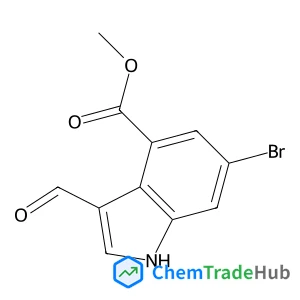
methyl 6-bromo-3-formyl-1H-indole-4-carboxylate
CAS Number:
1353636-63-1
Molecular Formula:
C11H8BrNO3
![N-[(6-Bromo-3-pyridinyl)methyl]ethanamine structure](https://static.chemtradehub.com/structs/120/120740-05-8-ca55.webp "N-[(6-Bromo-3-pyridinyl)methyl]ethanamine structure")
Recommended Suppliers






Disclaimer
This page provides academic journal information for reference and research purposes only. We are not affiliated with any journal publishers and do not handle publication submissions. For publication-related inquiries, please contact the respective journal publishers directly.
If you notice any inaccuracies in the information displayed, please contact us at support@chemtradehub.com. We will promptly review and address your concerns.