













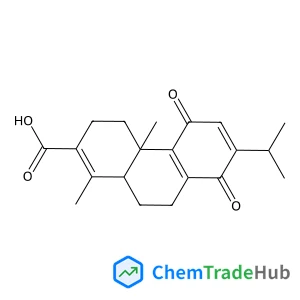
(4aS,10aS)-7-Isopropyl-1,4a-dimethyl-5,8-dioxo-3,4,4a,5,8,9,10,10a-octahydro-2-phenanthrenecarboxylic acid
CAS Number:
142950-86-5
Molecular Formula:
C20H24O4
A photocatalyst foam is developed by growing high-density CdS microspheres on Ni2P nanolayer-modified Ni foam (NF) (termed CdS/NF–P) for efficient visible-light-driven photocatalytic H2 evolution. The in situ grown Ni2P thin layer on NF not only provides a large number of anchoring sites for the growth of high-density CdS microspheres for enhancing the visible light capture ability, but also offers active sites for catalyzing the H2 evolution reaction (HER). Meanwhile, the multiple heterojunction interfaces formed among NF, Ni2P, and CdS can greatly promote the separation of photogenerated electrons and holes. As a consequence, the CdS/NF–P photocatalyst foam exhibits good photocatalytic H2 evolution activity under visible light irradiation. The H2 evolution rate reaches 4.82 mmol h−1 gCdS−1 over the best CdS/NF–P photocatalyst foam, which is about five times that of CdS particles suspended in the reaction solution. More attractively, the photocatalyst foam can be easily recovered and recycled in the reaction solution by simple magnetic separation. In addition, the structural integrity makes the photocatalyst foam highly stable in the photocatalytic HER for 35 h. This work provides a new strategy for the design of efficient and practical photocatalyst foams that are easy to prepare on a large scale and compatible with device manufacturing for large-scale photochemical energy conversion.
DOI: 10.1039/B008247N
DOI: 10.1039/A906437K
Gauthier Vanhaelewyn, Philippe Lahorte, Frank De Proft, Wim Mondelaers, Paul Geerlings, Freddy Callens
DOI: 10.1039/B008248L
Thomas Bräuniger, Raphy Poupko, Zeev Luz, Detlef Reichert, Herbert Zimmermann, Heike Schmitt, Ulrich Haeberlen
DOI: 10.1039/B008999K
DOI: 10.1039/B100238O
Matthew R. Bockman, Rishad J. Dalal, Ramya Kumar, Theresa M. Reineke
DOI: 10.1039/D1PY00250C
(3.beta.)-3-Hydroxy-N,N-dimethyl-chol-5-en-24-amide (CAS: 79066-03-8) is primari...
5-(Aminomethyl)-2-methoxyphenol (CAS: 89702-89-6) is classified under GHS as a s...
Thieno[2,3-c]pyridin-7(6H)-one (CAS: 28981-13-7) is a heterocyclic organic compo...
1-[(6-Methoxy-3-pyridinyl)methyl]-4-piperidinamine dihydrochloride is generally ...
[(2E)-3-Phenyl-2-propen-1-yl]phosphonic acid (CAS: 146404-58-2) is regulated und...
6-Bromo-7-methoxyquinoline (CAS: 1620515-86-7) falls under the scope of the Glob...
This compound is primarily used in the pharmaceutical industry for the developme...
1-Ethyl-7-[2-methyl-6-(4H-1,2,4-triazol-3-yl)-3-pyridinyl]-3,5-dihydropyrazino[2...
Alternative reagents such as 2-[(dimethylamino)methyl]phenylboronic acid or rela...
3-(Piperidin-4-yloxy)pyridine (CAS: 310881-48-2) is an organic compound with the...
![5,7-Dihydroxy-3-(4-hydroxyphenyl)-6-[(1R,6R)-3-methyl-6-prop-1-en-2-ylcyclohex-2-en-1-yl]chromen-4-one structure](https://static.chemtradehub.com/structs/191/1914963-20-4-2b05.webp "5,7-Dihydroxy-3-(4-hydroxyphenyl)-6-[(1R,6R)-3-methyl-6-prop-1-en-2-ylcyclohex-2-en-1-yl]chromen-4-one structure")
![(3E)-3-[4-Hydroxy-3,5-bis(2-methyl-2-propanyl)benzylidene]dihydro-2(3H)-furanone structure](https://static.chemtradehub.com/structs/102/102271-49-8-cba7.webp "(3E)-3-[4-Hydroxy-3,5-bis(2-methyl-2-propanyl)benzylidene]dihydro-2(3H)-furanone structure")




