













Synthesis of tailored oxymethylene ether (OME) fuels via transacetalization reactions
Literature Information
Publication Date
2021-07-23
DOI
10.1039/D1SE00631B
Impact Factor
6.367
Authors
Marius Drexler, Philipp Haltenort, Thomas A. Zevaco, Ulrich Arnold, Jörg Sauer
View Original
Abstract
In the field of alternative diesel fuels, so-called oxymethylene ethers (OMEs) are currently intensely investigated. Particularly OMEs of the type CH3O(CH2O)nCH3 with n = 3–5 exhibit promising fuel properties and combustion characteristics with strongly reduced particle and NOx emissions. According to their molecular structure, OMEs can be produced from methanol thus enabling sustainable production strategies from CO2 and renewable resources. Compared to the methyl derivatives, analogous compounds with higher alkyl groups (oxymethylene dialkyl ethers, OMDAEs) have been investigated to a much lesser extent. Thus, commercially available OMDAEs, i.e. compounds of the type ROCH2OR bearing ethyl, propyl, butyl and 2-ethylhexyl groups, have been studied. Furthermore, asymmetric compounds of the type R1OCH2OR2 have been synthesized from the symmetric compounds employing transacetalization reactions catalyzed by zeolite BEA-25. The OMDAEs have been characterized by spectroscopic and spectrometric methods and several physico-chemical, thermodynamic and fuel-related data have been determined and compared. Despite their structural peculiarities, such as the oxygen-containing acetal moiety in the molecular backbone, all OMDAEs exhibit properties similar to conventional diesel fuels. Based on experimental and analytical data, the development of tools for the prediction of properties by a simple regression method is described. Furthermore, the suitability of group contribution modelling is investigated for OMDAE compounds.
Recommended Journals
Related Literature
The structure of molten mixtures of iron(III) chloride with caesium chloride
Paper
DOI: 10.1039/A905655F
The energetically favorable cis peptide bond for the azaglycine-containing peptide: For-AzGly-NH2 model
Ho-Jin Lee, Jong-Won Song, Young-Sang Choi, Seonggu Ro, Chang-Ju Yoon
2001-04-04
Paper
DOI: 10.1039/B009651M
Molecular oxygen interaction with Bi2O3 : a spectroscopic and spectromagnetic investigation
Davide Barreca, Franca Morazzoni, Gian Andrea Rizzi, Roberto Scotti, Eugenio Tondello
2001-03-29
Paper
DOI: 10.1039/B009482J
MgO(100) surface relaxation and vacancy defects: a semi-empirical quantum-chemical study
Paper
DOI: 10.1039/A906046D
The oxidation of ascorbate at poly(aniline)–poly(vinylsulfonate) composite coated electrodes
2001-03-15
Paper
DOI: 10.1039/B009377G
Incorporation of magnesium in mesostructured and mesoporous aluminophosphates
2001-03-14
Paper
DOI: 10.1039/B010029N
Melting and freezing of water in ordered mesoporous silica materials
Andreas Schreiber, Ingke Ketelsen, Gerhard H. Findenegg
2001-03-08
Paper
DOI: 10.1039/B010086M
You might also like
Compound Q&A
What are the main uses of (3.beta.)-3-Hydroxy-N,N-dimethyl-chol-5-en-24-amide (CAS: 79066-03-8)?
(3.beta.)-3-Hydroxy-N,N-dimethyl-chol-5-en-24-amide (CAS: 79066-03-8) is primari...
79066-03-8(3.beta.)-3-Hydroxy-...
Compound Q&A
What regulatory guidelines apply to 5-(aminomethyl)-2-methoxyphenol (CAS: 89702-89-6)?
5-(Aminomethyl)-2-methoxyphenol (CAS: 89702-89-6) is classified under GHS as a s...
89702-89-65-(aminomethyl)-2-me...
Compound Q&A
What is Thieno[2,3-c]pyridin-7(6H)-one (CAS: 28981-13-7)?
Thieno[2,3-c]pyridin-7(6H)-one (CAS: 28981-13-7) is a heterocyclic organic compo...
28981-13-7Thieno[2,3-c]pyridin...
Compound Q&A
Is 1-[(6-Methoxy-3-pyridinyl)methyl]-4-piperidinamine dihydrochloride (CAS: 1185311-28-7) safe?
1-[(6-Methoxy-3-pyridinyl)methyl]-4-piperidinamine dihydrochloride is generally ...
1185311-28-71-[(6-Methoxy-3-pyri...
Compound Q&A
What regulatory guidelines apply to [(2E)-3-Phenyl-2-propen-1-yl]phosphonic acid (CAS: 146404-58-2)?
[(2E)-3-Phenyl-2-propen-1-yl]phosphonic acid (CAS: 146404-58-2) is regulated und...
146404-58-2[(2E)-3-Phenyl-2-pro...
Compound Q&A
What regulatory guidelines apply to 6-Bromo-7-methoxyquinoline (CAS: 1620515-86-7)?
6-Bromo-7-methoxyquinoline (CAS: 1620515-86-7) falls under the scope of the Glob...
1620515-86-76-Bromo-7-methoxyqui...
Compound Q&A
What industries use (2R)-1-(1-Benzofuran-2-yl)-N-propyl-2-pentanamine (CAS: 260550-89-8)?
This compound is primarily used in the pharmaceutical industry for the developme...
260550-89-8(2R)-1-(1-Benzofuran...
Compound Q&A
What are the main uses of 1-Ethyl-7-[2-methyl-6-(4H-1,2,4-triazol-3-yl)-3-pyridinyl]-3,5-dihydropyrazino[2,3-b]pyrazin-2(1H)-one (CAS: 1228013-15-7)?
1-Ethyl-7-[2-methyl-6-(4H-1,2,4-triazol-3-yl)-3-pyridinyl]-3,5-dihydropyrazino[2...
1228013-15-71-Ethyl-7-[2-methyl-...
Compound Q&A
Are there alternatives to {5-(Acryloylamino)-2-[(dimethylamino)methyl]phenyl}boronic acid (CAS: 1217500-78-1) in synthesis?
Alternative reagents such as 2-[(dimethylamino)methyl]phenylboronic acid or rela...
1217500-78-1{5-(Acryloylamino)-2...
Compound Q&A
What is 3-(Piperidin-4-yloxy)pyridine (CAS: 310881-48-2)?
3-(Piperidin-4-yloxy)pyridine (CAS: 310881-48-2) is an organic compound with the...
310881-48-23-(Piperidin-4-yloxy...
Source Journal
Recommended Compounds
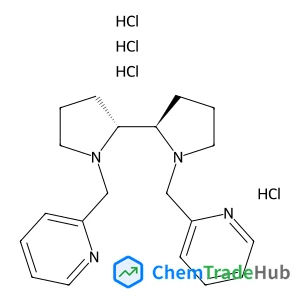
(2R,2'R)-1,1'-Bis(2-pyridinylmethyl)-2,2'-bipyrrolidine tetrahydrochloride
CAS Number:
1228077-88-0
Molecular Formula:
C20H30Cl4N4
![N-[4-(Cyanoethynyl)phenyl]-16-oxo-4,7,10,13-tetraoxa-17-azahenicos-1-yn-21-amide structure](https://static.chemtradehub.com/structs/218/2183440-36-8-68cb.webp "N-[4-(Cyanoethynyl)phenyl]-16-oxo-4,7,10,13-tetraoxa-17-azahenicos-1-yn-21-amide structure")
N-[4-(Cyanoethynyl)phenyl]-16-oxo-4,7,10,13-tetraoxa-17-azahenicos-1-yn-21-amide
CAS Number:
2183440-36-8
Molecular Formula:
C25H31N3O6
![4-[(4-Bromophenyl)sulfonyl]thiomorpholine structure](https://static.chemtradehub.com/structs/223/223555-81-5-2d67.webp "4-[(4-Bromophenyl)sulfonyl]thiomorpholine structure")
Recommended Suppliers





Disclaimer
This page provides academic journal information for reference and research purposes only. We are not affiliated with any journal publishers and do not handle publication submissions. For publication-related inquiries, please contact the respective journal publishers directly.
If you notice any inaccuracies in the information displayed, please contact us at support@chemtradehub.com. We will promptly review and address your concerns.