




NiO/ZrO2 nanocomposites as photocathodes of tandem DSCs with higher photoconversion efficiency with respect to parent single-photoelectrode p-DSCs‡
Literature Information
Publication Date
2021-08-20
DOI
10.1039/D1SE00566A
Impact Factor
6.367
Authors
Emmanuel J. Ekoi, Andrea G. Marrani, Ana Y. Segura Zarate, Denis P. Dowling, Danilo Dini
View Original
Abstract
The nanocomposites of nickel oxide (NiO) and zirconia (ZrO2) (NZNCs) are particularly effective photocathodic materials in p-type dye-sensitized solar cells (p-DSCs) and tandem DSCs (t-DSCs). The t-DSCs obtained from P1-sensitized NZNC as photocathode and nanostructured titania (TiO2) sensitized with squaraine VG10-C8 as photoanode display overall efficiencies of ca. 2% at their best and, more importantly, produced photocurrents that surpassed systematically the values obtained from the parent devices having one photoelectrochemical interface. Such a finding is a consequence of the diminished resistance of the electrolyte the thickness of which is systematically smaller in t-DSCs with respect to parent DSCs with a single photoelectrochemical junction and same interelectrodic separation. The results here reported demonstrate that a careful combination of photoelectroactive electrodes can lead to an increase in current density of more than 15% in the t-DSC with respect to single-junction DSCs employing the same photoelectrodes provided that the whole thickness of the t-DSC is the same as in the single photoelectrode DSC and the photoelectrodes in the t-DSC do not incur in short-circuit phenomena through the electrolyte. For the successful realization of t-DSCs another important aspect is the complementarity of the absorption properties of the chosen colorants with the sensitized electrodes having similar absorbance in their respective ranges of optical absorption. The latter condition in t-DSCs makes possible the achievement of photoactivity spectra with a uniform efficiency of conversion in the whole visible range. For the attainment of efficient t-DSCs the two different photoelectrodes from parent DSCs (i.e. the devices at a single photoeletrochemical interface), should generate anodic and cathodic photocurrent densities with very similar values. Such a matching of photocurrents requires a careful selection of the thickness values for the photoelectrodes especially in case of materials with considerably different characteristics of charge injection. The approach here considered is a promising one for the assembly of quasi-transparent photoelectrochemical tandem devices operating as smart windows that convert light into electrical power.
Recommended Journals

Journal of the Indian Institute of Science

Critical Reviews in Solid State and Materials Sciences

NDT & E International

Electroanalysis

Chinese Journal of Chemistry

Journal of Asian Natural Products Research

Biocatalysis and Biotransformation

Polycyclic Aromatic Compounds

Medicinal Chemistry Research

Herald of the Russian Academy of Sciences
Related Literature
Thermodynamic derivation of mechanical expressions for interfacial parameters
Paper
DOI: 10.1039/A906437K
Solution self-assembly of fluorinated polymers, an overview
Marc Guerre, Gérald Lopez, Bruno Améduri, Mona Semsarilar, Vincent Ladmiral
2021-05-25
Review Article
DOI: 10.1039/D1PY00221J
Role of hysteresis in the molecular picture of friction
D. J. Diestler, G. T. Gao, X. C. Zeng
2001-02-09
Paper
DOI: 10.1039/B007772K
Synthesis of core-crosslinked star polymers via organocatalyzed living radical polymerization
Yichao Zheng, Jit Sarkar, Hiroshi Niino, Shunsuke Chatani, Shu Yao Hsu, Atsushi Goto
2021-07-05
Paper
DOI: 10.1039/D1PY00663K
Complexation behaviour of p-tert-butylcalix[4]arene and p-tert-butylcalix[6]arene towards acetone
Francesca Benevelli, Waclaw Kolodziejski, Krzysztof Wozniak, Jacek Klinowski
2001-04-05
Paper
DOI: 10.1039/B100894N
Electronic spectra of linear isoelectronic species HC6H+, C6H, HC5N+
Sigrid D. Peyerimhoff
2001-03-19
Paper
DOI: 10.1039/B009604K
Role of potassium added to Ce/NaZSM-5 catalyst in partial oxidation activity of benzyl alcohol
Nao Idaka, Satoru Nishiyama, Shigeru Tsuruya
2001-04-11
Paper
DOI: 10.1039/B008093O
You might also like
Compound Q&A
What are the main uses of (3.beta.)-3-Hydroxy-N,N-dimethyl-chol-5-en-24-amide (CAS: 79066-03-8)?
(3.beta.)-3-Hydroxy-N,N-dimethyl-chol-5-en-24-amide (CAS: 79066-03-8) is primari...
79066-03-8(3.beta.)-3-Hydroxy-...
Compound Q&A
What regulatory guidelines apply to 5-(aminomethyl)-2-methoxyphenol (CAS: 89702-89-6)?
5-(Aminomethyl)-2-methoxyphenol (CAS: 89702-89-6) is classified under GHS as a s...
89702-89-65-(aminomethyl)-2-me...
Compound Q&A
What is Thieno[2,3-c]pyridin-7(6H)-one (CAS: 28981-13-7)?
Thieno[2,3-c]pyridin-7(6H)-one (CAS: 28981-13-7) is a heterocyclic organic compo...
28981-13-7Thieno[2,3-c]pyridin...
Compound Q&A
Is 1-[(6-Methoxy-3-pyridinyl)methyl]-4-piperidinamine dihydrochloride (CAS: 1185311-28-7) safe?
1-[(6-Methoxy-3-pyridinyl)methyl]-4-piperidinamine dihydrochloride is generally ...
1185311-28-71-[(6-Methoxy-3-pyri...
Compound Q&A
What regulatory guidelines apply to [(2E)-3-Phenyl-2-propen-1-yl]phosphonic acid (CAS: 146404-58-2)?
[(2E)-3-Phenyl-2-propen-1-yl]phosphonic acid (CAS: 146404-58-2) is regulated und...
146404-58-2[(2E)-3-Phenyl-2-pro...
Compound Q&A
What regulatory guidelines apply to 6-Bromo-7-methoxyquinoline (CAS: 1620515-86-7)?
6-Bromo-7-methoxyquinoline (CAS: 1620515-86-7) falls under the scope of the Glob...
1620515-86-76-Bromo-7-methoxyqui...
Compound Q&A
What industries use (2R)-1-(1-Benzofuran-2-yl)-N-propyl-2-pentanamine (CAS: 260550-89-8)?
This compound is primarily used in the pharmaceutical industry for the developme...
260550-89-8(2R)-1-(1-Benzofuran...
Compound Q&A
What are the main uses of 1-Ethyl-7-[2-methyl-6-(4H-1,2,4-triazol-3-yl)-3-pyridinyl]-3,5-dihydropyrazino[2,3-b]pyrazin-2(1H)-one (CAS: 1228013-15-7)?
1-Ethyl-7-[2-methyl-6-(4H-1,2,4-triazol-3-yl)-3-pyridinyl]-3,5-dihydropyrazino[2...
1228013-15-71-Ethyl-7-[2-methyl-...
Compound Q&A
Are there alternatives to {5-(Acryloylamino)-2-[(dimethylamino)methyl]phenyl}boronic acid (CAS: 1217500-78-1) in synthesis?
Alternative reagents such as 2-[(dimethylamino)methyl]phenylboronic acid or rela...
1217500-78-1{5-(Acryloylamino)-2...
Compound Q&A
What is 3-(Piperidin-4-yloxy)pyridine (CAS: 310881-48-2)?
3-(Piperidin-4-yloxy)pyridine (CAS: 310881-48-2) is an organic compound with the...
310881-48-23-(Piperidin-4-yloxy...
Source Journal
Recommended Compounds

![7-Bromo-5-chloro-1H-pyrazolo[4,3-b]pyridine structure](https://static.chemtradehub.com/structs/135/1351813-70-1-a716.webp "7-Bromo-5-chloro-1H-pyrazolo[4,3-b]pyridine structure")
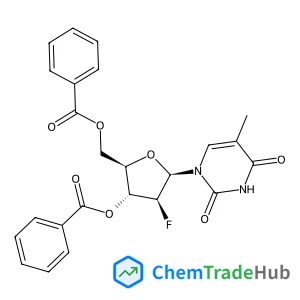
1-(3',5'-Di-O-benzoyl-2'-deoxy-2'-fluoro-b-D-arabinofuranosyl)thymine
CAS Number:
97614-47-6
Molecular Formula:
C24H21FN2O7
Recommended Suppliers






Disclaimer
This page provides academic journal information for reference and research purposes only. We are not affiliated with any journal publishers and do not handle publication submissions. For publication-related inquiries, please contact the respective journal publishers directly.
If you notice any inaccuracies in the information displayed, please contact us at support@chemtradehub.com. We will promptly review and address your concerns.