













Pilot-scale hydrotreating of catalytic fast pyrolysis biocrudes: process performance and product analysis
Literature Information
Publication Date
2021-08-12
DOI
10.1039/D1SE00540E
Impact Factor
6.367
Authors
Sylvain Verdier, Ofei D. Mante, Asger B. Hansen, Kristoffer G. Poulsen, Jan H. Christensen, Nadia Ammtizboll, Jostein Gabrielsen, David C. Dayton
View Original
Abstract
Catalytic fast pyrolysis (CFP) is a technology option for producing advanced biofuels from hydrocarbon-rich biocrude intermediates. The relatively high oxygen content of biocrudes compared to petroleum intermediates increases hydrogen consumption and the lower thermal stability accelerates catalyst deactivation and reactor fouling hindering the adaptation of hydrotreating technology for biocrude upgrading into biofuels. In this study, four chemically different biocrude feeds were upgraded in a pilot scale hydroprocessing unit at similar process conditions using a commercial hydrodeoxygenation (HDO) catalyst. The biocrude feeds and hydrotreated products were characterized using standard ASTM procedures and advanced analytical techniques (GCxGC-FID and GCxGC-MS). HDO catalyst activity was monitored by changes in physical properties and chemical composition of the upgraded products as a function of time on stream. Aliphatic acids, ketones, aldehydes, and furan derivatives were completely converted during the hydrotreating tests while the concentration of aromatics, aliphatic hydrocarbons and phenolics increased during the hydrotreating tests. The oxygen content, nitrogen content, specific gravity, viscosity and the heavy end of the boiling point range (determined by simulated distillation) of the upgraded products increased with increasing time on stream during hydrotreating. The deactivation rate was the lowest for the biocrude feed that contained the most aliphatic and aromatic hydrocarbons and was the highest for the biocrude feed that had the most anhydrosugars. Overall, the HDO deactivation rate correlates with the total amount of oxygen in the feed (17 wt% to 29 wt%, on a wet basis).
Related Literature
You might also like
Compound Q&A
What are the main uses of (3.beta.)-3-Hydroxy-N,N-dimethyl-chol-5-en-24-amide (CAS: 79066-03-8)?
(3.beta.)-3-Hydroxy-N,N-dimethyl-chol-5-en-24-amide (CAS: 79066-03-8) is primari...
79066-03-8(3.beta.)-3-Hydroxy-...
Compound Q&A
What regulatory guidelines apply to 5-(aminomethyl)-2-methoxyphenol (CAS: 89702-89-6)?
5-(Aminomethyl)-2-methoxyphenol (CAS: 89702-89-6) is classified under GHS as a s...
89702-89-65-(aminomethyl)-2-me...
Compound Q&A
What is Thieno[2,3-c]pyridin-7(6H)-one (CAS: 28981-13-7)?
Thieno[2,3-c]pyridin-7(6H)-one (CAS: 28981-13-7) is a heterocyclic organic compo...
28981-13-7Thieno[2,3-c]pyridin...
Compound Q&A
Is 1-[(6-Methoxy-3-pyridinyl)methyl]-4-piperidinamine dihydrochloride (CAS: 1185311-28-7) safe?
1-[(6-Methoxy-3-pyridinyl)methyl]-4-piperidinamine dihydrochloride is generally ...
1185311-28-71-[(6-Methoxy-3-pyri...
Compound Q&A
What regulatory guidelines apply to [(2E)-3-Phenyl-2-propen-1-yl]phosphonic acid (CAS: 146404-58-2)?
[(2E)-3-Phenyl-2-propen-1-yl]phosphonic acid (CAS: 146404-58-2) is regulated und...
146404-58-2[(2E)-3-Phenyl-2-pro...
Compound Q&A
What regulatory guidelines apply to 6-Bromo-7-methoxyquinoline (CAS: 1620515-86-7)?
6-Bromo-7-methoxyquinoline (CAS: 1620515-86-7) falls under the scope of the Glob...
1620515-86-76-Bromo-7-methoxyqui...
Compound Q&A
What industries use (2R)-1-(1-Benzofuran-2-yl)-N-propyl-2-pentanamine (CAS: 260550-89-8)?
This compound is primarily used in the pharmaceutical industry for the developme...
260550-89-8(2R)-1-(1-Benzofuran...
Compound Q&A
What are the main uses of 1-Ethyl-7-[2-methyl-6-(4H-1,2,4-triazol-3-yl)-3-pyridinyl]-3,5-dihydropyrazino[2,3-b]pyrazin-2(1H)-one (CAS: 1228013-15-7)?
1-Ethyl-7-[2-methyl-6-(4H-1,2,4-triazol-3-yl)-3-pyridinyl]-3,5-dihydropyrazino[2...
1228013-15-71-Ethyl-7-[2-methyl-...
Compound Q&A
Are there alternatives to {5-(Acryloylamino)-2-[(dimethylamino)methyl]phenyl}boronic acid (CAS: 1217500-78-1) in synthesis?
Alternative reagents such as 2-[(dimethylamino)methyl]phenylboronic acid or rela...
1217500-78-1{5-(Acryloylamino)-2...
Compound Q&A
What is 3-(Piperidin-4-yloxy)pyridine (CAS: 310881-48-2)?
3-(Piperidin-4-yloxy)pyridine (CAS: 310881-48-2) is an organic compound with the...
310881-48-23-(Piperidin-4-yloxy...
Source Journal
Recommended Compounds
![N-[4-(Cyanoethynyl)phenyl]-16-oxo-4,7,10,13-tetraoxa-17-azahenicos-1-yn-21-amide structure](https://static.chemtradehub.com/structs/218/2183440-36-8-68cb.webp "N-[4-(Cyanoethynyl)phenyl]-16-oxo-4,7,10,13-tetraoxa-17-azahenicos-1-yn-21-amide structure")
N-[4-(Cyanoethynyl)phenyl]-16-oxo-4,7,10,13-tetraoxa-17-azahenicos-1-yn-21-amide
CAS Number:
2183440-36-8
Molecular Formula:
C25H31N3O6
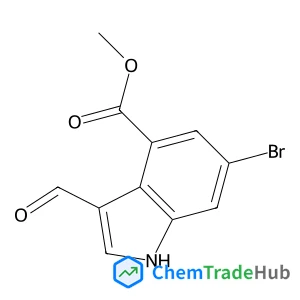
methyl 6-bromo-3-formyl-1H-indole-4-carboxylate
CAS Number:
1353636-63-1
Molecular Formula:
C11H8BrNO3
Recommended Suppliers






Disclaimer
This page provides academic journal information for reference and research purposes only. We are not affiliated with any journal publishers and do not handle publication submissions. For publication-related inquiries, please contact the respective journal publishers directly.
If you notice any inaccuracies in the information displayed, please contact us at support@chemtradehub.com. We will promptly review and address your concerns.