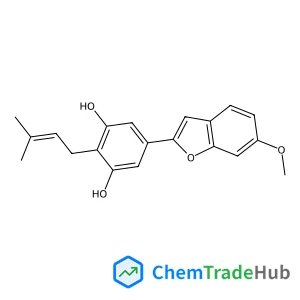
5-(6-Methoxy-1-benzofuran-2-yl)-2-(3-methyl-2-buten-1-yl)-1,3-benzenediol
CAS Number:
1017277-40-5
Molecular Formula:
C20H20O4
Jun Lu, Qing-Hua Lu, Xiao-Jun Li
The growth patterns, simulated photoelectron spectra, and electronic properties of LaASil (A = Sc, Y, and La; l ≤ 10) compounds and their anions were studied via quantum chemistry calculations using the Perdew–Burke–Ernzerhof (PBE) method and unprejudiced structural searching software ABCluster. The results revealed that the growth patterns of the most stable structures of neutral and anionic LaASil showed an adsorptive mode. The lowest-energy structures (LESs) of the LaASil (l ≤ 7) clusters were similar, except for those of anionic LaYSi4− and LaYSi5− and neutral LaScSi7. Additionally, we investigated and calculated the photoelectron spectra, vertical detachment energies, adiabatic electron affinities, relative stability, charge transfer, magnetic moment, and chemical bond analysis of the LaASil ground-state structures. The La2Sil clusters exhibited higher stability than the LaYSil and LaScSil systems owing to their higher dissociation energies (DEs). The DEs of the LESs in the LaASi3 molecule are higher than those of other clusters. Thus, the LaASi3 cluster shows potential as a building framework for Si-based cluster materials with good stability. The natural population analysis data and chemical bond analysis results showed that the spd hybridization of the orbitals of the metal atoms in the LaASil system occurred. Except for the LaScSi9 and LaScSi10 clusters, the neutral LaASil compounds transform into the corresponding anions when an extra electron is accepted by the Si clusters.
Takashi Yumura, Keisuke Kimura, Hisayoshi Kobayashi, Ryo Tanaka, Norio Okumura, Tokio Yamabe
DOI: 10.1039/B905866D
Selvarengan Paranthaman, François-Xavier Coudert, Alain H. Fuchs
DOI: 10.1039/B925074C
DOI: 10.1039/C003389H
Matthieu Hureau, Alain Moissette, Séverine Marquis, Claude Brémard, Hervé Vezin
DOI: 10.1039/B904010B
Run Long, Ying Dai, Guo Meng, Baibiao Huang
DOI: 10.1039/B903298C
Wibe A. de Jong, Eric Bylaska, Niranjan Govind, Curtis L. Janssen, Karol Kowalski, Thomas Müller, Ida M. B. Nielsen, Hubertus J. J. van Dam, Valera Veryazov, Roland Lindh
DOI: 10.1039/C002859B
Simon Mathieu, Georges Trinquier
DOI: 10.1039/B908152F
When handling 2-Methyl-2-propanyl 5-amino-2-thiophenecarboxylate (CAS: 1498311-5...
5-Bromo-1,2-dichloro-3-fluorobenzene (CAS: 1000572-93-9) is a crystalline solid ...
(2R)-2-Amino-2-(4-bromophenyl)ethanol (CAS: 354153-64-3) should be stored in a c...
Methyl 4-(aminomethyl)tetrahydro-2H-pyran-4-carboxylate hydrochloride (CAS: 3627...
1,4-Dimethyl-1H-pyrazole-5-sulfonyl chloride is primarily used as an intermediat...
Dinaphtho[1,2-b:2',1'-d]furan is generally safe when handled with appropriate pe...
The market for 7-Methyl-7,9-dihydro-1H-purine-2,6,8(3H)-trione (CAS: 612-37-3) i...
2-(4-Chlorophenyl)malonaldehyde (CAS: 205676-17-1) is a colorless or light yello...
2-Methylchrysene (CAS: 3351-32-4) is typically synthesized via the reaction of c...
N-(6-aminopyrimidin-4-yl)acetamide (CAS: 89533-23-3) is generally considered saf...

Physical Chemistry Chemical Physics (PCCP) is an international journal co-owned by 19 physical chemistry and physics societies from around the world. This journal publishes original, cutting-edge research in physical chemistry, chemical physics and biophysical chemistry. To be suitable for publication in PCCP, articles must include significant innovation and/or insight into physical chemistry; this is the most important criterion that reviewers and Editors will judge against when evaluating submissions. The journal has a broad scope and welcomes contributions spanning experiment, theory, computation and data science. Topical coverage includes spectroscopy, dynamics, kinetics, statistical mechanics, thermodynamics, electrochemistry, catalysis, surface science, quantum mechanics, quantum computing and machine learning. Interdisciplinary research areas such as polymers and soft matter, materials, nanoscience, energy, surfaces/interfaces, and biophysical chemistry are welcomed if they demonstrate significant innovation and/or insight into physical chemistry. Joined experimental/theoretical studies are particularly appreciated when complementary and based on up-to-date approaches.
![2,5-Dichloro-1H-pyrrolo[3,2-b]pyridine structure](https://static.chemtradehub.com/structs/100/1000342-87-9-f632.webp "2,5-Dichloro-1H-pyrrolo[3,2-b]pyridine structure")