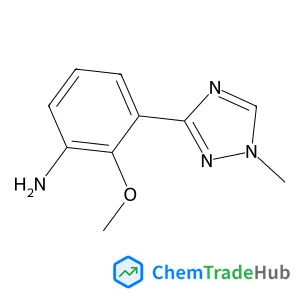
2-Methoxy-3-(1-methyl-1H-1,2,4-triazol-3-yl)aniline
CAS Number:
1609394-10-6
Molecular Formula:
C10H12N4O
Emily E. Claveau, Evangelos Miliordos
Multi-reference electronic structure calculations combined with large basis sets are performed to investigate the electronic structure of the ground and low-lying electronic states of the MO2+ diatomic species with M = Ti–Cu. These systems have shown high efficiency in the activation of the C–H of saturated hydrocarbons. This study is the first systematic and accurate work for these systems and our results and discussion provides insights into the reactivity and stability of MO2+ units. We find that they can be divided in three groups. The early transition metals (Ti, V, Cr) have very stable and well separated oxo (M4+O2−) character ground states, the middle transition metals (Mn, Fe) have oxyl (M3+O˙−) ground states with low-lying oxo excited states, and the late transition metals (Co, Ni, Cu) have well separated oxyl states. The reported spectroscopic constants will aid future experimental investigations, which are sparse in the literature. Periodic trends for the bond lengths, energetics, excitation energies, and wavefunction composition are discussed in detail. Complete basis set limit results indicate the high accuracy of the quintuple-ζ basis sets.

Russian Chemical Bulletin

Drug Discovery Today

Russian Journal of Bioorganic Chemistry

Current Opinion in Solid State & Materials Science

Russian Journal of Organic Chemistry

Journal of Natural Medicines

Crystallography Reports

Saudi Pharmaceutical Journal

Russian Journal of Coordination Chemistry

Acta Materialia
Songtao Cai, Chang Liu, Xiaojie Jiao, Song He, Liancheng Zhao
DOI: 10.1039/C9OB02188D
Bo-Shun Huang, Todd L. Lowary
DOI: 10.1039/D0OB00260G
Karlos Eduardo Pianoski, Julia Poletto, Michael Jackson Vieira da Silva, Jeniffer Nascimento Ascencio Camargo, Andrey Petita Jacomini, Davana Silva Gonçalves, Davi Fernando Back, Sidnei Moura, Fernanda Andreia Rosa
DOI: 10.1039/D0OB00319K
S. Israel Suarez, Caroline C. Warner, Heather Brown-Harding, Andrea M. Thooft, Brett VanVeller, John C. Lukesh, III
DOI: 10.1039/C9OB02486G
Joy Chakraborty, Samik Nanda
DOI: 10.1039/D0OB00237B
Mamidi Samarasimhareddy, Guy Mayer, Mattan Hurevich, Assaf Friedler
DOI: 10.1039/D0OB00499E
Dancan K. Njeri, Claude J. Pertuit, Justin R. Ragains
DOI: 10.1039/D0OB00373E
6-Bromo-2-methylimidazo[1,2-a]pyrimidine (CAS: 1111638-05-1) falls under various...
While there are no direct alternatives, similar compounds like 1-Pyrrolidineetha...
4-Methyl-2,6-bis(2-methyl-2-propanyl)phenyl methylcarbamate (CAS: 1918-11-2) is ...
2-(3-Bromo-4-fluorophenyl)-1,3-dioxolane (CAS: 77771-04-1) should be stored in a...
4,5,6,7-Tetrahydro-1H-indazole hydrochloride is a white crystalline solid with a...
(2R)-1-Methoxy-3-phenyl-2-propanamine is a chiral organic compound with the CAS ...
Ethyl 1-(1-phenylethyl)-1H-imidazole-5-carboxylate is used in various industries...
4-[(1E,3S)-1-(4-Hydroxyphenyl)-1,4-pentadien-3-yl]phenol (CAS: 17676-24-3) falls...
(S)-3-Amino-5-phenylpentanoic acid hydrochloride is primarily used in the pharma...
7-Methoxy-1-benzothiophene-2-carboxylic acid is typically synthesized by reactin...

Physical Chemistry Chemical Physics (PCCP) is an international journal co-owned by 19 physical chemistry and physics societies from around the world. This journal publishes original, cutting-edge research in physical chemistry, chemical physics and biophysical chemistry. To be suitable for publication in PCCP, articles must include significant innovation and/or insight into physical chemistry; this is the most important criterion that reviewers and Editors will judge against when evaluating submissions. The journal has a broad scope and welcomes contributions spanning experiment, theory, computation and data science. Topical coverage includes spectroscopy, dynamics, kinetics, statistical mechanics, thermodynamics, electrochemistry, catalysis, surface science, quantum mechanics, quantum computing and machine learning. Interdisciplinary research areas such as polymers and soft matter, materials, nanoscience, energy, surfaces/interfaces, and biophysical chemistry are welcomed if they demonstrate significant innovation and/or insight into physical chemistry. Joined experimental/theoretical studies are particularly appreciated when complementary and based on up-to-date approaches.