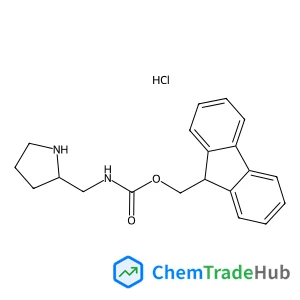
(S)-(9H-Fluoren-9-yl)methyl (pyrrolidin-2-ylmethyl)carbamate hydrochloride
CAS Number:
1217813-15-4
Molecular Formula:
C20H23ClN2O2
Xin Wang, Sivasudhan Rathnachalam, Klaas Bijlsma, Wen Li, Ronnie Hoekstra, Markus Kubin, Martin Timm, Bernd von Issendorff, Vicente Zamudio-Bayer, Shirin Faraji, Thomas Schlathölter
The conformation and the electronic structure of gas-phase oligonucleotides depends strongly on the protonation site. 5′-d(FUAG) can either be protonated at the A-N1 or at the G-N7 position. We have stored protonated 5′-d(FUAG) cations in a cryogenic ion trap held at about 20 K. To identify the protonation site and the corresponding electronic structure, we have employed soft X-ray absorption spectroscopy at the nitrogen K-edge. The obtained spectra were interpreted by comparison to time-dependent density functional theory calculations using a short-range exchange correlation functional. Despite the fact that guanine has a significantly higher proton affinity than adenine, the agreement between experiment and theory is better for the A-N1 protonated system. Furthermore, an inverse site sensitivity is observed in which the yield of the nucleobase fragments that contain the absorption site appears substantially reduced, which could be explained by non-statistical fragmentation processes, localized on the photoabsorbing nucleobase.
W. Liu, M. Nachtegaal, A. I. Frenkel, B. Rutkowski, M. Werheid, A.-K. Herrmann, C. Laugier-Bonnaud, H.-C. Yilmaz, N. Gaponik, A. Czyrska-Filemonowicz, A. Eychmüller
DOI: 10.1039/C6CP03527B
Biao Liu, Li-Juan Wu, Yu-Qing Zhao, Lin-Zhi Wang
DOI: 10.1039/C6CP03903K
Mitsunori Kitta, Riki Kataoka, Masanori Kohyama
DOI: 10.1039/C6CP03379B
A. V. Pomogaeva, A. Y. Timoshkin
DOI: 10.1039/C6CP02576E
Ting Gao, Wen-Juan Tian, Hui Bai, Su-Yan Zhang, Hai-Ru Li, Chang-Qing Miao, Yue-Wen Mu, Hai-Gang Lu, Si-Dian Li
DOI: 10.1039/C5CP03178H
Chao-Ying Fan, Huan-Huan Li, Lin-Lin Zhang, Hai-Zhu Sun, Xing-Long Wu, Hai-Ming Xie, Jing-Ping Zhang
DOI: 10.1039/C5CP02531A
DOI: 10.1039/C5CP02689J
Gina Smith, Jean-Sébastien Girardon, Jean-François Paul, Elise Berrier
DOI: 10.1039/C6CP02353C
Irene Iriarte-Carretero, Miguel A. Gonzalez
DOI: 10.1039/C6CP03082C
Waste containing N-Methoxy-N-methyl-1,3-thiazole-5-carboxamide (CAS: 898825-89-3...
N-(4-Biphenylyl)dibenzo[b,d]furan-4-amine should be stored in a tightly sealed c...
The market for 3-Acetamido-5-amino-2,4,6-triiodobenzoic acid (CAS: 1713-07-1) is...
Benzyl 2-O-acetyl-3,4,6-tri-O-benzyl-beta-D-galactopyranoside (CAS: 61820-03-9) ...
2-Ethylpiperazine dihydrochloride (CAS: 438050-52-3) is regulated under the Glob...
1,1'-[1,3-Phenylenebis(methylene)]bis(3-methyl-1H-pyrrole-2,5-dione) (CAS: 11946...
Several alternatives can be used in the synthesis of 5-Fluoro-2-(1-pyrrolidinyl)...
Proper personal protective equipment (PPE) must be worn when handling this compo...
When handling 6-Bromoimidazo[1,2-a]pyridin-8-amine, it is important to wear appr...
Alternatives to (2S,4R)-4-(4-Nitrobenzyl)pyrrolidine-2-carboxylic acid hydrochlo...

Physical Chemistry Chemical Physics (PCCP) is an international journal co-owned by 19 physical chemistry and physics societies from around the world. This journal publishes original, cutting-edge research in physical chemistry, chemical physics and biophysical chemistry. To be suitable for publication in PCCP, articles must include significant innovation and/or insight into physical chemistry; this is the most important criterion that reviewers and Editors will judge against when evaluating submissions. The journal has a broad scope and welcomes contributions spanning experiment, theory, computation and data science. Topical coverage includes spectroscopy, dynamics, kinetics, statistical mechanics, thermodynamics, electrochemistry, catalysis, surface science, quantum mechanics, quantum computing and machine learning. Interdisciplinary research areas such as polymers and soft matter, materials, nanoscience, energy, surfaces/interfaces, and biophysical chemistry are welcomed if they demonstrate significant innovation and/or insight into physical chemistry. Joined experimental/theoretical studies are particularly appreciated when complementary and based on up-to-date approaches.
![[5-fluoro-2-(morpholine-4-carbonyl)phenyl]boronic acid structure](https://static.chemtradehub.com/structs/121/1217501-26-2-505c.webp "[5-fluoro-2-(morpholine-4-carbonyl)phenyl]boronic acid structure")