


Blue emissive dimethylmethylene-bridged triphenylamine derivatives appending cross-linkable groups
Literature Information
Publication Date
2020-04-24
DOI
10.1039/D0OB00622J
Impact Factor
3.876
Authors
Kangyu Zhou, Hongfei Pan, Yongjie Zhang, Houchen Wang, Xiaofei Dong, Xiangkui Ren, Xianggao Li, Shirong Wang, Zhijian Chen
View Original
Abstract
Five new dimethylmethylene-bridged triphenylamine (DTPA) derivatives 4a–e bearing peripheral cross-linkable vinyl and trifluorovinyl groups were synthesized. The chemical structure of these compounds was characterized by 1H NMR, 13C NMR and HRMS. Their optical properties were studied by UV/Vis spectroscopy and fluorescence spectroscopy. Based on these studies, blue-coloured fluorescence and high fluorescence quantum yields were obtained for 4a–e. The electrochemical properties of these compounds were studied by cyclic voltammetry and the results were further elucidated by DFT calculations. Furthermore, the thermotropic properties of the new DTPAs were investigated by thermogravimetric analysis (TGA) and differential scanning calorimetry (DSC). Compounds 4a–d exhibit high thermal stability and thermal cross-linkable properties. These results provide an effective strategy for the design and synthesis of thermally stable and cross-linkable DTPA derivatives with tunable optical and electrochemical properties.
Recommended Journals

Russian Chemical Bulletin

Chemistry Education Research and Practice

Drug Discovery Today

Russian Journal of Organic Chemistry

Current Opinion in Solid State & Materials Science

Organic Process Research & Development

Saudi Pharmaceutical Journal

Journal of Natural Medicines

Crystallography Reports

Journal of Peptide Science
Related Literature
Coupling post-modification with reconstruction over Co-based metal–organic frameworks for electrochemical collective value-added recycling of nitrate and sulfion in wastewater
Tianlun Ren, Huizhen Wang, Shan Xu, Hongjie Yu, Kai Deng, Ziqiang Wang, Hongjing Wang, Liang Wang, You Xu
2023-10-24
Paper
DOI: 10.1039/D3TA04629J
Magnetic field-responsive graphene oxide photonic liquids
Yi-Tao Xu, Amanda J. Ackroyd, Arash Momeni, Mohamed Oudah
2024-01-10
Communication
DOI: 10.1039/D3NH00412K
Enriching 2D transition metal borides via MB XMenes (M = Fe, Co, Ir): Strong correlation and magnetism
Jiawei Tang, Duo Wang, Jing Zhang, Litao Sun, Baisheng Sa, Bobby G. Sumpter, Jingsong Huang, Weiwei Sun
2023-11-14
Communication
DOI: 10.1039/D3NH00364G
High-throughput design of energetic molecules
Jian Liu, Shicao Zhao, Bowen Duan, Xudong He, Chunming Yang, Xuemei Pu, Xinben Zhang, Yonghao Xiao, Fude Nie, Wen Qian, Geng Li
2023-11-02
Paper
DOI: 10.1039/D3TA05002E
Mechanical disassembly of human picobirnavirus like particles indicates that cargo retention is tuned by the RNA–coat protein interaction
Javier M. Rodríguez
2023-10-05
Communication
DOI: 10.1039/D3NH00195D
A bio-inspired multifunctional interface layer for high performance zinc-ion batteries via novel in situ electropolymerization
Jun Wang, Xiuyang Zou, Lina Song, Jianguo Lu, Xiang Gao, Qinggang He
2023-10-04
Paper
DOI: 10.1039/D3TA04886A
Local modulation of Au/MoS2 Schottky barriers using a top ZnO nanowire gate for high-performance photodetection
Yu Xiao, Guisheng Zou, Jinpeng Huo, Jin Peng, Zehua Li, Daozhi Shen, Lei Liu
2023-11-28
Communication
DOI: 10.1039/D3NH00448A
Fe(iii)-carboxythiolate layered metal–organic frameworks with interest as active materials for rechargeable alkali-ion batteries
Nusik Gedikoglu, Pablo Salcedo-Abraira, Nathalie Guillou, Nicolas Dupré, Christophe Payen, Philippe Poizot, Thomas Devic
2023-10-20
Paper
DOI: 10.1039/D3TA05353A
You might also like
Compound Q&A
What regulatory guidelines apply to 6-Bromo-2-methylimidazo[1,2-a]pyrimidine (CAS: 1111638-05-1)?
6-Bromo-2-methylimidazo[1,2-a]pyrimidine (CAS: 1111638-05-1) falls under various...
1111638-05-16-Bromo-2-methylimid...
Compound Q&A
Are there alternatives to 1-Pyrrolidineethanol, β-methyl-α-phenyl-, (αS,βR) (CAS: 123620-80-4) in synthesis?
While there are no direct alternatives, similar compounds like 1-Pyrrolidineetha...
123620-80-41-Pyrrolidineethanol...
Compound Q&A
Is 4-Methyl-2,6-bis(2-methyl-2-propanyl)phenyl methylcarbamate (CAS: 1918-11-2) safe?
4-Methyl-2,6-bis(2-methyl-2-propanyl)phenyl methylcarbamate (CAS: 1918-11-2) is ...
1918-11-24-Methyl-2,6-bis(2-m...
Compound Q&A
How should 2-(3-Bromo-4-fluorophenyl)-1,3-dioxolane (CAS: 77771-04-1) be stored?
2-(3-Bromo-4-fluorophenyl)-1,3-dioxolane (CAS: 77771-04-1) should be stored in a...
77771-04-12-(3-Bromo-4-fluorop...
Compound Q&A
What are the physical and chemical properties of 4,5,6,7-Tetrahydro-1H-indazole hydrochloride (CAS: 18161-11-0)?
4,5,6,7-Tetrahydro-1H-indazole hydrochloride is a white crystalline solid with a...
18161-11-04,5,6,7-Tetrahydro-1...
Compound Q&A
What is (2R)-1-Methoxy-3-phenyl-2-propanamine (CAS: 59919-07-2)?
(2R)-1-Methoxy-3-phenyl-2-propanamine is a chiral organic compound with the CAS ...
59919-07-2(2R)-1-Methoxy-3-phe...
Compound Q&A
What industries use Ethyl 1-(1-phenylethyl)-1H-imidazole-5-carboxylate (CAS: 56649-47-9)?
Ethyl 1-(1-phenylethyl)-1H-imidazole-5-carboxylate is used in various industries...
56649-47-9Ethyl 1-(1-phenyleth...
Compound Q&A
What regulatory guidelines apply to 4-[(1E,3S)-1-(4-Hydroxyphenyl)-1,4-pentadien-3-yl]phenol (CAS: 17676-24-3)?
4-[(1E,3S)-1-(4-Hydroxyphenyl)-1,4-pentadien-3-yl]phenol (CAS: 17676-24-3) falls...
17676-24-34-[(1E,3S)-1-(4-Hydr...
Compound Q&A
What industries use (S)-3-Amino-5-phenylpentanoic acid hydrochloride (CAS: 331846-97-0)?
(S)-3-Amino-5-phenylpentanoic acid hydrochloride is primarily used in the pharma...
331846-97-0(S)-3-Amino-5-phenyl...
Compound Q&A
How is 7-methoxy-1-benzothiophene-2-carboxylic acid (CAS: 88791-07-5) typically synthesized?
7-Methoxy-1-benzothiophene-2-carboxylic acid is typically synthesized by reactin...
88791-07-57-methoxy-1-benzothi...
Source Journal
Organic & Biomolecular Chemistry

CiteScore:
3.4
Self-citation Rate:
10.3%
Articles per Year:
1041
Organic & Biomolecular Chemistry (OBC) publishes original and high impact research and reviews in organic chemistry. We welcome research that shows new or significantly improved protocols or methodologies in total synthesis, synthetic methodology or physical and theoretical organic chemistry as well as research that shows a significant advance in the organic chemistry or molecular design aspects of chemical biology, catalysis, supramolecular and macromolecular chemistry, theoretical chemistry, mechanism-oriented physical organic chemistry, medicinal chemistry or natural products. Articles published in the journal should report new work which makes a highly-significant impact in the field. Routine and incremental work is generally not suitable for publication in the journal. More details about key areas of our scope are below. In all cases authors should include in their article clear rationale for why their research has been carried out.
Recommended Compounds
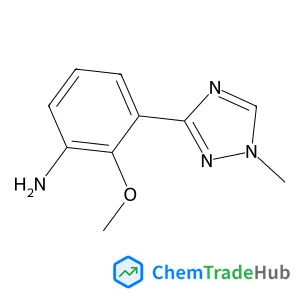
2-Methoxy-3-(1-methyl-1H-1,2,4-triazol-3-yl)aniline
CAS Number:
1609394-10-6
Molecular Formula:
C10H12N4O
Recommended Suppliers




Disclaimer
This page provides academic journal information for reference and research purposes only. We are not affiliated with any journal publishers and do not handle publication submissions. For publication-related inquiries, please contact the respective journal publishers directly.
If you notice any inaccuracies in the information displayed, please contact us at support@chemtradehub.com. We will promptly review and address your concerns.