


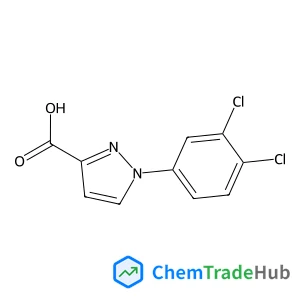
1-(3,4-Dichlorophenyl)-1H-pyrazole-3-carboxylic acid
CAS Number:
1152949-12-6
Molecular Formula:
C10H6Cl2N2O2
Shan-Jung Wu, Min-Sian Lin, Che-Yu Chiang, Genin Gary Huang
The heterogeneous oxidation reaction of single aqueous ascorbic acid (AH2) aerosol particles with gas-phase ozone was investigated in this study utilizing aerosol optical tweezers with Raman spectroscopy. The measured liquid-phase bimolecular rate coefficients of the AH2 + O3 reaction exhibit a significant pH dependence, and the corresponding values at ionic strength 0.2 M are (3.1 ± 2.0) × 105 M−1 s−1 and (1.2 ± 0.6) × 107 M−1 s−1 for pH ≈ 2 and 6, respectively. These results measured in micron-sized droplets are in agreement with those from previous bulk measurements, indicating that the observed aerosol reaction kinetics can be solely explained by liquid phase diffusion and AH2 + O3 reaction. Furthermore, the results indicate that high ionic strengths could enhance the liquid-phase rate coefficients of the AH2 + O3 reaction. The results also exhibit a negative ozone pressure dependence that can be rationalized in terms of a Langmuir–Hinshelwood type mechanism for the heterogeneous oxidation of AH2 aerosol particles by gas-phase ozone. The results of the present work imply that in acidified airway-lining fluids the antioxidant ability of AH2 against atmospheric ozone will be significantly suppressed.

European Journal of Organic Chemistry

Photochemical & Photobiological Sciences

Journal of Medical Biochemistry

Foundations of Chemistry

Journal of Enzyme inhibition and Medicinal Chemistry

Current Pharmaceutical Biotechnology

Coloration Technology

Environmental Toxicology and Pharmacology

Nature Reviews Drug Discovery

Lab on a Chip
Hongde Zhu, Junlan Liang, Sanlong Wang
DOI: 10.1039/D3TA04690G
Keqiang Zhang
DOI: 10.1039/D3NJ04596J
Thangavel Pavithra, Karthiyayini Gnanaoli, Deepan Babu Rajkumar, Arulmozhi Puhazhendhi, Soumya Sivalingam, Natarajan Sampath, Subbiah Nagarajan, Vellaisamy Sridharan, C. Uma Maheswari
DOI: 10.1039/D3NJ04721K
DOI: 10.1039/D3NP00023K
Lei Li, Jie Xu, Wenli Luo, Ke Zhong, Xiaohong Zhao, Yu Hu, Zhongyi Yuan, Yiwang Chen
DOI: 10.1039/D3TA04833K
Zhen Zhang, Linyan Zhao, Lin Cui, DongMei Li, Xing Tian, Zhiyong Liu, Shenglin Liu
DOI: 10.1039/D3NJ05042D
Sung-Jun Lee, Yoon-Gyung Sung, Santhia Kesavan, Chang-Lae Kim
DOI: 10.1039/D3NJ04802K
Zhiqiang Wang, Gen Li
DOI: 10.1039/D3NJ05280J
Zhaoshun Zhan, Qixing Shi, Lei Wang, Jinfeng Shen, Tianyou Bao, Lixin Li, Fanna Meng
DOI: 10.1039/D3NJ04981G
Waste containing N-Methoxy-N-methyl-1,3-thiazole-5-carboxamide (CAS: 898825-89-3...
N-(4-Biphenylyl)dibenzo[b,d]furan-4-amine should be stored in a tightly sealed c...
The market for 3-Acetamido-5-amino-2,4,6-triiodobenzoic acid (CAS: 1713-07-1) is...
Benzyl 2-O-acetyl-3,4,6-tri-O-benzyl-beta-D-galactopyranoside (CAS: 61820-03-9) ...
2-Ethylpiperazine dihydrochloride (CAS: 438050-52-3) is regulated under the Glob...
1,1'-[1,3-Phenylenebis(methylene)]bis(3-methyl-1H-pyrrole-2,5-dione) (CAS: 11946...
Several alternatives can be used in the synthesis of 5-Fluoro-2-(1-pyrrolidinyl)...
Proper personal protective equipment (PPE) must be worn when handling this compo...
When handling 6-Bromoimidazo[1,2-a]pyridin-8-amine, it is important to wear appr...
Alternatives to (2S,4R)-4-(4-Nitrobenzyl)pyrrolidine-2-carboxylic acid hydrochlo...

Physical Chemistry Chemical Physics (PCCP) is an international journal co-owned by 19 physical chemistry and physics societies from around the world. This journal publishes original, cutting-edge research in physical chemistry, chemical physics and biophysical chemistry. To be suitable for publication in PCCP, articles must include significant innovation and/or insight into physical chemistry; this is the most important criterion that reviewers and Editors will judge against when evaluating submissions. The journal has a broad scope and welcomes contributions spanning experiment, theory, computation and data science. Topical coverage includes spectroscopy, dynamics, kinetics, statistical mechanics, thermodynamics, electrochemistry, catalysis, surface science, quantum mechanics, quantum computing and machine learning. Interdisciplinary research areas such as polymers and soft matter, materials, nanoscience, energy, surfaces/interfaces, and biophysical chemistry are welcomed if they demonstrate significant innovation and/or insight into physical chemistry. Joined experimental/theoretical studies are particularly appreciated when complementary and based on up-to-date approaches.
![4-Chloro-2-{[(2-chlorophenoxy)acetyl]amino}benzoic acid structure](https://static.chemtradehub.com/structs/351/351424-20-9-9467.webp "4-Chloro-2-{[(2-chlorophenoxy)acetyl]amino}benzoic acid structure")
![2-(7,7-Difluorobicyclo[4.1.0]hept-1-yl)ethanamine structure](https://static.chemtradehub.com/structs/209/2098065-08-6-ff24.webp "2-(7,7-Difluorobicyclo[4.1.0]hept-1-yl)ethanamine structure")



