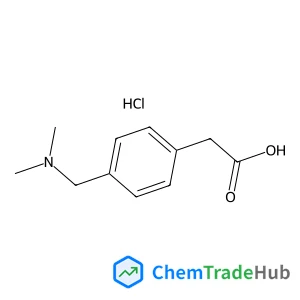
4-(Dimethylaminomethyl)phenylacetic acid hydrochloride
CAS Number:
99985-52-1
Molecular Formula:
C11H16ClNO2
Orhan Kıbrıslı, Naji Vahedigharehchopogh, Miray Çelikbilek Ersundu, Ali Erçin Ersundu
Lanthanide-doped upconversion luminescent materials are highly promising for diverse applications, e.g., solid-state lighting, volumetric displays, and anti-counterfeiting, owing to their unique optical feature of color-tunable emission under near-infrared excitation. Hence, in this study, emission color tuning of Er3+/Ho3+ ions in a fixed glass host is investigated via a facile excitation modulation technique. The upconversion emission color from green to yellowish is tuned successfully by regulating the frequency of the irradiation source. The population and depopulation rates of related transitions are investigated through time-resolved photoluminescence and Judd–Ofelt analysis in order to elucidate the proposed mechanism of color tuning. Upconversion quantum yield values are measured in the range of 0.12 to 0.17% for a better comparison of the emission properties. Additionally, thermal, and structural properties are investigated to reveal the favorable properties of the selected tellurite glass host. Ultimately, several patterns are designed and constructed by a screen-printing technique using powdered glass to demonstrate its suitability as a multicolor imaging method for anti-counterfeiting applications. The temporal color tuning of upconversion emission via a facile excitation modulation technique in a glass host clearly indicates that the proposed Er3+/Ho3+ co-doped glasses can be potentially applied in the state-of-the-art technologies, especially for anticounterfeiting purposes.
Novrita Idayanti
DOI: 10.1039/D4SE90004A
Ainhoa Oliden-Sánchez, Rebeca Sola-Llano, Joaquín Pérez-Pariente, Luis Gómez-Hortigüela, Virginia Martínez-Martínez
DOI: 10.1039/D3CP02625F
Bayram Deviren, Seyma Akkaya Deviren, Tevfik Fikret Yagmuroglu
DOI: 10.1039/D3CP04785G
Bratislav P. Marinković, Jaime Rosado, Francisco Blanco, Gustavo García, Jelena B. Maljković
DOI: 10.1039/D3CP05052A
Meng Xia, Xinyao Liu, Zhaorong Shang, Fuqiang Fan
DOI: 10.1039/D3CP03879C
Yi-Rong Liu, Yan Jiang
DOI: 10.1039/D3CP04702D
Yan Sun, Zhongzhu Jiang, Yang Li, Lanxin Liu, Hui Liang, Yiyan Wang, Dandan Wu, Na Li, Ying Zhou, Qiuju Li, Xiaoyu Yue, Wei Tong, Xuan Luo, Jianghe Lan, Xuefeng Sun
DOI: 10.1039/D3CP03854H
Waste containing N-Methoxy-N-methyl-1,3-thiazole-5-carboxamide (CAS: 898825-89-3...
N-(4-Biphenylyl)dibenzo[b,d]furan-4-amine should be stored in a tightly sealed c...
The market for 3-Acetamido-5-amino-2,4,6-triiodobenzoic acid (CAS: 1713-07-1) is...
Benzyl 2-O-acetyl-3,4,6-tri-O-benzyl-beta-D-galactopyranoside (CAS: 61820-03-9) ...
2-Ethylpiperazine dihydrochloride (CAS: 438050-52-3) is regulated under the Glob...
1,1'-[1,3-Phenylenebis(methylene)]bis(3-methyl-1H-pyrrole-2,5-dione) (CAS: 11946...
Several alternatives can be used in the synthesis of 5-Fluoro-2-(1-pyrrolidinyl)...
Proper personal protective equipment (PPE) must be worn when handling this compo...
When handling 6-Bromoimidazo[1,2-a]pyridin-8-amine, it is important to wear appr...
Alternatives to (2S,4R)-4-(4-Nitrobenzyl)pyrrolidine-2-carboxylic acid hydrochlo...

Physical Chemistry Chemical Physics (PCCP) is an international journal co-owned by 19 physical chemistry and physics societies from around the world. This journal publishes original, cutting-edge research in physical chemistry, chemical physics and biophysical chemistry. To be suitable for publication in PCCP, articles must include significant innovation and/or insight into physical chemistry; this is the most important criterion that reviewers and Editors will judge against when evaluating submissions. The journal has a broad scope and welcomes contributions spanning experiment, theory, computation and data science. Topical coverage includes spectroscopy, dynamics, kinetics, statistical mechanics, thermodynamics, electrochemistry, catalysis, surface science, quantum mechanics, quantum computing and machine learning. Interdisciplinary research areas such as polymers and soft matter, materials, nanoscience, energy, surfaces/interfaces, and biophysical chemistry are welcomed if they demonstrate significant innovation and/or insight into physical chemistry. Joined experimental/theoretical studies are particularly appreciated when complementary and based on up-to-date approaches.

![4-[(2-{2-[2-(2-Aminoethoxy)ethoxy]ethoxy}ethyl)amino]-2-(2,6-dioxo-3-piperidinyl)-1H-isoindole-1,3(2H)-dione structure](https://static.chemtradehub.com/structs/209/2093416-31-8-3162.webp "4-[(2-{2-[2-(2-Aminoethoxy)ethoxy]ethoxy}ethyl)amino]-2-(2,6-dioxo-3-piperidinyl)-1H-isoindole-1,3(2H)-dione structure")
![[(5-Methyl-1,3,4-thiadiazol-2-yl)sulfanyl]acetic acid structure](https://static.chemtradehub.com/structs/509/50918-26-8-4ce8.webp "[(5-Methyl-1,3,4-thiadiazol-2-yl)sulfanyl]acetic acid structure")