












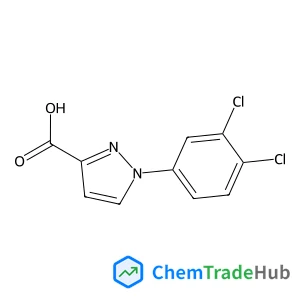
1-(3,4-Dichlorophenyl)-1H-pyrazole-3-carboxylic acid
CAS Number:
1152949-12-6
Molecular Formula:
C10H6Cl2N2O2
Na Cheng, Feng Chen, Nan Wang, Zhuocong Xiao, Colm Durkan, Liuyue Zhang, Jianwei Zhao
Focusing on the potential applications of tailored graphene nanoribbons (t-GNRs), in this work, we systematically study size effects on the electronic transport in t-GNR-based molecular junctions. As a result of the manufacturing error generated during the processing or synthesis of t-GNRs using techniques such as ion beam lithography, the final dimensions of the as-fabricated devices often deviate from the design values, giving rise to a size distribution around the mean value which could considerably affect the device performance. To simulate the effects of the manufacturing error, a series of t-GNR-based junctions with various dimensions have been modelled and systematically investigated using density functional theory (DFT) coupled with the non-equilibrium Green's function (NEGF). For junctions that consist of an acene chain connected with two graphene nanosheets, it is found that the chain length has little influence on the electronic transport and that, on the other hand, the junction conductivity is significantly altered by its width due to the different number and nature of the electron transfer pathways. Furthermore, increasing the width of the junction leads to a clear odd–even variation of decreasing amplitude in its transport behavior. These findings underpin further fundamental and device-based studies of t-GNRs.
Kumar Ayush, Pooja Sahu, Sk. Musharaf Ali, Tarak K. Patra
DOI: 10.1039/D3CP05136F
Jinfan Wu, Tao Wang, Fen Xu, Lixian Sun, Yuan Gao, Hehui Wang, Guorong Zhang, Zhong Cao, Julan Zeng
DOI: 10.1039/D3SE01162C
Nicolas Velasquez, Fernanda B. Nunes, Jessica B. Martins, Denis Céolin, Laure Fillaud, Ralph Püttner, Maria Novella Piancastelli, Michael Odelius, Marcella Iannuzzi
DOI: 10.1039/D3CP04303G
Hainan Jiang, Yaolong He, Xiaolin Li, Zhiyao Jin, Huijie Yu, Dawei Li
DOI: 10.1039/D3CP04274J
Naixia Lv, Hongshun Ran, Jinrui Zhang, Jie Yin, Yuan Zhang, Hongping Li, Linhua Zhu
DOI: 10.1039/D3CP04963A
Japheth Joseph Yeow Wan Foong, Herlina Arianita Dewi, Ayan A. Zhumekenov, Benny Febriansyah, Annalisa Bruno, Teddy Salim, Hesham R. Abuzeid, Teck Ming Koh
DOI: 10.1039/D3SE01369C
Iosif V. Leibin, Dmitry S. Bezrukov, Alexei A. Buchachenko
DOI: 10.1039/D3CP04178F
Qifeng Mu, Jian Hu
DOI: 10.1039/D3CP04160C
Zhiye Wang, Yunchuan Li, Mingjun Sun
DOI: 10.1039/D3CP04593E
Waste containing N-Methoxy-N-methyl-1,3-thiazole-5-carboxamide (CAS: 898825-89-3...
N-(4-Biphenylyl)dibenzo[b,d]furan-4-amine should be stored in a tightly sealed c...
The market for 3-Acetamido-5-amino-2,4,6-triiodobenzoic acid (CAS: 1713-07-1) is...
Benzyl 2-O-acetyl-3,4,6-tri-O-benzyl-beta-D-galactopyranoside (CAS: 61820-03-9) ...
2-Ethylpiperazine dihydrochloride (CAS: 438050-52-3) is regulated under the Glob...
1,1'-[1,3-Phenylenebis(methylene)]bis(3-methyl-1H-pyrrole-2,5-dione) (CAS: 11946...
Several alternatives can be used in the synthesis of 5-Fluoro-2-(1-pyrrolidinyl)...
Proper personal protective equipment (PPE) must be worn when handling this compo...
When handling 6-Bromoimidazo[1,2-a]pyridin-8-amine, it is important to wear appr...
Alternatives to (2S,4R)-4-(4-Nitrobenzyl)pyrrolidine-2-carboxylic acid hydrochlo...

Physical Chemistry Chemical Physics (PCCP) is an international journal co-owned by 19 physical chemistry and physics societies from around the world. This journal publishes original, cutting-edge research in physical chemistry, chemical physics and biophysical chemistry. To be suitable for publication in PCCP, articles must include significant innovation and/or insight into physical chemistry; this is the most important criterion that reviewers and Editors will judge against when evaluating submissions. The journal has a broad scope and welcomes contributions spanning experiment, theory, computation and data science. Topical coverage includes spectroscopy, dynamics, kinetics, statistical mechanics, thermodynamics, electrochemistry, catalysis, surface science, quantum mechanics, quantum computing and machine learning. Interdisciplinary research areas such as polymers and soft matter, materials, nanoscience, energy, surfaces/interfaces, and biophysical chemistry are welcomed if they demonstrate significant innovation and/or insight into physical chemistry. Joined experimental/theoretical studies are particularly appreciated when complementary and based on up-to-date approaches.

![4-[(2-{2-[2-(2-Aminoethoxy)ethoxy]ethoxy}ethyl)amino]-2-(2,6-dioxo-3-piperidinyl)-1H-isoindole-1,3(2H)-dione structure](https://static.chemtradehub.com/structs/209/2093416-31-8-3162.webp "4-[(2-{2-[2-(2-Aminoethoxy)ethoxy]ethoxy}ethyl)amino]-2-(2,6-dioxo-3-piperidinyl)-1H-isoindole-1,3(2H)-dione structure")





