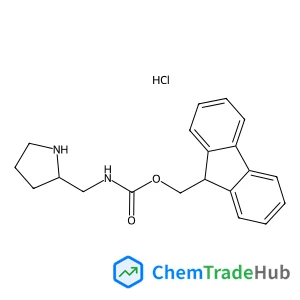
(S)-(9H-Fluoren-9-yl)methyl (pyrrolidin-2-ylmethyl)carbamate hydrochloride
CAS Number:
1217813-15-4
Molecular Formula:
C20H23ClN2O2
Camille A. Farfan, Daniel B. Turner
Despite their important role in photochemistry and expected presence in most polyatomic molecules, conical intersections have been thoroughly characterized in a comparatively small number of systems. Conical intersections can confer molecular photoreactivity or photostability, often with remarkable efficacy, due to their unique structure: at a conical intersection, the adiabatic potential energy surfaces of two or more electronic states are degenerate, enabling ultrafast decay from an excited state without radiative emission, known as nonadiabatic transfer. Furthermore, the precise conical intersection topography determines fundamental properties of photochemical processes, including excited-state decay rate, efficacy, and molecular products that are formed. However, these relationships have yet to be defined comprehensively. In this article, we use an adaptable computational model to investigate a variety of conical intersection topographies, simulate resulting nonadiabatic dynamics, and calculate key photochemical observables. We varied the vibrational mode frequencies to modify conical intersection topography systematically in four primary classes of conical intersections and quantified the resulting rate, total yield, and product yield of nonadiabatic decay. The results reveal that higher vibrational mode frequencies reduce nonadiabatic transfer, but increase the transfer rate and resulting photoproduct formation. These trends can inform progress toward experimental control of photochemical reactions or tuning of molecules’ photochemical properties based on conical intersections and their topography.
DOI: 10.1039/JA993080197R
Waste containing N-Methoxy-N-methyl-1,3-thiazole-5-carboxamide (CAS: 898825-89-3...
N-(4-Biphenylyl)dibenzo[b,d]furan-4-amine should be stored in a tightly sealed c...
The market for 3-Acetamido-5-amino-2,4,6-triiodobenzoic acid (CAS: 1713-07-1) is...
Benzyl 2-O-acetyl-3,4,6-tri-O-benzyl-beta-D-galactopyranoside (CAS: 61820-03-9) ...
2-Ethylpiperazine dihydrochloride (CAS: 438050-52-3) is regulated under the Glob...
1,1'-[1,3-Phenylenebis(methylene)]bis(3-methyl-1H-pyrrole-2,5-dione) (CAS: 11946...
Several alternatives can be used in the synthesis of 5-Fluoro-2-(1-pyrrolidinyl)...
Proper personal protective equipment (PPE) must be worn when handling this compo...
When handling 6-Bromoimidazo[1,2-a]pyridin-8-amine, it is important to wear appr...
Alternatives to (2S,4R)-4-(4-Nitrobenzyl)pyrrolidine-2-carboxylic acid hydrochlo...

Physical Chemistry Chemical Physics (PCCP) is an international journal co-owned by 19 physical chemistry and physics societies from around the world. This journal publishes original, cutting-edge research in physical chemistry, chemical physics and biophysical chemistry. To be suitable for publication in PCCP, articles must include significant innovation and/or insight into physical chemistry; this is the most important criterion that reviewers and Editors will judge against when evaluating submissions. The journal has a broad scope and welcomes contributions spanning experiment, theory, computation and data science. Topical coverage includes spectroscopy, dynamics, kinetics, statistical mechanics, thermodynamics, electrochemistry, catalysis, surface science, quantum mechanics, quantum computing and machine learning. Interdisciplinary research areas such as polymers and soft matter, materials, nanoscience, energy, surfaces/interfaces, and biophysical chemistry are welcomed if they demonstrate significant innovation and/or insight into physical chemistry. Joined experimental/theoretical studies are particularly appreciated when complementary and based on up-to-date approaches.
![4-[(2-{2-[2-(2-Aminoethoxy)ethoxy]ethoxy}ethyl)amino]-2-(2,6-dioxo-3-piperidinyl)-1H-isoindole-1,3(2H)-dione structure](https://static.chemtradehub.com/structs/209/2093416-31-8-3162.webp "4-[(2-{2-[2-(2-Aminoethoxy)ethoxy]ethoxy}ethyl)amino]-2-(2,6-dioxo-3-piperidinyl)-1H-isoindole-1,3(2H)-dione structure")