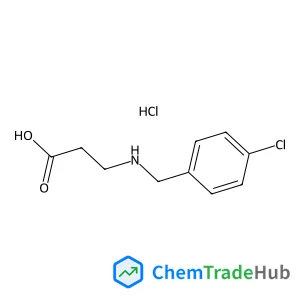
N-(4-Chlorobenzyl)-beta-alanine hydrochloride (1:1)
CAS Number:
1172479-10-5
Molecular Formula:
C10H13Cl2NO2
Timothy J. Lee
The growth mechanisms of organic molecules in an ionizing environment such as the interstellar medium are not completely understood. Here we examine by means of ab initio molecular dynamics (AIMD) simulations and density functional theory (DFT) computations the possibility of bond formation and molecular growth upon ionization of van der Waals clusters of pure HCN clusters, and mixed clusters of HCN and HCCH, both of which are widespread in the interstellar medium. Ionization of van der Waals clusters can potentially lead to growth in low temperature and low-density environments. Our results show, that upon ionization of the pure HCN clusters, strongly bound stable structures are formed that contain N⋯H bonds, and growth beyond pairwise HCN molecules is seen only in a small percentage of cases. In contrast, mixed clusters, where HCCH is preferentially ionized over HCN, can grow up to 3 or 4 units long with new carbon–carbon and carbon–nitrogen covalent bonds. Moreover, cyclic molecules formed, such as the radical cation of pyridine, which is a prebiotic molecule. The results presented here are significant as they provide a feasible pathway for molecular growth of small organic molecules containing both carbon and nitrogen in cold and relatively denser environments such as in dense molecular clouds but closer to the photo-dissociation regions, and protoplanetary disks. In the mechanism we propose, first, a neutral van der Waals cluster is formed. Once the cluster is formed it can undergo photoionization which leads to chemical reactivity without any reaction barrier.
Waste containing N-Methoxy-N-methyl-1,3-thiazole-5-carboxamide (CAS: 898825-89-3...
N-(4-Biphenylyl)dibenzo[b,d]furan-4-amine should be stored in a tightly sealed c...
The market for 3-Acetamido-5-amino-2,4,6-triiodobenzoic acid (CAS: 1713-07-1) is...
Benzyl 2-O-acetyl-3,4,6-tri-O-benzyl-beta-D-galactopyranoside (CAS: 61820-03-9) ...
2-Ethylpiperazine dihydrochloride (CAS: 438050-52-3) is regulated under the Glob...
1,1'-[1,3-Phenylenebis(methylene)]bis(3-methyl-1H-pyrrole-2,5-dione) (CAS: 11946...
Several alternatives can be used in the synthesis of 5-Fluoro-2-(1-pyrrolidinyl)...
Proper personal protective equipment (PPE) must be worn when handling this compo...
When handling 6-Bromoimidazo[1,2-a]pyridin-8-amine, it is important to wear appr...
Alternatives to (2S,4R)-4-(4-Nitrobenzyl)pyrrolidine-2-carboxylic acid hydrochlo...

Physical Chemistry Chemical Physics (PCCP) is an international journal co-owned by 19 physical chemistry and physics societies from around the world. This journal publishes original, cutting-edge research in physical chemistry, chemical physics and biophysical chemistry. To be suitable for publication in PCCP, articles must include significant innovation and/or insight into physical chemistry; this is the most important criterion that reviewers and Editors will judge against when evaluating submissions. The journal has a broad scope and welcomes contributions spanning experiment, theory, computation and data science. Topical coverage includes spectroscopy, dynamics, kinetics, statistical mechanics, thermodynamics, electrochemistry, catalysis, surface science, quantum mechanics, quantum computing and machine learning. Interdisciplinary research areas such as polymers and soft matter, materials, nanoscience, energy, surfaces/interfaces, and biophysical chemistry are welcomed if they demonstrate significant innovation and/or insight into physical chemistry. Joined experimental/theoretical studies are particularly appreciated when complementary and based on up-to-date approaches.
![4-[(2-{2-[2-(2-Aminoethoxy)ethoxy]ethoxy}ethyl)amino]-2-(2,6-dioxo-3-piperidinyl)-1H-isoindole-1,3(2H)-dione structure](https://static.chemtradehub.com/structs/209/2093416-31-8-3162.webp "4-[(2-{2-[2-(2-Aminoethoxy)ethoxy]ethoxy}ethyl)amino]-2-(2,6-dioxo-3-piperidinyl)-1H-isoindole-1,3(2H)-dione structure")