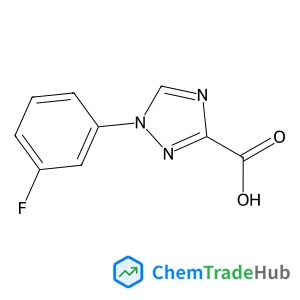
1-(3-Fluorophenyl)-1H-1,2,4-triazole-3-carboxylic acid
CAS Number:
1292369-51-7
Molecular Formula:
C9H6FN3O2
Gildas Goldsztejn, Venkateswara Rao Mundlapati, Valérie Brenner, Eric Gloaguen, Michel Mons, Carlos Cabezas, Iker León, José Luis Alonso
A dual microwave and optical spectroscopic study of a capped cysteine amino acid isolated in a supersonic expansion, combined with quantum chemistry modelling, enabled us to characterize the conformational preferences of Cys embedded in a protein chain. IR/UV double resonance spectroscopy provided evidence for the coexistence of two conformers, assigned to folded and extended backbones (with classical C7 and C5 backbone H-bonding respectively), each of them additionally stabilized by specific main-chain/side-chain H-bonding, where the sulfur atom essentially plays the role of H-bond acceptor. The folded structure was confirmed by microwave spectroscopy, which demonstrated the validity of the DFT-D methods currently used in the field. These structural and spectroscopic results, complemented by a theoretical Natural Bond Orbital analysis, enabled us to document the capacity of the weakly polar –CH2–SH side chain of Cys to adapt itself to the intrinsic local preferences of the peptide backbone, i.e., a γ-turn or a β-sheet extended secondary structure. The corresponding local H-bonding bridges the side chain acceptor S atom to the backbone NH donor site of the same or the next residue along the chain, through a 5- or a 6-membered ring respectively.
DOI: 10.1039/JA993080027N
DOI: 10.1039/JA989040199R
Waste containing N-Methoxy-N-methyl-1,3-thiazole-5-carboxamide (CAS: 898825-89-3...
N-(4-Biphenylyl)dibenzo[b,d]furan-4-amine should be stored in a tightly sealed c...
The market for 3-Acetamido-5-amino-2,4,6-triiodobenzoic acid (CAS: 1713-07-1) is...
Benzyl 2-O-acetyl-3,4,6-tri-O-benzyl-beta-D-galactopyranoside (CAS: 61820-03-9) ...
2-Ethylpiperazine dihydrochloride (CAS: 438050-52-3) is regulated under the Glob...
1,1'-[1,3-Phenylenebis(methylene)]bis(3-methyl-1H-pyrrole-2,5-dione) (CAS: 11946...
Several alternatives can be used in the synthesis of 5-Fluoro-2-(1-pyrrolidinyl)...
Proper personal protective equipment (PPE) must be worn when handling this compo...
When handling 6-Bromoimidazo[1,2-a]pyridin-8-amine, it is important to wear appr...
Alternatives to (2S,4R)-4-(4-Nitrobenzyl)pyrrolidine-2-carboxylic acid hydrochlo...

Physical Chemistry Chemical Physics (PCCP) is an international journal co-owned by 19 physical chemistry and physics societies from around the world. This journal publishes original, cutting-edge research in physical chemistry, chemical physics and biophysical chemistry. To be suitable for publication in PCCP, articles must include significant innovation and/or insight into physical chemistry; this is the most important criterion that reviewers and Editors will judge against when evaluating submissions. The journal has a broad scope and welcomes contributions spanning experiment, theory, computation and data science. Topical coverage includes spectroscopy, dynamics, kinetics, statistical mechanics, thermodynamics, electrochemistry, catalysis, surface science, quantum mechanics, quantum computing and machine learning. Interdisciplinary research areas such as polymers and soft matter, materials, nanoscience, energy, surfaces/interfaces, and biophysical chemistry are welcomed if they demonstrate significant innovation and/or insight into physical chemistry. Joined experimental/theoretical studies are particularly appreciated when complementary and based on up-to-date approaches.
![[5-fluoro-2-(morpholine-4-carbonyl)phenyl]boronic acid structure](https://static.chemtradehub.com/structs/121/1217501-26-2-505c.webp "[5-fluoro-2-(morpholine-4-carbonyl)phenyl]boronic acid structure")
![4-Chloro-2-{[(2-chlorophenoxy)acetyl]amino}benzoic acid structure](https://static.chemtradehub.com/structs/351/351424-20-9-9467.webp "4-Chloro-2-{[(2-chlorophenoxy)acetyl]amino}benzoic acid structure")