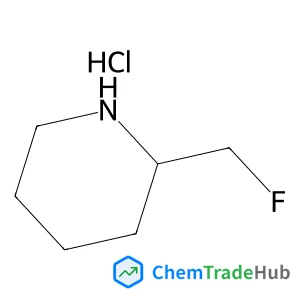
(2S)-2-(Fluoromethyl)piperidine hydrochloride (1:1)
CAS Number:
886216-73-5
Molecular Formula:
C6H13ClFN
Manish Kumar Mohanta, I. S. Fathima, Abir De Sarkar
The response of the electronic properties of the HfN2 monolayer to external perturbation, such as strain and electric fields, has been extensively investigated using density functional theory calculations for its device-based applications and photocatalysis. The HfN2 monolayer is found to be a semiconductor showing a direct band gap of 1.44 eV, which is widely tunable by 0.9 eV via application of biaxial strain. Furthermore, the tunability in the band edges of the HfN2 monolayer straddling the water redox potential under a biaxial strain of ±10% makes it suitable for solar energy harvesting via photocatalytic applications over a wide range (0–7) of pH. The band gap can be decreased by 29.8% under a biaxial tensile strain of 10%. Upon incorporation of spin orbit coupling (SOC) a large spin splitting at the conduction band (Δc ∼ 314 meV) and a small splitting at the valence band (Δv ∼ 32 meV) are noted, which is attributable to the orbital composition of the band edges. The spin splitting in the band edges is found to be adjustable via biaxial compressive strain. The strain dependent mechanical properties and stability reveal the ability of the HfN2 monolayer to withstand a large magnitude of strain of up to ±10%, thereby bringing about a giant tunability in its Young modulus (Y) from 66 N m−1 to 283 N m−1, which is gainfully exploitable in flexible electronics. The tunability in Y over such a wide range has not been observed in other 2D materials. Moreover, the HfN2 monolayer undergoes a transition from a semiconducting to a metallic state under the application of a normal electric field or gate voltage of 0.48 V Å−1, which may potentially serve as the OFF (semiconducting) and ON (metallic) state in devices. Interestingly, an electric field of such intensity has been realized experimentally using pulsed ac field technology. Such a small gate voltage will greatly lower its power consumption. The electronic origin of this transition from the OFF to the ON state is found to arise from unoccupied NFEG (Nearly Free Electron Gas) states. A HfN2 monolayer based tunnel field effect transistor (t-FET) is proposed herewith as a model device for low-power digital data storage, thereby paving new avenues in flexible electronics and memory devices.
DOI: 10.1039/JA993080027N
Waste containing N-Methoxy-N-methyl-1,3-thiazole-5-carboxamide (CAS: 898825-89-3...
N-(4-Biphenylyl)dibenzo[b,d]furan-4-amine should be stored in a tightly sealed c...
The market for 3-Acetamido-5-amino-2,4,6-triiodobenzoic acid (CAS: 1713-07-1) is...
Benzyl 2-O-acetyl-3,4,6-tri-O-benzyl-beta-D-galactopyranoside (CAS: 61820-03-9) ...
2-Ethylpiperazine dihydrochloride (CAS: 438050-52-3) is regulated under the Glob...
1,1'-[1,3-Phenylenebis(methylene)]bis(3-methyl-1H-pyrrole-2,5-dione) (CAS: 11946...
Several alternatives can be used in the synthesis of 5-Fluoro-2-(1-pyrrolidinyl)...
Proper personal protective equipment (PPE) must be worn when handling this compo...
When handling 6-Bromoimidazo[1,2-a]pyridin-8-amine, it is important to wear appr...
Alternatives to (2S,4R)-4-(4-Nitrobenzyl)pyrrolidine-2-carboxylic acid hydrochlo...

Physical Chemistry Chemical Physics (PCCP) is an international journal co-owned by 19 physical chemistry and physics societies from around the world. This journal publishes original, cutting-edge research in physical chemistry, chemical physics and biophysical chemistry. To be suitable for publication in PCCP, articles must include significant innovation and/or insight into physical chemistry; this is the most important criterion that reviewers and Editors will judge against when evaluating submissions. The journal has a broad scope and welcomes contributions spanning experiment, theory, computation and data science. Topical coverage includes spectroscopy, dynamics, kinetics, statistical mechanics, thermodynamics, electrochemistry, catalysis, surface science, quantum mechanics, quantum computing and machine learning. Interdisciplinary research areas such as polymers and soft matter, materials, nanoscience, energy, surfaces/interfaces, and biophysical chemistry are welcomed if they demonstrate significant innovation and/or insight into physical chemistry. Joined experimental/theoretical studies are particularly appreciated when complementary and based on up-to-date approaches.
![[(5-Methyl-1,3,4-thiadiazol-2-yl)sulfanyl]acetic acid structure](https://static.chemtradehub.com/structs/509/50918-26-8-4ce8.webp "[(5-Methyl-1,3,4-thiadiazol-2-yl)sulfanyl]acetic acid structure")
![tert-Butyl 6-chloro-4-oxospiro[chroman-2,4'-piperidine]-1'-carboxylate structure](https://static.chemtradehub.com/structs/101/1011482-37-3-88a5.webp "tert-Butyl 6-chloro-4-oxospiro[chroman-2,4'-piperidine]-1'-carboxylate structure")