












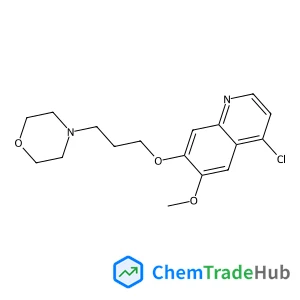
4-(3-((4-Chloro-6-methoxyquinolin-7-yl)oxy)propyl)morpholine
CAS Number:
205448-32-4
Molecular Formula:
C17H21ClN2O3
Hang Zhong, Jun Chen, Jinfan Chen, Ran Tao, Jiaolai Jiang, Yi Hu, Jingsong Xu, Tianzhu Zhang, Junsheng Liao
The p-aminothiophenol (PATP) coupling reaction on plasmon substrates such as Ag and Au nanoparticles has received extensive attention since the catalytic effect of the surface plasmon was found. Currently, in situ kinetic studies of this reaction are rare, especially those focusing on the specific role of the hot electron–hole carriers. Here, in situ electrochemical surface-enhanced Raman spectroscopy (SERS) is developed to study the plasmon catalytic reaction of PATP in a controlled aqueous environment involving the factors of O2, electron and hole carriers, and solution pH. Ag nanoparticles supported on graphite serve as a SERS substrate, which could separate hot electron–hole pairs effectively and is beneficial to study the effects of hot carriers on plasmon-driven reactions. In situ electrochemical SERS measurements reveal two reaction paths for the PATP coupling reaction. One is that plasmon-induced hot holes activate the dehydrogenation of PATP and then the radical coupling reaction to form p,p′-dimercaptoazobenzene (DMAB) under O2-free conditions. Another is likely to be that the surface Ag2O/AgOH, which is generated from Ag and 1O2/O2−, catalyzes the oxidation of PATP and then the coupling process under O2-rich conditions. Benefitting from the potential/atmosphere controlled measurements in situ, the intermediate species of PATP(NH)/PATP(N) are observed with vibrational bands at around 1056, 1202, 1253, 1395, 1514 and 1540 cm−1.
Jian-Hang Hu, Cheng-Hui Wang, Qing-Hong Bai, Li-Xia Chen, An-Ting Zhao, Shang-Wei Yuan, Qing Chen, Pei-Hua Ma, Zhu Tao, Xin Xiao
DOI: 10.1039/D3CC03750A
DOI: 10.1039/D3CC04160C
Zhigang Ma, Xinxin Wu, Haotian Li, Zhu Cao
DOI: 10.1039/D3SC04886A
Ping Wang, Yu-Qiao Tong, Shi-Qing Yin, Qian-Jun Gu, Bo Huang, Ai-Xin Zhu
DOI: 10.1039/D3CC04186G
Mokilla Ramachandra Reddy, Eerappa Rajakumara, Gedu Satyanarayana
DOI: 10.1039/D3CC04473D
Anna A. Wilson, Lucy Hart, Thomas Shalvey, Michael Sachs, Weidong Xu, Benjamin Moss, Eva Mazzolini, Asim Mumtaz
DOI: 10.1039/D3CC04616H
Minakshi Altia, Pazhamalai Anbarasan
DOI: 10.1039/D3CC04144A
Carlos E. Puerto Galvis, Eugenia Martínez-Ferrero
DOI: 10.1039/D3SC04668K
Kai Wu, Xiaojing Wang, Piaoru Wu, Yiyang Cao, Xiuhong Lu, Yixin Xu
DOI: 10.1039/D3SC04636B
(5-Sulfamoyl-3-pyridinyl)boronic acid is primarily used in chemical synthesis, p...
Benzyl 2-methyl-2-(methylsulfonyl)-4-pentenoate is typically synthesized via est...
When handling 8-Fluoroquinolin-6-ol (CAS: 209353-22-0), it is important to use p...
1,3-Dibromo-5-(2-methyl-2-propanyl)benzene (CAS: 129316-09-2) is a crystalline c...
Ethyl 7-chloro-4-oxo-1-(1,3-thiazol-2-yl)-1,4-dihydro-1,8-naphthyridine-3-carbox...
When handling Delta-7-Avenasterol (CAS: 23290-26-8), it is important to wear app...
Proper handling involves the use of personal protective equipment such as gloves...
When handling 2-Methyl-2-proanyl 4-[(2-aminophenyl)amino]-1-piperidinecarboxylat...
N-Methyl-4-chlorobenzylamine hydrochloride (CAS: 65542-24-7) is a organic compou...
[2-(Dodecyloxy)ethoxy]acetic acid (CAS: 27306-90-7) is generally considered safe...

Physical Chemistry Chemical Physics (PCCP) is an international journal co-owned by 19 physical chemistry and physics societies from around the world. This journal publishes original, cutting-edge research in physical chemistry, chemical physics and biophysical chemistry. To be suitable for publication in PCCP, articles must include significant innovation and/or insight into physical chemistry; this is the most important criterion that reviewers and Editors will judge against when evaluating submissions. The journal has a broad scope and welcomes contributions spanning experiment, theory, computation and data science. Topical coverage includes spectroscopy, dynamics, kinetics, statistical mechanics, thermodynamics, electrochemistry, catalysis, surface science, quantum mechanics, quantum computing and machine learning. Interdisciplinary research areas such as polymers and soft matter, materials, nanoscience, energy, surfaces/interfaces, and biophysical chemistry are welcomed if they demonstrate significant innovation and/or insight into physical chemistry. Joined experimental/theoretical studies are particularly appreciated when complementary and based on up-to-date approaches.
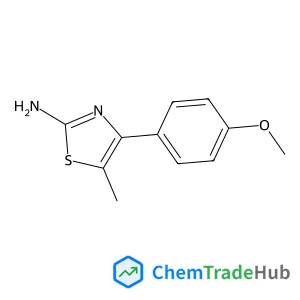
![2-Methyl-2-propanyl 4-oxo-3,9-diazabicyclo[4.2.1]nonane-9-carboxylate structure](https://static.chemtradehub.com/structs/131/1312456-05-5-9a15.webp "2-Methyl-2-propanyl 4-oxo-3,9-diazabicyclo[4.2.1]nonane-9-carboxylate structure")
![4,10-Dihydroxy-3H-pyrano[3,4,5-kl]xanthen-3-one structure](https://static.chemtradehub.com/structs/125/1259330-61-4-de48.webp "4,10-Dihydroxy-3H-pyrano[3,4,5-kl]xanthen-3-one structure")
![(4-Methyl-1H-benzo[d]imidazol-2-yl)methanamine structure](https://static.chemtradehub.com/structs/933/933756-31-1-7b0b.webp "(4-Methyl-1H-benzo[d]imidazol-2-yl)methanamine structure")




