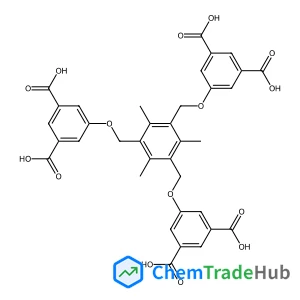
5,5',5''-(((2,4,6-Trimethylbenzene-1,3,5-triyl)tris(methylene))tris(oxy))triisophthalic acid
CAS Number:
1159974-70-5
Molecular Formula:
C36H30O15
Yuan Yuan, Si Wu, Hongqi Ai, Baotao Kang
Graphyne materials are potential candidates to fabricate low-cost but efficient metal-free oxygen reduction reaction (ORR) electrocatalysts. However, due to the coexistence of sp and sp2 carbon atoms in graphyne, some factors playing important roles in determining the ORR activity have received little attention. In the present paper, we carried out thorough density functional theory (DFT) calculations to study the curvature effect on the ORR activity of γ-graphyne. Our results suggest that the (5, 0)-γGyNT would be an excellent metal-free ORR catalyst. Its limiting potential was computed to be 0.80 V and the corresponding active sites occupy up to 16.7% in content, much better than previously reported CACs. Moreover, it is revealed that the curvature can tune the degree of exposure of p electrons of active sites, thus tuning the ORR activity. Our findings are beneficial for further understanding catalytic behavior on graphyne related materials and we suggest a new strategy to design high performance metal-free ORR catalysts.

Photochemical & Photobiological Sciences

Green Chemistry

Physical Chemistry Chemical Physics

Faraday Discussions

Angewandte Chemie International Edition

Environmental Toxicology and Pharmacology

Current Pharmaceutical Biotechnology

Contact Lens & Anterior Eye

Journal of Enzyme inhibition and Medicinal Chemistry

Mini-Reviews in Medicinal Chemistry
DOI: 10.1039/D3NJ05137D
Yujie Xu
DOI: 10.1039/D3TA05035A
Christina Braun, Lukas Martin Wingen, Dirk Menche
DOI: 10.1039/D3NP00018D
Yu Guo, Yinghui Shang, Bingqian Jiao, Yuting Guo, Yujing Tang, Saiji Shen, Dongbei Wu, Xia Wang, Wenju Li, Qigang Wang
DOI: 10.1039/D3TA04985J
Le Wang, Yong-Shuang Li, Yu Cao
DOI: 10.1039/D3NJ05053J
Angela A. Salim, Mark S. Butler, Mark A. T. Blaskovich, Ian R. Henderson, Robert J. Capon
DOI: 10.1039/D3NP00019B
Min Liu, Qi Liu, Xue-Ting Jin, Ya-Chen Zou, Di-Ning Li, Pan Feng, Yang-Hui Luo
DOI: 10.1039/D3TA05384A
Liang Zeng, Ming Zhang, Mengyuan Gao, Lingwei Xue, Haiqiao Wang, Zhi-Guo Zhang, Long Ye
DOI: 10.1039/D3TA04761J
Waste containing N-Methoxy-N-methyl-1,3-thiazole-5-carboxamide (CAS: 898825-89-3...
N-(4-Biphenylyl)dibenzo[b,d]furan-4-amine should be stored in a tightly sealed c...
The market for 3-Acetamido-5-amino-2,4,6-triiodobenzoic acid (CAS: 1713-07-1) is...
Benzyl 2-O-acetyl-3,4,6-tri-O-benzyl-beta-D-galactopyranoside (CAS: 61820-03-9) ...
2-Ethylpiperazine dihydrochloride (CAS: 438050-52-3) is regulated under the Glob...
1,1'-[1,3-Phenylenebis(methylene)]bis(3-methyl-1H-pyrrole-2,5-dione) (CAS: 11946...
Several alternatives can be used in the synthesis of 5-Fluoro-2-(1-pyrrolidinyl)...
Proper personal protective equipment (PPE) must be worn when handling this compo...
When handling 6-Bromoimidazo[1,2-a]pyridin-8-amine, it is important to wear appr...
Alternatives to (2S,4R)-4-(4-Nitrobenzyl)pyrrolidine-2-carboxylic acid hydrochlo...
Physical Chemistry Chemical Physics (PCCP) is an international journal co-owned by 19 physical chemistry and physics societies from around the world. This journal publishes original, cutting-edge research in physical chemistry, chemical physics and biophysical chemistry. To be suitable for publication in PCCP, articles must include significant innovation and/or insight into physical chemistry; this is the most important criterion that reviewers and Editors will judge against when evaluating submissions. The journal has a broad scope and welcomes contributions spanning experiment, theory, computation and data science. Topical coverage includes spectroscopy, dynamics, kinetics, statistical mechanics, thermodynamics, electrochemistry, catalysis, surface science, quantum mechanics, quantum computing and machine learning. Interdisciplinary research areas such as polymers and soft matter, materials, nanoscience, energy, surfaces/interfaces, and biophysical chemistry are welcomed if they demonstrate significant innovation and/or insight into physical chemistry. Joined experimental/theoretical studies are particularly appreciated when complementary and based on up-to-date approaches.