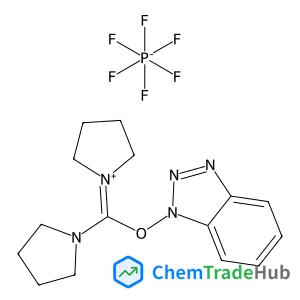
(1H-Benzotriazol-1-yloxy)(di-1-pyrrolidinyl)methylium hexafluorophosphate
CAS Number:
105379-24-6
Molecular Formula:
C15H21F6N5OP
Paul A. Brown, Caleb D. Martin, Kevin L. Shuford
A compendium of pnictogen and chalcogen substituted boron heterocycles were assessed for their aromatic character by first principles density functional theory. Group-15 and Group-16 elements were placed at the ortho-, meta-, and para-positions of six-membered rings relative to boron to assess their impact on the aromaticity of the unsaturated heterocycles. Aromaticity was analyzed by a multidimensional approach using nuclear independent chemical shifts, gauge-including magnetically induced current, as well as natural bond orbital and natural resonance theory analyses. Based on these methods, we observe a general decline of aromaticity in heavier pnictaborines while the chalcogen analogues maintain relatively strong aromatic character. These general trends result from complementary π–π* natural bond order interactions that sustain resonance within the ring of each heterocycle establishing a pattern of cyclic delocalization. Consequently, natural resonance theory displays strong resonance, which is corroborated with the signed modulus of ring current, toroidal vortices of current maps, and elevated average induced current throughout the ring. The 1,3-configurations for pnictaborines and chalcogenaborines are generally more aromatic compared to the 1,2- and 1,4-isomers, which contain π-holes that limit diatropism within the heterocycles. However, an energetic trend favors the 1,2-heterocycles in both groups, with a few exceptions driven in large-part by π-donation of the lone pair on the heteroatom to the pz orbital on the adjacent boron resulting in stabilization. The importance of planarity for high aromaticity is demonstrated, especially in the pnictaborine isomers where pyramidalization at the pnictogen is favored, while bond regularity seems a less important criterion.
Thomas J. McDonough, Lushuai Zhang, Susmit Singha Roy, Nicholas M. Kearns, Michael S. Arnold, Martin T. Zanni
DOI: 10.1039/C6CP06454J
Dorothy M. Duffy
DOI: 10.1039/C6CP08157F
E. Voss, B. Vigolo, G. Medjahdi, C. Hérold, J.-F. Marêché, J. Ghanbaja, F. Le Normand, V. Mamane
DOI: 10.1039/C6CP08568G
Yue Tong, Xiaowen Yu, Gaoquan Shi
DOI: 10.1039/C6CP08176B
Yuanjun Lu, Bryan E. G. Lucier, Yue Zhang, Anmin Zheng, Yining Huang
DOI: 10.1039/C7CP00199A
K. E. A. Hooper, H. K. H. Lee, M. J. Newman, S. Meroni, J. Baker, T. M. Watson, W. C. Tsoi
DOI: 10.1039/C6CP05123E
Dharmendar Kumar Sharma, Shuzo Hirata, Lukasz Bujak, Vasudevanpillai Biju, Tatsuya Kameyama, Marino Kishi, Tsukasa Torimoto, Martin Vacha
DOI: 10.1039/C6CP07550A
When handling 4-(2-Furylmethyl)thiomorpholine 1,1-dioxide (CAS: 79206-94-3), it ...
When handling 4-Chloro-N-[2-(4-morpholinyl)ethyl]benzamide (CAS: 71320-77-9), it...
Waste containing this compound (CAS: 62921-74-8) should be handled according to ...
Waste containing (S)-Methyl 2-amino-3-cyclohexylpropanoate should be collected i...
This compound can be synthesized using a multi-step process involving the conjug...
There are several alternatives to (2E)-3-(3,4-Dichlorophenyl)acrylic acid in syn...
Ethyl 6-(2-nitrophenyl)imidazo[2,1-b][1,3]thiazole-3-carboxylate (CAS: 925437-84...
Waste containing 2-(1,3-Thiazol-2-yl)ethanamine (CAS: 18453-07-1) should be coll...
Methyl 5-iodo-2-methylbenzoate can be synthesized through the iodination of meth...
5-Chloro[1,2,4]triazolo[1,5-a]pyridine is commonly synthesized via the condensat...

Physical Chemistry Chemical Physics (PCCP) is an international journal co-owned by 19 physical chemistry and physics societies from around the world. This journal publishes original, cutting-edge research in physical chemistry, chemical physics and biophysical chemistry. To be suitable for publication in PCCP, articles must include significant innovation and/or insight into physical chemistry; this is the most important criterion that reviewers and Editors will judge against when evaluating submissions. The journal has a broad scope and welcomes contributions spanning experiment, theory, computation and data science. Topical coverage includes spectroscopy, dynamics, kinetics, statistical mechanics, thermodynamics, electrochemistry, catalysis, surface science, quantum mechanics, quantum computing and machine learning. Interdisciplinary research areas such as polymers and soft matter, materials, nanoscience, energy, surfaces/interfaces, and biophysical chemistry are welcomed if they demonstrate significant innovation and/or insight into physical chemistry. Joined experimental/theoretical studies are particularly appreciated when complementary and based on up-to-date approaches.