












Exciton dissociation in an NIR-active triohybrid nanocrystal leading to efficient generation of reactive oxygen species
Literature Information
Publication Date
2019-04-18
DOI
10.1039/C9CP01923E
Impact Factor
3.676
Authors
Jayita Patwari, Harmit Joshi, Harahari Mandal, Lopamudra Roy, Chinmoy Bhattacharya, Samir Kumar Pal
View Original
Abstract
Lead sulfide (PbS) colloidal quantum dots (QDs) are emerging materials for fundamental studies because of their potential application in near infrared (NIR) light harvesting technologies. However, inefficient electron separation, facile charge recombination and defect state trapping of photoexcited carriers are reported as limitations of the PbS QDs to achieve efficient energy conversion. In the present study, we have synthesized a triohybrid by assembling a semiconductor titanium dioxide (TiO2), an organic oxidizing molecule phenothiazine (PTZ) and PbS QDs. The triohybrid along with PbS_TiO2 and PbS_PTZ hybrids has been characterized and the attachment of different components is verified by spectroscopic and microscopic techniques. The interfacial dynamics of the photoexcited carriers in the PbS_TiO2 and PbS_PTZ hybrids have been investigated separately using steady state and time resolved photoluminescence (TRPL) measurements. The photoinduced electron transfer (PET) from the PbS QD to the conduction band (CB) of TiO2 and photoinduced hole transfer (PHT) from the valence band (VB) of the QD to the highest occupied molecular orbital (HOMO) of PTZ have been observed and correlated mechanistically to the energy level alignments obtained from cyclic voltammetric (CV) analysis. The PTZ molecule is also found to act as a surface defect passivator of the PbS QD. Finally, simultaneous exciton dissociation and reduced back recombination phenomena have been correlated with a higher reactive oxygen species (ROS) generation activity of the triohybrid than the other two, under IR light irradiation. Thus, a detailed investigation of carrier dynamics and the mechanism of higher NIR light activity for a novel nanohybrid is explored and analyzed which could be beneficial for NIR catalysis or antibacterial activities.
Related Literature
Ionic liquid induced G-quadruplex formation and stabilization: spectroscopic and simulation studies
Sagar Satpathi, Mandar Kulkarni, Arnab Mukherjee, Partha Hazra
2016-10-06
Paper
DOI: 10.1039/C6CP05732B
The effect of C–OH functionality on the surface chemistry of biomass-derived molecules: ethanol chemistry on Rh(100)
C. J. (Kees-Jan) Weststrate
2016-10-12
Paper
DOI: 10.1039/C6CP06069B
Predicted low thermal conductivities in antimony films and the role of chemical functionalization
Tian Zhang, Yuan-Yuan Qi, Xiang-Rong Chen, Ling-Cang Cai
2016-10-24
Paper
DOI: 10.1039/C6CP05908B
Predicting molecular self-assembly at surfaces: a statistical thermodynamics and modeling approach
Simone Conti, Marco Cecchini
2016-10-21
Paper
DOI: 10.1039/C6CP05249E
Solvation dynamics of an ionic probe in choline chloride-based deep eutectic solvents
Y. Cui, K. D. Fulfer, J. Ma, T. K. Weldeghiorghis, D. G. Kuroda
2016-11-01
Paper
DOI: 10.1039/C6CP06318G
Extracting nano-gold from HAuCl4 solution manipulated with electrons
Y. Lu, K. Wang, F.-R. Chen, W. Zhang, M. L. Sui
2016-10-12
Paper
DOI: 10.1039/C6CP06032C
Reaction dynamics inside superfluid helium nanodroplets: the formation of the Ne2 molecule from Ne + Ne@(4He)N
Arnau Vilà, Miguel González
2016-10-10
Paper
DOI: 10.1039/C6CP03942A
A comparative study of Ni–Mn layered double hydroxide/carbon composites with different morphologies for supercapacitors
M. Li, F. Liu, X. B. Zhang, J. P. Cheng
2016-10-06
Paper
DOI: 10.1039/C6CP05119G
On the origin of the great rigidity of self-assembled diphenylalanine nanotubes
Pavel Zelenovskiy, Igor Kornev, Semen Vasilev
2016-10-13
Communication
DOI: 10.1039/C6CP04337B
Electrons, excitons and hydrogen bonding: electron-promoted desorption from molecular ice surfaces
Demian Marchione, Martin R. S. McCoustra
2016-10-17
Paper
DOI: 10.1039/C6CP05814K
You might also like
Compound Q&A
What precautions should be taken when handling 2-Chloro-1,2-bis(4-methylphenyl)ethanone (CAS: 71193-32-3)?
When handling 2-Chloro-1,2-bis(4-methylphenyl)ethanone (CAS: 71193-32-3), it is ...
71193-32-32-Chloro-1,2-bis(4-m...
Compound Q&A
What industries use 4-Ethoxy-3-(5-methyl-4-oxo-7-propyl-1,4-dihydroimidazo[5,1-f][1,2,4]triazin-2-yl)benzenesulfonyl chloride (CAS: 224789-26-8)?
4-Ethoxy-3-(5-methyl-4-oxo-7-propyl-1,4-dihydroimidazo[5,1-f][1,2,4]triazin-2-yl...
224789-26-84-Ethoxy-3-(5-methyl...
Compound Q&A
How should Methyl 3-Oxo-4-Androsten-17-Carboxylate (CAS: 2681-55-2) be stored?
Methyl 3-Oxo-4-Androsten-17-Carboxylate (CAS: 2681-55-2) should be stored in a c...
2681-55-2Methyl 3-Oxo-4-Andro...
Compound Q&A
What are the main uses of (R)-3-Amino-4-(3-hexylphenylamino)-4-oxobutylphosphonic acid (CAS: 909725-61-7)?
(R)-3-Amino-4-(3-hexylphenylamino)-4-oxobutylphosphonic acid is primarily used i...
909725-61-7(R)-3-Amino-4-(3-hex...
Compound Q&A
What regulatory guidelines apply to 2-Methyl-2-propanyl 3-amino-3-carbamoyl-1-azetidinecarboxylate (CAS: 1254120-14-3)?
2-Methyl-2-propanyl 3-amino-3-carbamoyl-1-azetidinecarboxylate (CAS: 1254120-14-...
1254120-14-32-Methyl-2-propanyl ...
Compound Q&A
Are there alternatives to (E)-4-(tert-Butoxy)-4-oxobut-2-enoic acid (CAS: 135355-96-3) in synthesis?
There are alternative reagents that can be used in synthesis instead of (E)-4-(t...
135355-96-3(E)-4-(tert-Butoxy)-...
Compound Q&A
What are the physical and chemical properties of [2-(3-Chlorophenyl)-1,3-thiazol-4-yl]methanol (CAS: 121202-20-8)?
[2-(3-Chlorophenyl)-1,3-thiazol-4-yl]methanol (CAS: 121202-20-8) is a crystallin...
121202-20-8[2-(3-Chlorophenyl)-...
Compound Q&A
What is the market or research trend for Methyl (2S)-[(4S)-2,2-dimethyl-1,3-dioxolan-4-yl]{[(4-methylphenyl)sulfonyl]oxy}acetate (CAS: 166249-17-8)?
The market and research trends for Methyl (2S)-[(4S)-2,2-dimethyl-1,3-dioxolan-4...
166249-17-8Methyl (2S)-[(4S)-2,...
Compound Q&A
What is the market or research trend for 1-Bromo-2-isocyanatoethane (CAS: 42865-19-0)?
The market for 1-Bromo-2-isocyanatoethane (CAS: 42865-19-0) is driven by its use...
42865-19-01-Bromo-2-isocyanato...
Compound Q&A
What are the main uses of 4-Nitro-D-phenylalanine hydrochloride (CAS: 147065-06-3)?
4-Nitro-D-phenylalanine hydrochloride (CAS: 147065-06-3) is primarily used in re...
147065-06-34-Nitro-D-phenylalan...
Source Journal
Physical Chemistry Chemical Physics

CiteScore:
5.5
Self-citation Rate:
10.3%
Articles per Year:
3036
Physical Chemistry Chemical Physics (PCCP) is an international journal co-owned by 19 physical chemistry and physics societies from around the world. This journal publishes original, cutting-edge research in physical chemistry, chemical physics and biophysical chemistry. To be suitable for publication in PCCP, articles must include significant innovation and/or insight into physical chemistry; this is the most important criterion that reviewers and Editors will judge against when evaluating submissions. The journal has a broad scope and welcomes contributions spanning experiment, theory, computation and data science. Topical coverage includes spectroscopy, dynamics, kinetics, statistical mechanics, thermodynamics, electrochemistry, catalysis, surface science, quantum mechanics, quantum computing and machine learning. Interdisciplinary research areas such as polymers and soft matter, materials, nanoscience, energy, surfaces/interfaces, and biophysical chemistry are welcomed if they demonstrate significant innovation and/or insight into physical chemistry. Joined experimental/theoretical studies are particularly appreciated when complementary and based on up-to-date approaches.
Recommended Compounds

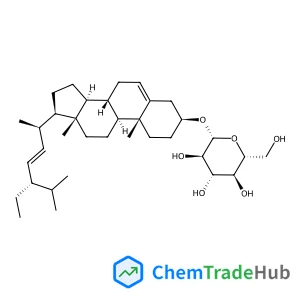
(3beta,22E)-Stigmasta-5,22-dien-3-yl beta-D-glucopyranoside
CAS Number:
19716-26-8
Molecular Formula:
C35H58O6

Recommended Suppliers





Disclaimer
This page provides academic journal information for reference and research purposes only. We are not affiliated with any journal publishers and do not handle publication submissions. For publication-related inquiries, please contact the respective journal publishers directly.
If you notice any inaccuracies in the information displayed, please contact us at support@chemtradehub.com. We will promptly review and address your concerns.