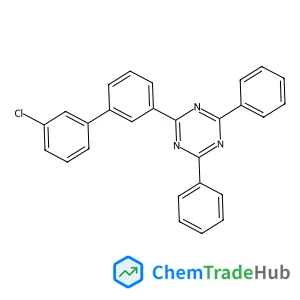
2-(3'-Chlorobiphenyl-3-yl)-4,6-diphenyl-1,3,5-triazine
CAS Number:
1443049-83-9
Molecular Formula:
C27H18ClN3
James N. Bull, Christopher W. West, Cate S. Anstöter, Gabriel da Silva, Evan J. Bieske, Jan R. R. Verlet
The photoinduced excited state dynamics of gas-phase trans-retinoate (deprotonated trans-retinoic acid, trans-RA−) are studied using tandem ion mobility spectrometry coupled with laser spectroscopy, and frequency-, angle- and time-resolved photoelectron imaging. Photoexcitation of the bright S3(ππ*) ← S0 transition leads to internal conversion to the S1(ππ*) state on a ≈80 fs timescale followed by recovery of S0 and concomitant isomerisation to give the 13-cis (major) and 9-cis (minor) photoisomers on a ≈180 fs timescale. The sub-200 fs stereoselective photoisomerisation parallels that for the retinal protonated Schiff base chromophore in bacteriorhodopsin. Measurements on trans-RA− in methanol using the solution photoisomerisation action spectroscopy technique show that 13-cis-RA− is also the principal photoisomer, although the 13-cis and 9-cis photoisomers are formed with an inverted branching ratio with photon energy in methanol when compared with the gas phase, presumably due to solvent-induced modification of potential energy surfaces and inhibition of electron detachment processes. Comparison of the gas-phase time-resolved data with transient absorption spectroscopy measurements on retinoic acid in methanol suggest that photoisomerisation is roughly six times slower in solution. This work provides clear evidence that solvation significantly affects the photoisomerisation dynamics of retinoid molecules.
Thomas Danielson, Eric Tea
DOI: 10.1039/C6CP05233A
Mateus A. M. Paiva, Bárbara M. T. C. Peluzo, Jadson C. Belchior, Breno R. L. Galvão
DOI: 10.1039/C6CP05605A
Shirui Luo, Jarrod Schiffbauer
DOI: 10.1039/C6CP06085D
Hanna L. B. Boström, Joshua A. Hill, Andrew L. Goodwin
DOI: 10.1039/C6CP05730F
Lingling Bi, Dedong Meng, Qijing Bu, Yanhong Lin, Tengfeng Xie
DOI: 10.1039/C6CP05618K
Kaichi Yamamoto, Yusuke Kanematsu, Umpei Nagashima, Akira Ueda, Hatsumi Mori, Masanori Tachikawa
DOI: 10.1039/C6CP05414E
Rui-Qin Zhang, Yan-Ling Zhao, Fei Qi, Klaus Hermann, Michel A. Van Hove
DOI: 10.1039/C6CP05996A
Lei Chen, Yeonju Park, Qian Cong, Xiaoxia Han, Bing Zhao, Young Mee Jung
DOI: 10.1039/C6CP05978C
When handling 2-Chloro-1,2-bis(4-methylphenyl)ethanone (CAS: 71193-32-3), it is ...
4-Ethoxy-3-(5-methyl-4-oxo-7-propyl-1,4-dihydroimidazo[5,1-f][1,2,4]triazin-2-yl...
Methyl 3-Oxo-4-Androsten-17-Carboxylate (CAS: 2681-55-2) should be stored in a c...
(R)-3-Amino-4-(3-hexylphenylamino)-4-oxobutylphosphonic acid is primarily used i...
2-Methyl-2-propanyl 3-amino-3-carbamoyl-1-azetidinecarboxylate (CAS: 1254120-14-...
There are alternative reagents that can be used in synthesis instead of (E)-4-(t...
[2-(3-Chlorophenyl)-1,3-thiazol-4-yl]methanol (CAS: 121202-20-8) is a crystallin...
The market and research trends for Methyl (2S)-[(4S)-2,2-dimethyl-1,3-dioxolan-4...
The market for 1-Bromo-2-isocyanatoethane (CAS: 42865-19-0) is driven by its use...
4-Nitro-D-phenylalanine hydrochloride (CAS: 147065-06-3) is primarily used in re...

Physical Chemistry Chemical Physics (PCCP) is an international journal co-owned by 19 physical chemistry and physics societies from around the world. This journal publishes original, cutting-edge research in physical chemistry, chemical physics and biophysical chemistry. To be suitable for publication in PCCP, articles must include significant innovation and/or insight into physical chemistry; this is the most important criterion that reviewers and Editors will judge against when evaluating submissions. The journal has a broad scope and welcomes contributions spanning experiment, theory, computation and data science. Topical coverage includes spectroscopy, dynamics, kinetics, statistical mechanics, thermodynamics, electrochemistry, catalysis, surface science, quantum mechanics, quantum computing and machine learning. Interdisciplinary research areas such as polymers and soft matter, materials, nanoscience, energy, surfaces/interfaces, and biophysical chemistry are welcomed if they demonstrate significant innovation and/or insight into physical chemistry. Joined experimental/theoretical studies are particularly appreciated when complementary and based on up-to-date approaches.

![2-Hydroxy-4-[({[(4-methylphenyl)sulfonyl]oxy}acetyl)amino]benzoic acid structure](https://static.chemtradehub.com/structs/501/501919-59-1-579f.webp "2-Hydroxy-4-[({[(4-methylphenyl)sulfonyl]oxy}acetyl)amino]benzoic acid structure")