












An initial estimation method using cosine similarity for multivariate curve resolution: application to NMR spectra of chemical mixtures
Literature Information
Publication Date
2019-09-09
DOI
10.1039/C9AN01416K
Impact Factor
4.616
Authors
Yuya Nagai, Woon Yong Sohn
View Original
Abstract
Multivariate curve resolution (MCR) has been widely utilized to reveal the constituents of chemicals from multiple spectral data of chemical mixtures. In the MCR calculation, the singular value decomposition (SVD) has been utilized to obtain the initial estimation of the spectra for pure chemicals and they are adjusted to obtain the best fit using the alternating least squares (ALS) algorithm. However, wrong initial estimation by SVD frequently leads to convergence at an incorrect local minimum of the least square error. To overcome this problem, we have developed a robust calculation technique, which utilizes a new initial estimation using cosine similarity, and the following optimization was performed by MCR. The calculation was applied for 1H-NMR mixture spectra of 4 different chemicals, and this methodology could recover the spectra of pure chemicals (>85% consistency) and the concentration profile for each mixture within an accuracy of <10%.
Related Literature
Thermally activated delayed fluorescence in a deep red dinuclear iridium(iii) complex: a hidden mechanism for short luminescence lifetimes
Andrey V. Zaytsev, Amit Sil, Glib V. Baryshnikov, J. A. Gareth Williams, Fernando B. Dias, Valery N. Kozhevnikov
2023-11-14
Edge Article
DOI: 10.1039/D3SC04450E
Artificial cells with viscoadaptive behavior based on hydrogel-loaded giant unilamellar vesicles
2023-12-04
Edge Article
DOI: 10.1039/D3SC04687G
Solution-state mechanochromic luminescence of Pt(ii)-complexes displayed within micellar aromatic capsules
Yoshihisa Hashimoto, Yuri Katagiri, Yuya Tanaka, Michito Yoshizawa
2023-11-21
Edge Article
DOI: 10.1039/D3SC04613C
Photoredox-catalyzed stereo- and regioselective vicinal fluorosulfonyl-borylation of unsaturated hydrocarbons
Heyin Li, Mengjun Huang, Zhenlei Zou, Zhen Wang, Yifan Li, Chao Sun, Wangzhe Chen, Yi Pan, Weigang Zhang, Yi Wang
2023-11-13
Edge Article
DOI: 10.1039/D3SC03101B
Organic metal chalcogenide-assisted metabolic molecular diagnosis of central precocious puberty
Dan Ouyang, Chuanzhe Wang, Chao Zhong, Juan Lin, Gang Xu, Guane Wang, Zian Lin
2023-11-27
Edge Article
DOI: 10.1039/D3SC05633C
From non-conductive MOF to proton-conducting metal-HOFs: a new class of reversible transformations induced by solvent-free mechanochemistry
Marcin Oszajca, Dariusz Matoga
2023-11-27
Edge Article
DOI: 10.1039/D3SC04401G
Recent advances in the utilization of covalent organic frameworks (COFs) as electrode materials for supercapacitors
Shen Xu, Jinghang Wu, Xiang Wang
2023-11-07
Review Article
DOI: 10.1039/D3SC04571D
Mutual induced fit transition structure stabilization of corannulene's bowl-to-bowl inversion in a perylene bisimide cyclophane
Manuel Weh, Olga Anhalt
2023-11-27
Edge Article
DOI: 10.1039/D3SC05341E
Thermally activated delayed fluorescence in a mechanically soft charge-transfer complex: role of the locally excited state
Kalyan Jyoti Kalita, Saikat Mondal, C. Malla Reddy, Ratheesh K. Vijayaraghavan
2023-11-10
Edge Article
DOI: 10.1039/D3SC03267A
Improving the potential of paraCEST through magnetic-coupling induced line sharpening
Xin Guo, Jiesheng Hu, Meng Yu, Gyula Tircsó, Jun Tao
2023-11-21
Edge Article
DOI: 10.1039/D3SC04770A
You might also like
Compound Q&A
What precautions should be taken when handling 4-(2-Furylmethyl)thiomorpholine 1,1-dioxide (CAS: 79206-94-3)?
When handling 4-(2-Furylmethyl)thiomorpholine 1,1-dioxide (CAS: 79206-94-3), it ...
79206-94-34-(2-Furylmethyl)thi...
Compound Q&A
What precautions should be taken when handling 4-Chloro-N-[2-(4-morpholinyl)ethyl]benzamide (CAS: 71320-77-9)?
When handling 4-Chloro-N-[2-(4-morpholinyl)ethyl]benzamide (CAS: 71320-77-9), it...
71320-77-94-Chloro-N-[2-(4-mor...
Compound Q&A
How should waste containing 2-[2-(2-Methoxyethoxy)ethoxy]ethyl 4-methylbenzenesulfonate (CAS: 62921-74-8) be handled?
Waste containing this compound (CAS: 62921-74-8) should be handled according to ...
62921-74-82-[2-(2-Methoxyethox...
Compound Q&A
How should waste containing (S)-Methyl 2-amino-3-cyclohexylpropanoate be handled?
Waste containing (S)-Methyl 2-amino-3-cyclohexylpropanoate should be collected i...
40056-18-6(S)-Methyl 2-amino-3...
Compound Q&A
How is 5-({4-[(2S,4R)-4-Hydroxy-2-methyltetrahydro-2H-pyran-4-yl]-2-thienyl}sulfanyl)-1-methyl-1,3-dihydro-2H-indol-2-one (CAS: 166882-70-8) typically synthesized?
This compound can be synthesized using a multi-step process involving the conjug...
166882-70-85-({4-[(2S,4R)-4-Hyd...
Compound Q&A
Are there alternatives to (2E)-3-(3,4-Dichlorophenyl)acrylic acid (CAS: 7312-27-8) in synthesis?
There are several alternatives to (2E)-3-(3,4-Dichlorophenyl)acrylic acid in syn...
7312-27-8(2E)-3-(3,4-Dichloro...
Compound Q&A
How should Ethyl 6-(2-nitrophenyl)imidazo[2,1-b][1,3]thiazole-3-carboxylate (CAS: 925437-84-9) be stored?
Ethyl 6-(2-nitrophenyl)imidazo[2,1-b][1,3]thiazole-3-carboxylate (CAS: 925437-84...
925437-84-9Ethyl 6-(2-nitrophen...
Compound Q&A
How should waste containing 2-(1,3-Thiazol-2-yl)ethanamine (CAS: 18453-07-1) be handled?
Waste containing 2-(1,3-Thiazol-2-yl)ethanamine (CAS: 18453-07-1) should be coll...
18453-07-12-(1,3-Thiazol-2-yl)...
Compound Q&A
How is Methyl 5-iodo-2-methylbenzoate (CAS: 103440-54-6) typically synthesized?
Methyl 5-iodo-2-methylbenzoate can be synthesized through the iodination of meth...
103440-54-6Methyl 5-iodo-2-meth...
Compound Q&A
How is 5-Chloro[1,2,4]triazolo[1,5-a]pyridine (CAS: 1427399-34-5) typically synthesized?
5-Chloro[1,2,4]triazolo[1,5-a]pyridine is commonly synthesized via the condensat...
1427399-34-55-Chloro[1,2,4]triaz...
Source Journal
Analyst

CiteScore:
7.8
Self-citation Rate:
5.6%
Articles per Year:
653
Analyst publishes analytical and bioanalytical research that reports premier fundamental discoveries and inventions, and the applications of those discoveries, unconfined by traditional discipline barriers.
Recommended Compounds
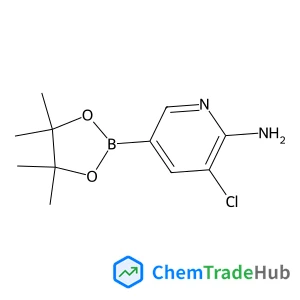
3-Chloro-5-(4,4,5,5-tetramethyl-1,3,2-dioxaborolan-2-yl)-2-pyridinamine
CAS Number:
1032758-99-8
Molecular Formula:
C11H16BClN2O2

Recommended Suppliers






Disclaimer
This page provides academic journal information for reference and research purposes only. We are not affiliated with any journal publishers and do not handle publication submissions. For publication-related inquiries, please contact the respective journal publishers directly.
If you notice any inaccuracies in the information displayed, please contact us at support@chemtradehub.com. We will promptly review and address your concerns.