












Peroxy self-reaction leading to the formation of furfural
Literature Information
Publication Date
2019-03-20
DOI
10.1039/C8CP07571A
Impact Factor
3.676
Authors
Audrey R. Smith, Simone Di Muzio, Fabio Ramondo, Giovanni Meloni
View Original
Abstract
Interest in alternative fuels to petroleum and classical fuels has been growing very rapidly in recent years. Furan and its alkyl derivatives, such as methylfuran (2MF), have been identified as valid alternative biofuels. This study focuses on the self-reaction of the peroxy radical generated in the first oxidation step of 2MF, initiated by Cl atoms at 323 K and 4 Torr. The experiments have been carried out by a multiplexed synchrotron photoionization mass spectrometer (mSPIMS) at the Advanced Light Source (ALS) of Lawrence Berkeley National Laboratory (USA). The presence of a peak at m/z = 96 reveals that furfural is the dominant product of 2MF oxidation. Various reaction mechanisms for furfural formation are proposed here. The potential energy surfaces for singlet and triplet spin states have been mapped using quantum mechanical methods, such as CCSD(T), DFT-B3LYP, and composites models (CBS-QB3), to optimize the products, transition states, and intermediates. Experimental and theoretical results provide evidence that furfural does not form by primary reaction chemistry. Self-reaction of the peroxy radical generated in the first oxidation step of 2MF has been proposed as the pathway leading to the formation of furfural. Among various reaction channels, we indentified some entirely exothermic pathways involving oxygen–oxygen coupling and the formation of ROOOOR Russell intermediates.
Recommended Journals
Related Literature
Dark states enhance the photocell power via phononic dissipation
Yiteng Zhang, Aaron Wirthwein, Fahhad H. Alharbi, Gregory S. Engel
2016-11-07
Paper
DOI: 10.1039/C6CP06098F
Predicting molecular self-assembly at surfaces: a statistical thermodynamics and modeling approach
Simone Conti, Marco Cecchini
2016-10-21
Paper
DOI: 10.1039/C6CP05249E
Peeling the astronomical onion
Alexander Rosu-Finsen, Demian Marchione, Tara L. Salter, James W. Stubbing, Wendy A. Brown, Martin R. S. McCoustra
2016-11-08
Paper
DOI: 10.1039/C6CP05751A
Chemical vapor deposition-prepared sub-nanometer Zr clusters on Pd surfaces: promotion of methane dry reforming
Xue-Rong Shi, Norbert Köpfle, Dmitry Y. Zemlyanov, Axel Knop-Gericke, Michael Hävecker, Bernhard Klötzer, Simon Penner
2016-11-08
Paper
DOI: 10.1039/C6CP07197J
On the origin of the great rigidity of self-assembled diphenylalanine nanotubes
Pavel Zelenovskiy, Igor Kornev, Semen Vasilev
2016-10-13
Communication
DOI: 10.1039/C6CP04337B
Interface phonon modes in the [AlN/GaN]20 and [Al0.35Ga0.65N/Al0.55Ga0.45N]20 2D multi-quantum well structures
A. K. Sivadasan, Chirantan Singha, A. Bhattacharyya, Sandip Dhara
2016-10-04
Paper
DOI: 10.1039/C6CP05520F
Thermoelectricity in transition metal compounds: the role of spin disorder
Prashun Gorai, Eric S. Toberer, Vladan Stevanović
2016-11-01
Paper
DOI: 10.1039/C6CP06943F
The impact of endohedral atoms on the electronic and optical properties of Au25(SR)18 and Au38(SR)24
2016-05-24
Paper
DOI: 10.1039/C6CP02691E
You might also like
Compound Q&A
What precautions should be taken when handling 2-Chloro-1,2-bis(4-methylphenyl)ethanone (CAS: 71193-32-3)?
When handling 2-Chloro-1,2-bis(4-methylphenyl)ethanone (CAS: 71193-32-3), it is ...
71193-32-32-Chloro-1,2-bis(4-m...
Compound Q&A
What industries use 4-Ethoxy-3-(5-methyl-4-oxo-7-propyl-1,4-dihydroimidazo[5,1-f][1,2,4]triazin-2-yl)benzenesulfonyl chloride (CAS: 224789-26-8)?
4-Ethoxy-3-(5-methyl-4-oxo-7-propyl-1,4-dihydroimidazo[5,1-f][1,2,4]triazin-2-yl...
224789-26-84-Ethoxy-3-(5-methyl...
Compound Q&A
How should Methyl 3-Oxo-4-Androsten-17-Carboxylate (CAS: 2681-55-2) be stored?
Methyl 3-Oxo-4-Androsten-17-Carboxylate (CAS: 2681-55-2) should be stored in a c...
2681-55-2Methyl 3-Oxo-4-Andro...
Compound Q&A
What are the main uses of (R)-3-Amino-4-(3-hexylphenylamino)-4-oxobutylphosphonic acid (CAS: 909725-61-7)?
(R)-3-Amino-4-(3-hexylphenylamino)-4-oxobutylphosphonic acid is primarily used i...
909725-61-7(R)-3-Amino-4-(3-hex...
Compound Q&A
What regulatory guidelines apply to 2-Methyl-2-propanyl 3-amino-3-carbamoyl-1-azetidinecarboxylate (CAS: 1254120-14-3)?
2-Methyl-2-propanyl 3-amino-3-carbamoyl-1-azetidinecarboxylate (CAS: 1254120-14-...
1254120-14-32-Methyl-2-propanyl ...
Compound Q&A
Are there alternatives to (E)-4-(tert-Butoxy)-4-oxobut-2-enoic acid (CAS: 135355-96-3) in synthesis?
There are alternative reagents that can be used in synthesis instead of (E)-4-(t...
135355-96-3(E)-4-(tert-Butoxy)-...
Compound Q&A
What are the physical and chemical properties of [2-(3-Chlorophenyl)-1,3-thiazol-4-yl]methanol (CAS: 121202-20-8)?
[2-(3-Chlorophenyl)-1,3-thiazol-4-yl]methanol (CAS: 121202-20-8) is a crystallin...
121202-20-8[2-(3-Chlorophenyl)-...
Compound Q&A
What is the market or research trend for Methyl (2S)-[(4S)-2,2-dimethyl-1,3-dioxolan-4-yl]{[(4-methylphenyl)sulfonyl]oxy}acetate (CAS: 166249-17-8)?
The market and research trends for Methyl (2S)-[(4S)-2,2-dimethyl-1,3-dioxolan-4...
166249-17-8Methyl (2S)-[(4S)-2,...
Compound Q&A
What is the market or research trend for 1-Bromo-2-isocyanatoethane (CAS: 42865-19-0)?
The market for 1-Bromo-2-isocyanatoethane (CAS: 42865-19-0) is driven by its use...
42865-19-01-Bromo-2-isocyanato...
Compound Q&A
What are the main uses of 4-Nitro-D-phenylalanine hydrochloride (CAS: 147065-06-3)?
4-Nitro-D-phenylalanine hydrochloride (CAS: 147065-06-3) is primarily used in re...
147065-06-34-Nitro-D-phenylalan...
Source Journal
Physical Chemistry Chemical Physics

CiteScore:
5.5
Self-citation Rate:
10.3%
Articles per Year:
3036
Physical Chemistry Chemical Physics (PCCP) is an international journal co-owned by 19 physical chemistry and physics societies from around the world. This journal publishes original, cutting-edge research in physical chemistry, chemical physics and biophysical chemistry. To be suitable for publication in PCCP, articles must include significant innovation and/or insight into physical chemistry; this is the most important criterion that reviewers and Editors will judge against when evaluating submissions. The journal has a broad scope and welcomes contributions spanning experiment, theory, computation and data science. Topical coverage includes spectroscopy, dynamics, kinetics, statistical mechanics, thermodynamics, electrochemistry, catalysis, surface science, quantum mechanics, quantum computing and machine learning. Interdisciplinary research areas such as polymers and soft matter, materials, nanoscience, energy, surfaces/interfaces, and biophysical chemistry are welcomed if they demonstrate significant innovation and/or insight into physical chemistry. Joined experimental/theoretical studies are particularly appreciated when complementary and based on up-to-date approaches.
Recommended Compounds

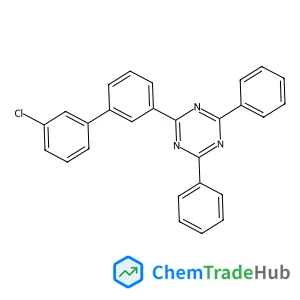
2-(3'-Chlorobiphenyl-3-yl)-4,6-diphenyl-1,3,5-triazine
CAS Number:
1443049-83-9
Molecular Formula:
C27H18ClN3
![2-Hydroxy-4-[({[(4-methylphenyl)sulfonyl]oxy}acetyl)amino]benzoic acid structure](https://static.chemtradehub.com/structs/501/501919-59-1-579f.webp "2-Hydroxy-4-[({[(4-methylphenyl)sulfonyl]oxy}acetyl)amino]benzoic acid structure")
2-Hydroxy-4-[({[(4-methylphenyl)sulfonyl]oxy}acetyl)amino]benzoic acid
CAS Number:
501919-59-1
Molecular Formula:
C16H15NO7S
Recommended Suppliers




Disclaimer
This page provides academic journal information for reference and research purposes only. We are not affiliated with any journal publishers and do not handle publication submissions. For publication-related inquiries, please contact the respective journal publishers directly.
If you notice any inaccuracies in the information displayed, please contact us at support@chemtradehub.com. We will promptly review and address your concerns.