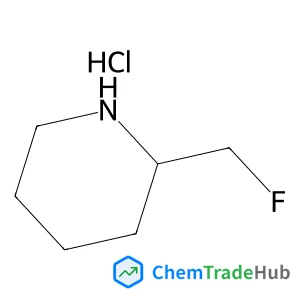
(2S)-2-(Fluoromethyl)piperidine hydrochloride (1:1)
CAS Number:
886216-73-5
Molecular Formula:
C6H13ClFN
Volodymyr Bon, Claire L. Hobday, Stefan Kaskel, Tina Düren
Metal–organic frameworks (MOFs) are coordination networks with organic ligands containing potential voids. Some MOFs show pronounced structural flexibility that may result in closing and re-opening these pores. Here, we show that collective flexibility in a MOF-DUT-8(Ni) – is controlled by conformational isomerism. DUT-8(Ni), a pillared-layer MOF with Ni2 paddle-wheels, dabco pillars and naphthalene dicarboxylate (ndc) linkers, can crystallize in many conformational isomers that depend on the orientation of the non-linear ndc linkers with respect to each other. While the open form is compatible with several of these conformations, only one of them, with alternating linker orientations, is stable as the closed form. We show, by means of first principles calculations, that in the stable closed form, the appreciable lattice strain is compensated by London-dispersion forces between the ndc linkers that arrange with maximum overlap in a stacking order similar to the stacking in graphite. We substantiate these results by well-tempered metadynamics calculations on the DFT-based Born–Oppenheimer potential energy surface, by refined X-ray diffraction data and by nitrogen adsorption data obtained by experiment and grand-canonical Monte-Carlo simulations based on the DFT-optimized and PXRD-derived geometries. While the reported origin of flexibility cannot be generalized to all flexible MOFs, it offers a rational design concept of folding mechanisms in switchable MOFs by exploitation of the stabilization effect of linker stacking in the closed form.
Martí López, Luke Broderick, John J. Carey, Francesc Viñes, Michael Nolan, Francesc Illas
DOI: 10.1039/C8CP03648A
M. Oujja, J. G. Izquierdo, L. Bañares, R. de Nalda, M. Castillejo
DOI: 10.1039/C8CP02825G
Marcelo Goulart, Lorenz Kranabetter, Martin Kuhn, Paul Martini, Paul Scheier
DOI: 10.1039/C8CP00486B
Eduardo Gomez, Mario Gutiérrez, Miquel Moreno, Ichiro Hisaki, Schoichi Nakagawa, Abderrazzak Douhal
DOI: 10.1039/C7CP06819K
T. I. Burganov, S. A. Katsyuba, S. M. Sharipova, A. A. Kalinin, A. Monari, X. Assfeld
DOI: 10.1039/C8CP03780A
Luke R. Anderson, Andrew M. Ediger
DOI: 10.1039/C8CP02829J
Małgorzata Sternik, Urszula D. Wdowik
DOI: 10.1039/C7CP08270C
Jinjin Wang, Zhanyu Wang, R. J. Zhang, Y. X. Zheng, L. Y. Chen, Chia-Chin Tsoo, Hung-Ji Huang
DOI: 10.1039/C8CP02624F
Sesha Vempati
DOI: 10.1039/C7CP08334C
Waste containing N-Methoxy-N-methyl-1,3-thiazole-5-carboxamide (CAS: 898825-89-3...
N-(4-Biphenylyl)dibenzo[b,d]furan-4-amine should be stored in a tightly sealed c...
The market for 3-Acetamido-5-amino-2,4,6-triiodobenzoic acid (CAS: 1713-07-1) is...
Benzyl 2-O-acetyl-3,4,6-tri-O-benzyl-beta-D-galactopyranoside (CAS: 61820-03-9) ...
2-Ethylpiperazine dihydrochloride (CAS: 438050-52-3) is regulated under the Glob...
1,1'-[1,3-Phenylenebis(methylene)]bis(3-methyl-1H-pyrrole-2,5-dione) (CAS: 11946...
Several alternatives can be used in the synthesis of 5-Fluoro-2-(1-pyrrolidinyl)...
Proper personal protective equipment (PPE) must be worn when handling this compo...
When handling 6-Bromoimidazo[1,2-a]pyridin-8-amine, it is important to wear appr...
Alternatives to (2S,4R)-4-(4-Nitrobenzyl)pyrrolidine-2-carboxylic acid hydrochlo...

Physical Chemistry Chemical Physics (PCCP) is an international journal co-owned by 19 physical chemistry and physics societies from around the world. This journal publishes original, cutting-edge research in physical chemistry, chemical physics and biophysical chemistry. To be suitable for publication in PCCP, articles must include significant innovation and/or insight into physical chemistry; this is the most important criterion that reviewers and Editors will judge against when evaluating submissions. The journal has a broad scope and welcomes contributions spanning experiment, theory, computation and data science. Topical coverage includes spectroscopy, dynamics, kinetics, statistical mechanics, thermodynamics, electrochemistry, catalysis, surface science, quantum mechanics, quantum computing and machine learning. Interdisciplinary research areas such as polymers and soft matter, materials, nanoscience, energy, surfaces/interfaces, and biophysical chemistry are welcomed if they demonstrate significant innovation and/or insight into physical chemistry. Joined experimental/theoretical studies are particularly appreciated when complementary and based on up-to-date approaches.