












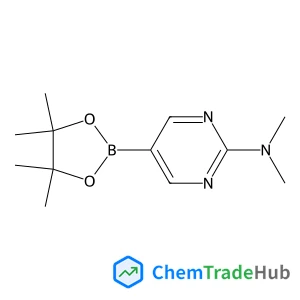
N,N-Dimethyl-5-(4,4,5,5-tetramethyl-1,3,2-dioxaborolan-2-yl)-2-pyrimidinamine
CAS Number:
1032759-30-0
Molecular Formula:
C12H20BN3O2
Li Yang, Ziye Wu, Jun Jiang, Guozhen Zhang
A newly reported woven covalent organic framework (COF-505) with a stable and flexible structure is believed to be a promising candidate for photocatalysis. Here, we carried out density functional theory calculations to investigate the properties of COF-505 related to photocatalysis. We first investigated the ability of visible light absorption by this COF-505. Variations of central metal ions and the dihedral angle between two adjacent ligand groups were respectively taken into account for adjusting its light harvesting capabilities. Replacing the original Cu(I) ions with Pd(II) ions causes a red shift in the visible light region. Increasing the dihedral angle results in an increase of the band gap for COF-505 with Cu(I) and a decrease for COF-505 with Pd(II), respectively. The potential of COF-505 as a photocatalyst was furthermore explored by studying the adsorption of H2, CO2 and H2O on it. All molecules can be stably adsorbed. In particular, COF-505 with Pd(II) exhibits appreciable O–H activation of the adsorbed H2O in the presence of a positive charge, which is promising for initiating water splitting. Overall, our results suggest that COF-505 holds great potential for photocatalytic applications.
José A. Jiménez, Dugan Hayes, Cali Antolini, Benjamin J. Reinhart
DOI: 10.1039/D3CP04784A
Kanhu Charan Behera, Mangalampalli Ravikanth
DOI: 10.1039/D3CP04234K
When considering alternatives to 1-(4-Chlorophenyl)-N-hydroxymethanimine (CAS: 3...
This compound should be stored in a cool, dry place away from direct sunlight. I...
3-(4-Bromophenyl)-5-(2-fluorophenyl)-1,2,4-oxadiazole is synthesized through a m...
5-Chloro-2-(4-chlorophenyl)-4-methyl-6-[3-(1-piperidinyl)propoxy]pyrimidine (CAS...
2-Chloro-4-(difluoromethoxy)pyridine is used in the pharmaceutical industry for ...
3-Chloro-6-methylpyridazine (CAS: 1121-79-5) is classified under the Globally Ha...
Several alternatives can be used in the synthesis of Methyl 4,5-dimethyl-2-nitro...
Alternatives to (2E,2'E)-3,3'-(1,4-Phenylene)bisacrylaldehyde include other acry...
3-Amino-5-chloropyridin-2-ol hydrochloride is an organic compound with the CAS n...
When handling 6,7-Difluoro-2,3-dihydro-4H-chromen-4-one, it is essential to wear...

Physical Chemistry Chemical Physics (PCCP) is an international journal co-owned by 19 physical chemistry and physics societies from around the world. This journal publishes original, cutting-edge research in physical chemistry, chemical physics and biophysical chemistry. To be suitable for publication in PCCP, articles must include significant innovation and/or insight into physical chemistry; this is the most important criterion that reviewers and Editors will judge against when evaluating submissions. The journal has a broad scope and welcomes contributions spanning experiment, theory, computation and data science. Topical coverage includes spectroscopy, dynamics, kinetics, statistical mechanics, thermodynamics, electrochemistry, catalysis, surface science, quantum mechanics, quantum computing and machine learning. Interdisciplinary research areas such as polymers and soft matter, materials, nanoscience, energy, surfaces/interfaces, and biophysical chemistry are welcomed if they demonstrate significant innovation and/or insight into physical chemistry. Joined experimental/theoretical studies are particularly appreciated when complementary and based on up-to-date approaches.

![[4-(Isobutyrylamino)phenyl]boronic acid structure](https://static.chemtradehub.com/structs/874/874219-50-8-6ab5.webp "[4-(Isobutyrylamino)phenyl]boronic acid structure")





