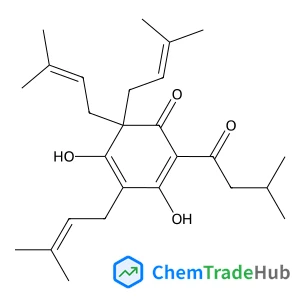
3,5-Dihydroxy-4-(3-methylbutanoyl)-2,6,6-tris(3-methyl-2-buten-1-yl)-2,4-cyclohexadien-1-one
CAS Number:
468-28-0
Molecular Formula:
C26H38O4
A graphical abstract is available for this content
Ke Feng, Leonardo De Boni, Lino Misoguti, C. R. Mendonça, Michael Meador, Fu-Lian Hsu, Xiu R. Bu
DOI: 10.1039/B402019G
Isabelle Gener, Philippe Ayrault, Michel Guisnet
DOI: 10.1039/B409964H
Banu Kesanli, Wenbin Lin
DOI: 10.1039/B406697A
Chuanlang Zhan, Lizhu Liu, Yanbiao Zhou, Minghua Liu
DOI: 10.1039/B402956A
Michał K. Cyrański, Siân T. Howard, Michał L. Chodkiewicz
DOI: 10.1039/B408903K
Freddy Kleitz, Leonid A. Solovyov, Gopinathan M. Anilkumar, Shin Hei Choi, Ryong Ryoo
DOI: 10.1039/B403903C
Junfeng Geng, David A. Jefferson, Brian F. G. Johnson
DOI: 10.1039/B406227B
Stephen G. Davies, Gesine J. Hermann, Miles J. Sweet, Andrew D. Smith
DOI: 10.1039/B401293C
Panagiotis Manesiotis, Andrew J. Hall, Marco Emgenbroich, Milena Quaglia, Ersilia De Lorenzi, Börje Sellergren
DOI: 10.1039/B407870E
Julie Grumelard, Andreas Taubert, Wolfgang Meier
DOI: 10.1039/B405671J
When handling 2-Chloro-1,2-bis(4-methylphenyl)ethanone (CAS: 71193-32-3), it is ...
4-Ethoxy-3-(5-methyl-4-oxo-7-propyl-1,4-dihydroimidazo[5,1-f][1,2,4]triazin-2-yl...
Methyl 3-Oxo-4-Androsten-17-Carboxylate (CAS: 2681-55-2) should be stored in a c...
(R)-3-Amino-4-(3-hexylphenylamino)-4-oxobutylphosphonic acid is primarily used i...
2-Methyl-2-propanyl 3-amino-3-carbamoyl-1-azetidinecarboxylate (CAS: 1254120-14-...
There are alternative reagents that can be used in synthesis instead of (E)-4-(t...
[2-(3-Chlorophenyl)-1,3-thiazol-4-yl]methanol (CAS: 121202-20-8) is a crystallin...
The market and research trends for Methyl (2S)-[(4S)-2,2-dimethyl-1,3-dioxolan-4...
The market for 1-Bromo-2-isocyanatoethane (CAS: 42865-19-0) is driven by its use...
4-Nitro-D-phenylalanine hydrochloride (CAS: 147065-06-3) is primarily used in re...

Organic & Biomolecular Chemistry (OBC) publishes original and high impact research and reviews in organic chemistry. We welcome research that shows new or significantly improved protocols or methodologies in total synthesis, synthetic methodology or physical and theoretical organic chemistry as well as research that shows a significant advance in the organic chemistry or molecular design aspects of chemical biology, catalysis, supramolecular and macromolecular chemistry, theoretical chemistry, mechanism-oriented physical organic chemistry, medicinal chemistry or natural products. Articles published in the journal should report new work which makes a highly-significant impact in the field. Routine and incremental work is generally not suitable for publication in the journal. More details about key areas of our scope are below. In all cases authors should include in their article clear rationale for why their research has been carried out.
![2-Hydroxy-4-[({[(4-methylphenyl)sulfonyl]oxy}acetyl)amino]benzoic acid structure](https://static.chemtradehub.com/structs/501/501919-59-1-579f.webp "2-Hydroxy-4-[({[(4-methylphenyl)sulfonyl]oxy}acetyl)amino]benzoic acid structure")