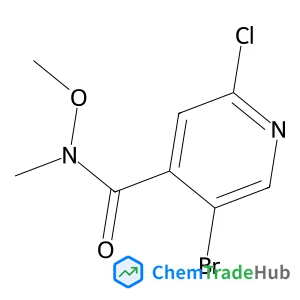
5-Bromo-2-chloro-N-methoxy-N-methylisonicotinamide
CAS Number:
1256790-08-5
Molecular Formula:
C8H8BrClN2O2
Kong Wu, Zhong Pao Xie, Dong-Mei Cui, Chen Zhang
An efficient synthetic pathway for the total synthesis of salvianolic acid N has been reported. The key reaction steps, the Wittig reaction for Z-stereoselectivity and an intramolecular cyclization for a seven membered ring skeleton, have been optimized to improve the synthetic feasibility and provide the best conditions in terms of yield. Moreover, a notable reaction is the reaction of the deprotected allylic group with Pd catalyst. An improved overall yield of 11% has been achieved for salvianolic acid N starting from 3,4-dimethoxybenzaldehyde in 11 steps.
Tamar L. Greaves, Celesta Fong, Calum J. Drummond
DOI: 10.1039/C2CP23698B
Alexandra Nemkevich, Ben Corry, Mark A. Spackman
DOI: 10.1039/C2CP23384C
Sebastian Weibels, Adrian Syguda, Christian Herrmann, Hermann Weingärtner
DOI: 10.1039/C2CP24041F
Lisandro Buljubasich, Laura M. Schreiber, Hans W. Spiess, Kerstin Münnemann
DOI: 10.1039/C2CP22822J
Joana Vitorino, Manuel E. Minas da Piedade
DOI: 10.1039/C2CP40213K
A. L. Jouonang, P. Didier, Y. Mély
DOI: 10.1039/C2CP22334A
Vincent Maurel, Mohammad Jouni, Piotr Baran, Nicolas Onofrio, Serge Gambarelli, Jean-Marie Mouesca, David Djurado, Lionel Dubois, Jean-François Jacquot, Gérard Desfonds, Irena Kulszewicz-Bajer
DOI: 10.1039/C1CP22766A
Roberto Linguerri, Najia Komiha, Majdi Hochlaf
DOI: 10.1039/C2CP24004A
Stéphane Aloïse, Zuzanna Pawlowska, Cyril Ruckebusch, Michel Sliwa, Julien Dubois, Olivier Poizat, Guy Buntinx, Aurélie Perrier, François Maurel, Patrice Jacques, Jean-Pierre Malval, Lionel Poisson, Giovanni Piani, Jiro Abe
DOI: 10.1039/C2CP22254J
F. Zhang, F. Roosen-Runge, M. W. A. Skoda, R. M. J. Jacobs, M. Wolf, Ph. Callow, H. Frielinghaus, V. Pipich, S. Prévost, F. Schreiber
DOI: 10.1039/C2CP23460B
(3.beta.)-3-Hydroxy-N,N-dimethyl-chol-5-en-24-amide (CAS: 79066-03-8) is primari...
5-(Aminomethyl)-2-methoxyphenol (CAS: 89702-89-6) is classified under GHS as a s...
Thieno[2,3-c]pyridin-7(6H)-one (CAS: 28981-13-7) is a heterocyclic organic compo...
1-[(6-Methoxy-3-pyridinyl)methyl]-4-piperidinamine dihydrochloride is generally ...
[(2E)-3-Phenyl-2-propen-1-yl]phosphonic acid (CAS: 146404-58-2) is regulated und...
6-Bromo-7-methoxyquinoline (CAS: 1620515-86-7) falls under the scope of the Glob...
This compound is primarily used in the pharmaceutical industry for the developme...
1-Ethyl-7-[2-methyl-6-(4H-1,2,4-triazol-3-yl)-3-pyridinyl]-3,5-dihydropyrazino[2...
Alternative reagents such as 2-[(dimethylamino)methyl]phenylboronic acid or rela...
3-(Piperidin-4-yloxy)pyridine (CAS: 310881-48-2) is an organic compound with the...

Organic & Biomolecular Chemistry (OBC) publishes original and high impact research and reviews in organic chemistry. We welcome research that shows new or significantly improved protocols or methodologies in total synthesis, synthetic methodology or physical and theoretical organic chemistry as well as research that shows a significant advance in the organic chemistry or molecular design aspects of chemical biology, catalysis, supramolecular and macromolecular chemistry, theoretical chemistry, mechanism-oriented physical organic chemistry, medicinal chemistry or natural products. Articles published in the journal should report new work which makes a highly-significant impact in the field. Routine and incremental work is generally not suitable for publication in the journal. More details about key areas of our scope are below. In all cases authors should include in their article clear rationale for why their research has been carried out.
![Ethanone, 1-[4-chloro-2-(methylthio)-5-pyrimidinyl]- structure](https://static.chemtradehub.com/structs/661/66116-82-3-863e.webp "Ethanone, 1-[4-chloro-2-(methylthio)-5-pyrimidinyl]- structure")