


A mild method for synthesizing carboxylic acids by oxidation of aldoximes using hypervalent iodine reagents
Literature Information
Publication Date
2018-01-02
DOI
10.1039/C7OB02858J
Impact Factor
3.876
Authors
Akira Nakamura, Hodaka Kanou, Junki Tanaka, Akira Imamiya, Tomohiro Maegawa
View Original
Abstract
A mild oxidation method for the conversion of aldoximes to carboxylic acids was developed mediated by hypervalent iodine reagents. This method covers a wide range of functionalized aldoximes and proceeds under mild conditions, utilizing PhI(OH)OTs as an oxidant.
Recommended Journals

Current Opinion in Solid State & Materials Science

Russian Journal of Organic Chemistry

Organic Process Research & Development

Journal of Saudi Chemical Society

Drug Discovery Today

Russian Journal of Applied Chemistry

Chemical Communications

Russian Journal of Coordination Chemistry

Acta Materialia

Saudi Pharmaceutical Journal
Related Literature
On the analyses of fluorescence depolarisation data in the presence of electronic energy migration. Part II: Applying and evaluating two-photon excited fluorescence
Oleg Opanasyuk, Therese Mikaelsson, Linus Ryderfors, Emad Mukhtar, Lennart B.-Å. Johansson
2011-11-30
Paper
DOI: 10.1039/C2CP23177H
Photophysics of indole-2-carboxylic acid in an aqueous environment studied by fluorescence spectroscopy in combination with ab initio calculations
Annemarie Huijser, Michał F. Rode, Alice Corani, Andrzej L. Sobolewski, Villy Sundström
2012-01-10
Paper
DOI: 10.1039/C2CP22958G
First-principles study of the triwing graphenenanoribbons: junction-dependent electronic structures and electric field modulations
Yi Ding, Yanli Wang
2012-01-10
Paper
DOI: 10.1039/C2CP22905F
Surface state engineering of molecule–molecule interactions
Geoffrey Rojas, Scott Simpson, Xumin Chen, Donna A. Kunkel, Justin Nitz, Jie Xiao, Peter A. Dowben, Eva Zurek, Axel Enders
2012-02-20
Paper
DOI: 10.1039/C2CP40254H
The natural DNA bending angle in the lac repressor headpiece–O1 operator complex is determined by protein–DNA contacts and water release
Daniel Barr, Arjan van der Vaart
2011-12-09
Paper
DOI: 10.1039/C2CP23780F
Computational study of methyl group dynamics in the hydroquinoneclathrate of acetonitrile
Alexandra Nemkevich, Ben Corry, Mark A. Spackman
2011-12-06
Communication
DOI: 10.1039/C2CP23384C
The electric field as a novel switch for uptake/release of hydrogen for storage in nitrogen doped graphene
Z. M. Ao, F. M. Peeters, S. Li
2011-11-21
Paper
DOI: 10.1039/C1CP23153G
Solvation effects and stabilization of multicharged ions: a case study of ArmBeOq+ complexes
Roberto Linguerri, Najia Komiha, Majdi Hochlaf
2012-02-02
Paper
DOI: 10.1039/C2CP24004A
Pulsed EPR characterization of encapsulated atomic hydrogen in octasilsesquioxane cages
George Mitrikas
2012-01-23
Paper
DOI: 10.1039/C2CP24057B
Laser pulse trains for controlling excited state dynamics of adenine in water
Jens Petersen, Matthias Wohlgemuth, Bernhard Sellner, Roland Mitrić
2012-01-17
Paper
DOI: 10.1039/C2CP24002E
You might also like
Compound Q&A
What are the main uses of (3.beta.)-3-Hydroxy-N,N-dimethyl-chol-5-en-24-amide (CAS: 79066-03-8)?
(3.beta.)-3-Hydroxy-N,N-dimethyl-chol-5-en-24-amide (CAS: 79066-03-8) is primari...
79066-03-8(3.beta.)-3-Hydroxy-...
Compound Q&A
What regulatory guidelines apply to 5-(aminomethyl)-2-methoxyphenol (CAS: 89702-89-6)?
5-(Aminomethyl)-2-methoxyphenol (CAS: 89702-89-6) is classified under GHS as a s...
89702-89-65-(aminomethyl)-2-me...
Compound Q&A
What is Thieno[2,3-c]pyridin-7(6H)-one (CAS: 28981-13-7)?
Thieno[2,3-c]pyridin-7(6H)-one (CAS: 28981-13-7) is a heterocyclic organic compo...
28981-13-7Thieno[2,3-c]pyridin...
Compound Q&A
Is 1-[(6-Methoxy-3-pyridinyl)methyl]-4-piperidinamine dihydrochloride (CAS: 1185311-28-7) safe?
1-[(6-Methoxy-3-pyridinyl)methyl]-4-piperidinamine dihydrochloride is generally ...
1185311-28-71-[(6-Methoxy-3-pyri...
Compound Q&A
What regulatory guidelines apply to [(2E)-3-Phenyl-2-propen-1-yl]phosphonic acid (CAS: 146404-58-2)?
[(2E)-3-Phenyl-2-propen-1-yl]phosphonic acid (CAS: 146404-58-2) is regulated und...
146404-58-2[(2E)-3-Phenyl-2-pro...
Compound Q&A
What regulatory guidelines apply to 6-Bromo-7-methoxyquinoline (CAS: 1620515-86-7)?
6-Bromo-7-methoxyquinoline (CAS: 1620515-86-7) falls under the scope of the Glob...
1620515-86-76-Bromo-7-methoxyqui...
Compound Q&A
What industries use (2R)-1-(1-Benzofuran-2-yl)-N-propyl-2-pentanamine (CAS: 260550-89-8)?
This compound is primarily used in the pharmaceutical industry for the developme...
260550-89-8(2R)-1-(1-Benzofuran...
Compound Q&A
What are the main uses of 1-Ethyl-7-[2-methyl-6-(4H-1,2,4-triazol-3-yl)-3-pyridinyl]-3,5-dihydropyrazino[2,3-b]pyrazin-2(1H)-one (CAS: 1228013-15-7)?
1-Ethyl-7-[2-methyl-6-(4H-1,2,4-triazol-3-yl)-3-pyridinyl]-3,5-dihydropyrazino[2...
1228013-15-71-Ethyl-7-[2-methyl-...
Compound Q&A
Are there alternatives to {5-(Acryloylamino)-2-[(dimethylamino)methyl]phenyl}boronic acid (CAS: 1217500-78-1) in synthesis?
Alternative reagents such as 2-[(dimethylamino)methyl]phenylboronic acid or rela...
1217500-78-1{5-(Acryloylamino)-2...
Compound Q&A
What is 3-(Piperidin-4-yloxy)pyridine (CAS: 310881-48-2)?
3-(Piperidin-4-yloxy)pyridine (CAS: 310881-48-2) is an organic compound with the...
310881-48-23-(Piperidin-4-yloxy...
Source Journal
Organic & Biomolecular Chemistry

CiteScore:
3.4
Self-citation Rate:
10.3%
Articles per Year:
1041
Organic & Biomolecular Chemistry (OBC) publishes original and high impact research and reviews in organic chemistry. We welcome research that shows new or significantly improved protocols or methodologies in total synthesis, synthetic methodology or physical and theoretical organic chemistry as well as research that shows a significant advance in the organic chemistry or molecular design aspects of chemical biology, catalysis, supramolecular and macromolecular chemistry, theoretical chemistry, mechanism-oriented physical organic chemistry, medicinal chemistry or natural products. Articles published in the journal should report new work which makes a highly-significant impact in the field. Routine and incremental work is generally not suitable for publication in the journal. More details about key areas of our scope are below. In all cases authors should include in their article clear rationale for why their research has been carried out.
Recommended Compounds
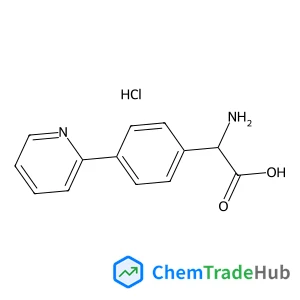
2-Amino-2-(4-(pyridin-2-YL)phenyl)acetic acid hydrochloride
CAS Number:
1135818-89-1
Molecular Formula:
C13H13ClN2O2
![7-Bromo-5-chloro-1H-pyrazolo[4,3-b]pyridine structure](https://static.chemtradehub.com/structs/135/1351813-70-1-a716.webp "7-Bromo-5-chloro-1H-pyrazolo[4,3-b]pyridine structure")
Recommended Suppliers






Disclaimer
This page provides academic journal information for reference and research purposes only. We are not affiliated with any journal publishers and do not handle publication submissions. For publication-related inquiries, please contact the respective journal publishers directly.
If you notice any inaccuracies in the information displayed, please contact us at support@chemtradehub.com. We will promptly review and address your concerns.